
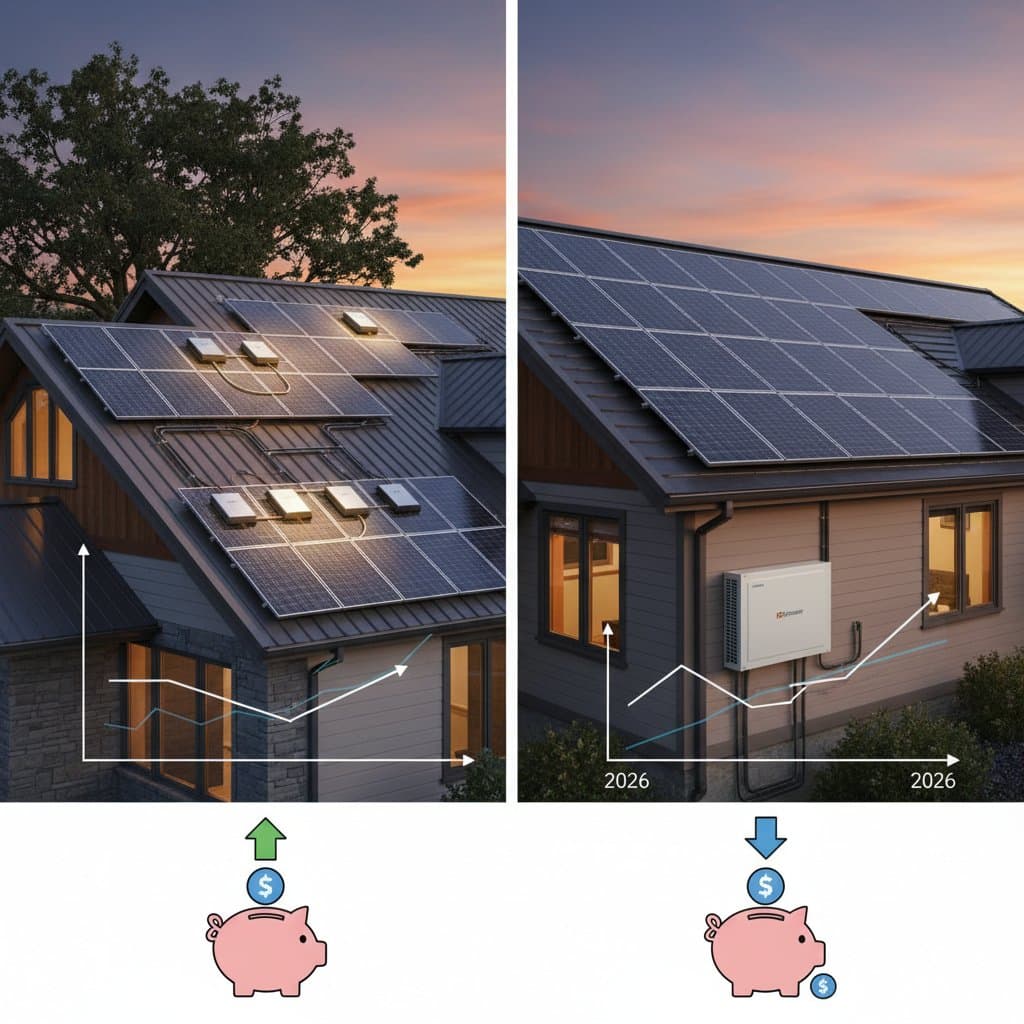
Microinverters vs. String Inverters: Analyzing 2026 ROI
Solar panels generate direct current electricity, but homes require alternating current. Inverters perform this essential conversion. For residential solar setups, microinverters and string inverters represent the primary choices. These options vary in design, efficiency, and expense, all of which affect the time required to recover initial investment through energy bill reductions.
This analysis examines the operational principles, performance outcomes, safety implications, and financial projections for each type. Homeowners gain practical guidance to align selections with property characteristics, local regulations, and long-term financial goals.
Understanding Microinverter Functionality
Microinverters connect directly to individual solar panels on the roof. Each unit handles the power conversion for its assigned panel, eliminating reliance on a centralized device.
This independent operation ensures that shading on one panel does not impair others. For instance, tree branches or nearby structures might block sunlight intermittently, yet unaffected panels maintain peak production. Many microinverter models integrate monitoring capabilities, allowing users to track output per panel via a secure online portal. Such visibility aids in early detection of issues like debris accumulation or hardware degradation.
Key Benefits of Microinverters
- Individual Panel Optimization: Every panel reaches its maximum power point independently, boosting overall system efficiency by up to 5 to 25 percent in shaded environments.
- Targeted Diagnostics: Monitoring systems pinpoint underperforming panels, enabling precise repairs without system-wide inspections.
- Enhanced Safety Features: Conversion at the panel level reduces high-voltage direct current on the roof, minimizing risks during maintenance or emergencies.
- Scalable Design: Future expansions involve simply adding panels with integrated inverters, avoiding complex rewiring.
Potential Drawbacks
- Elevated Initial Investment: The per-panel cost accumulates quickly for larger arrays, often increasing total expenses by 10 to 20 percent over string alternatives.
- Increased Component Count: More inverters mean more elements susceptible to wear, though robust warranties mitigate this concern.
- Access Challenges for Repairs: Failed units necessitate roof visits, potentially raising service fees compared to ground-mounted replacements.
Evaluating ROI Through Performance and Durability
ROI calculations hinge on energy yield minus ongoing costs, projected over 20 to 25 years. Microinverters excel in variable conditions, such as east-west oriented roofs or those with chimneys casting shadows. Independent tracking prevents production losses from the weakest panel, which string systems propagate across the array.
In optimal, south-facing unshaded setups, string inverters suffice with uniform output. Their centralized design simplifies wiring and reduces material needs, yielding quicker payback periods of 6 to 8 years versus 8 to 10 for microinverters. However, factor in longevity: microinverters boast 25-year warranties matching panel lifespans, while string inverters typically last 10 to 15 years, incurring replacement costs of $1,500 to $3,000 plus labor.
To estimate personal ROI, review historical site-specific irradiance data from tools like the National Renewable Energy Laboratory database. Subtract annual maintenance from projected kilowatt-hour savings at current utility rates, assuming a 2 to 3 percent annual escalation. This approach reveals microinverters' edge in suboptimal sites, where added output recoups premiums within the warranty period.
Navigating Codes, Permits, and Compliance
Solar installations must adhere to evolving standards, including the National Electrical Code's rapid shutdown provisions. Permits involve plan submissions, inspections, and utility approvals to ensure grid safety.
Microinverters inherently support rapid shutdown, as each module de-energizes locally, often without extra hardware. String inverters require supplemental devices, such as module-level power electronics, positioned near panels to comply. These additions can add $500 to $1,000 to costs but enhance fire safety by limiting fault currents.
Verify certifications from bodies like Underwriters Laboratories or Intertek. Consult your utility's approved equipment list for interconnection eligibility. During permitting, provide detailed schematics showing grounding methods, arc-fault protection, and labeling placements to expedite approvals and avoid rework.
Steps for Informed Decision-Making and Implementation
Engage a certified solar professional early to assess your roof's orientation, shading patterns, and electrical infrastructure. Request side-by-side proposals featuring identical panel configurations but differing inverter types. Compare annualized production estimates, derived from modeling software like PVsyst, alongside total ownership costs including incentives like the federal investment tax credit.
Inquire about warranty coverage, including labor inclusions and performance guarantees. Secure written confirmation of code compliance, such as as-built drawings and inspection certificates. Post-installation, retain monitoring login details and maintenance schedules to optimize system health.
Selecting the appropriate inverter aligns solar investments with practical realities. Homeowners achieve accelerated payback, reduced risks, and sustained energy independence through deliberate, informed choices.