
Solid-State Batteries: Revolutionizing Home Storage by 2026
Solar research might feel overwhelming at first, particularly when new battery technologies emerge every few months and claim to alter the landscape. Homeowners often wonder if they should wait for advancements or proceed with current options. Solid-state batteries represent the current focal point, offering safer, longer lasting, and more compact energy storage for residential use. Grasping their unique features clarifies their proximity to practical application and their potential impact on solar powered homes.
What Makes a Battery Solid-State
A solid-state battery substitutes the liquid or gel electrolyte in traditional lithium-ion batteries with a solid material, such as ceramic, glass, or polymer. This solid layer facilitates the movement of lithium ions between the positive and negative electrodes during charging and discharging. Without flammable liquids, fire risks decrease substantially. The design also enables denser cell packing, elevated energy density, and reduced weight.
Consider a lithium-ion battery as a sponge saturated with fluid that transports charge. In contrast, a solid-state battery functions like a dense brick that conducts ions via solid matter. This brick stores more energy within the same volume, paving the way for transformative home energy solutions.
How the Technology Works in Practice
Solar panels generate electricity when sunlight strikes them, sending electrons through circuits to power the home. Excess energy charges the battery for later use. In a solid-state system, ions travel through the solid electrolyte to store energy in the electrodes. At night or during outages, the ions reverse direction to release electricity.
The solid electrolyte provides greater stability, allowing the battery to withstand higher voltages with minimal degradation. Laboratory tests indicate that certain prototypes retain over 90 percent capacity after thousands of cycles, compared to lithium-ion systems that fall below 80 percent. Such longevity could extend battery life beyond a decade, cutting replacement expenses and minimizing waste.
Efficiency and Performance Gains
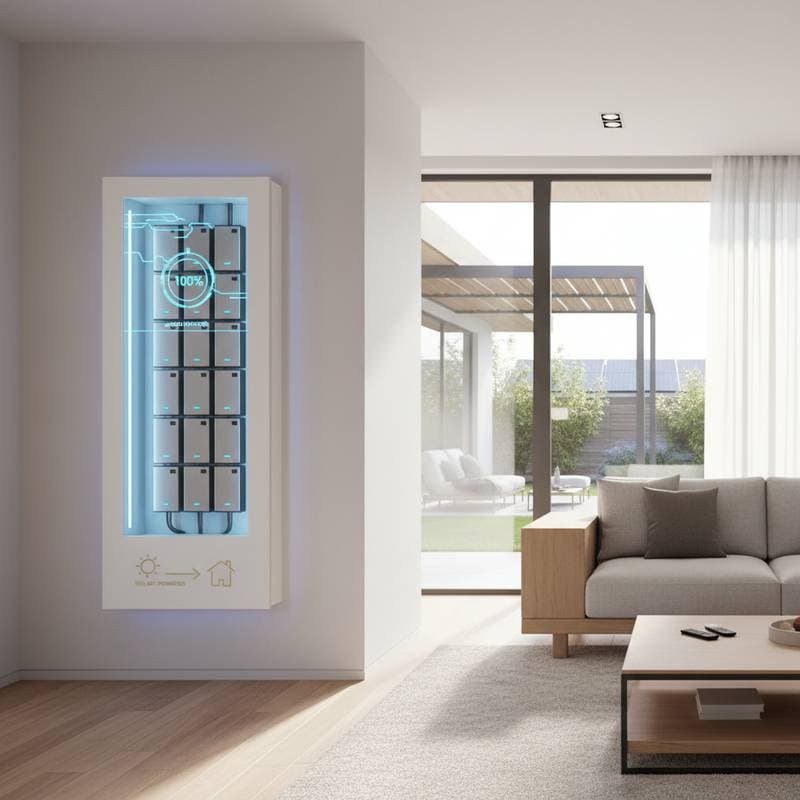
Current home batteries deliver approximately 250 watt-hours per kilogram. Solid-state variants may achieve 400 watt-hours or higher. Homeowners benefit from smaller, lighter units that store equivalent energy, enabling space efficient installations like wall mounted designs with extended runtime.
For instance, a 10 kilowatt-hour lithium-ion battery might cost 9,000 dollars installed and offset 40 percent of annual home usage. A solid-state equivalent with 60 percent higher energy density could provide the same 10 kilowatt-hours in a compact form or store 16 kilowatt-hours in the original space. At 15 cents per kilowatt-hour, this additional capacity saves about 270 dollars yearly through greater stored energy utilization.
Cost Remains the Primary Barrier
Manufacturing presents the main hurdle, as producing the solid electrolyte demands precise conditions and costly materials. Initial units may price at two to three times the cost of conventional systems. However, as production scales and techniques advance, costs will decline, mirroring trends in solar panels and lithium-ion batteries.
Experts forecast cost parity with advanced lithium-ion options within a few product generations. At that point, superior safety and lifespan will position solid-state batteries as the top selection for new solar plus storage setups.
Integration with Home Solar Systems
Most inverters and monitoring systems require only software updates to accommodate solid-state batteries. Their charge and discharge patterns resemble those of existing technologies, yet they support higher power draws and rapid charging. This capability accelerates recovery after cloudy days and optimizes time of use rates, where utilities impose peak hour surcharges.
Take a 7 kilowatt solar array in Philadelphia, which generates roughly 9,100 kilowatt-hours annually. Coupled with a 15 kilowatt-hour solid-state battery, homeowners can redirect more production to evening hours, boosting self consumption from 40 percent to nearly 70 percent. This shift shortens payback periods by years, amplified by available tax incentives.
Environmental and Lifecycle Advantages
Solid-state batteries incorporate fewer liquid solvents and rely on more abundant materials than traditional lithium cells. Their recycling proves easier, as the solid electrolyte separates cleanly from electrodes. These traits foster a reduced environmental impact throughout the lifecycle of home storage systems.
Steps to Prepare for Adoption
Homeowners planning solar installations should not postpone decisions awaiting solid-state availability. Existing lithium-ion batteries offer reliability and qualify for incentives. Opt for modular systems that permit future battery upgrades without full replacements.
Installers now develop compatible cabinets and software for multiple battery types. When solid-state options proliferate, users can swap or augment storage seamlessly. Maintain units by cleaning surfaces, ensuring ventilation, and tracking performance via apps to uphold safety and efficiency.
FAQ
What distinguishes solid-state batteries from lithium-ion batteries?
Solid-state batteries employ a solid electrolyte rather than a liquid one, enhancing safety and energy density.
Are solid-state batteries ready for home use?
They appear in limited pilot programs. Broader availability awaits scaled production.