
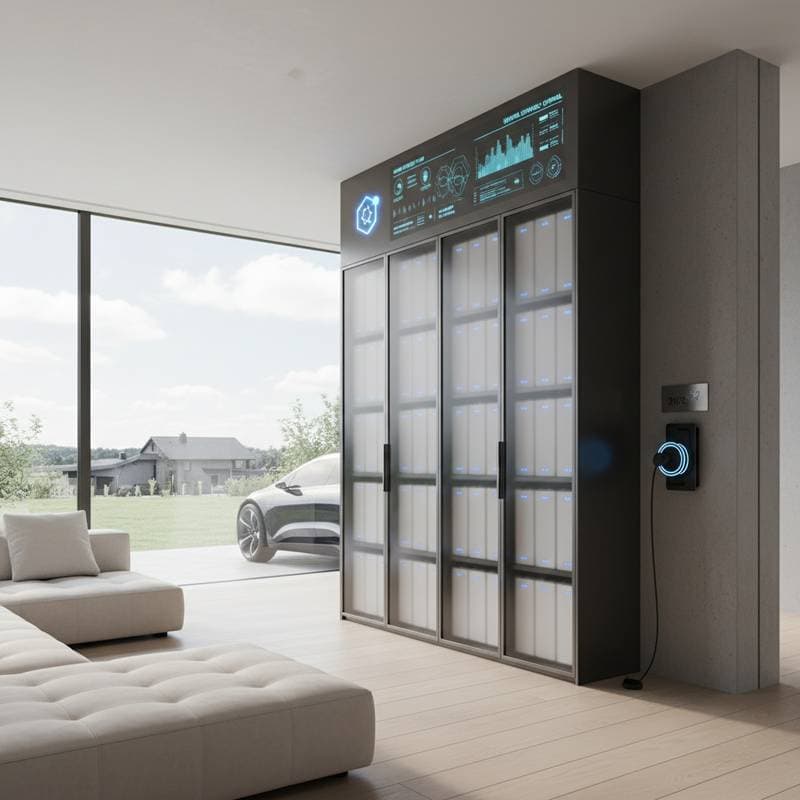
The Safety Edge of Solid-State Batteries for Home Energy Storage
Navigating solar energy options often presents challenges for homeowners. Emerging battery technologies, shifting incentives, and technical terminology can complicate decisions. Solid-state batteries represent a pivotal advancement in residential energy storage, transitioning from experimental stages to practical applications. These batteries redefine solar power utilization in homes by prioritizing safety and performance.
Understanding Solid-State Battery Design
Conventional lithium-ion batteries rely on a liquid or gel electrolyte to facilitate ion movement between electrodes. This flammable component restricts energy capacity and durability. Solid-state batteries employ a solid electrolyte, such as ceramic, glass, or polymer, to achieve a more secure, compact, and resilient structure.
During charging, lithium ions migrate from the positive electrode to the negative through the solid medium. Upon discharge, the ions return, generating current for household needs or grid export. The solid electrolyte effectively prevents dendrite formation, minimizing short-circuit risks and thermal accumulation.
Key Benefits for Residential Use
Safety stands as the primary advantage. Solid-state batteries exhibit reduced susceptibility to thermal runaway or ignition. Homeowners gain flexibility to position units indoors, including basements or garages, without requiring extensive ventilation or separation distances.
These batteries also demonstrate exceptional longevity. Individual cells maintain over 80 percent capacity following thousands of charge-discharge cycles, supporting 20 years or more of operation in typical home setups.
Higher energy density further enhances appeal. Solid-state designs store 30 to 50 percent more energy per volume than lithium-ion equivalents. For instance, a 10 kWh lithium-ion system could transition to a 7 kWh solid-state counterpart, preserving equivalent output while reducing footprint and installation complexity.
Integration with Solar Systems
A standard 7 kW solar array generates approximately 9,100 kWh annually, assuming 1,300 kWh per kW of production. For a household consuming 750 kWh monthly, this output meets most yearly needs. However, peak generation occurs midday, often misaligning with higher evening usage.
Solid-state batteries address this by capturing excess daytime solar energy and releasing it during peak demand periods, such as evenings for lighting, cooling, or cooking. A 10 kWh unit enables shifting roughly one-third of daily consumption from grid reliance to stored reserves. Annually, this adjustment could offset 3,000 kWh or greater, yielding savings of about 540 dollars at 18 cents per kWh. Time-of-use pricing structures amplify these benefits.
Financial Considerations and Return on Investment
Initial costs for solid-state systems exceed those of lithium-ion options, though economies of scale drive rapid price declines. Consider a 10 kWh lithium-ion installation at 8,000 dollars, with a 12-year lifespan to 70 percent capacity. A comparable solid-state unit at 10,000 dollars installed offers 20 years of service at 85 percent retention.
Amortized annually, the lithium-ion system equates to 667 dollars per year, versus 500 dollars for solid-state. Long-term advantages include diminished replacement expenses and streamlined recycling. When combined with solar panels, the overall payback shortens from 11 years to 8 or 9 years, influenced by local incentives and rates.
Pathways to Adoption in Homes
Production efforts currently focus on scaling reliable electrolytes, including ceramics and sulfides, for larger, crack-resistant cells. Energy providers develop modular enclosures that allow seamless substitution of solid-state modules into existing lithium-ion frameworks, preserving inverter compatibility.
Homeowners benefit from phased integration. As availability grows, certified installers facilitate upgrades, enabling evolution without full system overhauls.
Upkeep and Sustainability Practices
Maintenance demands remain low for solid-state batteries. Absent liquid components, cooling systems prove unnecessary, and solid structures withstand temperature fluctuations effectively. Annual checks on voltage equilibrium and battery management software updates suffice to optimize performance.
Optimal placement in climate-stable environments further preserves efficiency. Recycling processes benefit from the design, as fewer hazardous liquids simplify disassembly. Recovery of critical elements like lithium, nickel, and cobalt becomes more straightforward, fostering a circular economy for energy storage.
Preparing for Future Energy Needs
Evolving utility policies, including dynamic pricing and net metering, elevate the role of home batteries in demand management and outage resilience. Solid-state innovations contribute lighter, more secure, and space-efficient solutions.
Prospective solar adopters should consult installers on inverter selections supporting modular expansions. A strategic rollout—solar panels first, followed by initial battery addition and later solid-state upgrade—distributes costs while ensuring adaptability.
Frequently Asked Questions
What distinguishes solid-state batteries from lithium-ion batteries?
Solid-state batteries incorporate a solid electrolyte in place of liquid, enhancing safety, energy storage capacity, and operational lifespan.
Do solid-state batteries suit indoor home installations?
Yes, their low fire risk allows placement in enclosed areas without specialized safeguards.
What is the expected service life of solid-state home batteries?
They typically deliver around 20 years, retaining at least 80 percent capacity.
Can solid-state batteries integrate with current solar setups?
Yes, contemporary hybrid inverters accommodate them upon module availability.
Are solid-state batteries environmentally friendly for disposal?
Yes, their composition eases recycling and minimizes ecological footprint.