
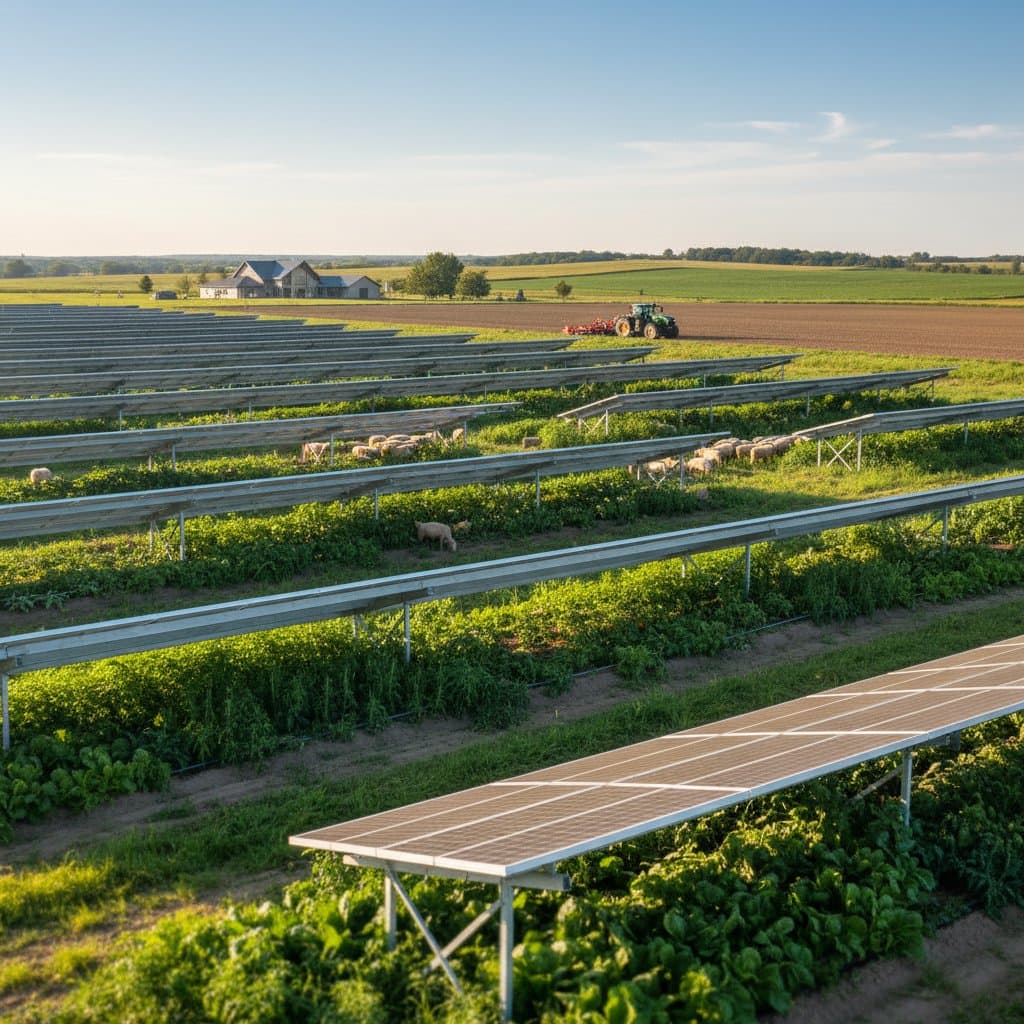
Solar Farms That Produce Food and Energy: The 2026 Expansion
Solar energy development often raises concerns among landowners about conflicts with agriculture. Homeowners and farmers question whether renewable power installations can coexist with crop production. Agrivoltaics, or dual-use solar, demonstrates that shared land use is feasible and beneficial.
This innovative practice gains traction as regions seek to expand clean energy while safeguarding food supplies. Traditional solar farms that blanketed fertile fields now incorporate designs that accommodate crops, livestock, and wildlife habitats under and around panel arrays.
Understanding Agrivoltaics Mechanics
Agrivoltaics merges solar photovoltaic systems with ongoing farming activities. Panels mount on elevated structures, typically 6 to 10 feet above ground, with wider spacing between rows compared to conventional setups. This configuration permits sunlight penetration to vegetation while offering shade that mitigates heat and evaporation.
Photovoltaic cells convert sunlight into electricity through the movement of electrons between P-type and N-type semiconductor layers. The direct current produced travels to inverters for conversion to alternating current, suitable for grid integration or local consumption. Beneath the panels, the land functions as an active farm, yielding both electricity and produce.
Certain crops excel in this environment. Shade-tolerant options like lettuce, strawberries, and carrots benefit from moderated temperatures and diffused light. Sheep or goats can graze the understory, controlling weeds without mechanical intervention and reducing operational expenses.
Evaluating Dual Outputs
Effective agrivoltaic installations generate robust performance across energy and agricultural metrics. Consider a 5-megawatt facility: it typically yields 1,300 kilowatt-hours per kilowatt of capacity annually, totaling approximately 6.5 million kilowatt-hours per year. Valued at 15 cents per kilowatt-hour, this translates to nearly $975,000 in annual revenue prior to deductions for maintenance and land costs.
Agriculturally, productivity reaches 70 to 90 percent of conventional field rates, varying by crop and layout. Although yields may dip slightly, the synergy of energy sales and farm income surpasses revenues from either activity in isolation. Landowners often report enhanced overall profitability through this integration.
Investment and Return Timeline
Initial costs for agrivoltaic systems exceed those of standard ground-mount arrays due to reinforced supports, extended wiring, and terrain preparation. Expect expenditures of $1.3 to $1.6 million per megawatt. Government programs substantially alleviate this burden.
The federal Investment Tax Credit reimburses up to 30 percent of eligible expenses. Additional state-level rebates or performance-based incentives for renewables further reduce outlays. Factoring in agricultural proceeds and avoided land conversion fees, systems recoup investments within 7 to 10 years. Subsequent operations yield profits for 20 years or more, supported by minimal annual maintenance.
Sustainability and Local Impacts
Agrivoltaics delivers environmental advantages that extend beyond energy generation. Shaded ground covers preserve soil moisture, potentially lowering irrigation demands by 20 percent. Native plantings beneath panels foster habitats for pollinators, bolstering biodiversity and aiding adjacent agricultural operations.
Grazing integrates seamlessly, minimizing fuel consumption from equipment and enhancing soil health through natural fertilization. On a broader scale, these projects improve air quality and stimulate regional economies. Farmers retain viable land uses, utilities secure stable renewable sources, and communities avoid tensions over land development.
Key Factors in Site Planning
Landowners contemplating agrivoltaics must assess site-specific elements to optimize success.
- Solar Exposure: Prioritize locations with ample daily sunlight and southward panel orientation for peak efficiency.
- Soil Quality: Test for fertility, pH, and drainage to select compatible crops or forage.
- Layout Accessibility: Ensure row spacing accommodates farm vehicles or animal movement, typically 10 to 15 feet.
- Grid Connection: Review utility policies on export capacity and rate structures for power sales.
- Regulatory Compliance: Consult local authorities for zoning approvals and environmental impact assessments.
Advanced tools, including sensors for light levels, soil metrics, and output tracking, enable real-time adjustments. Operators can fine-tune irrigation schedules or panel angles to balance energy capture and crop vitality.
Sustaining Operations Over Time
Efficient management demands regular oversight to maintain dual productivity. Conduct yearly checks on electrical components, structural integrity, and ground conditions. Employ grazing or selective trimming for vegetation management, supplemented by targeted watering systems.
Solar modules warrant performance guarantees spanning 25 years, with degradation rates around 0.5 percent annually. Systems retain over 85 percent capacity after 20 years. At end-of-life, recycling protocols recover valuable materials such as silicon, glass, and metals, promoting circular economy principles.
By diversifying revenue, agrivoltaics shields farmers from climate variability and price fluctuations. This resilience fortifies local food systems and energy independence.
Addressing Common Questions
Which crops suit agrivoltaic setups?
Shade-adapted varieties like spinach, kale, blueberries, and potatoes yield reliably under panels.
Is grazing compatible with solar infrastructure?
Absolutely. Compact animals such as sheep navigate rows effectively and prevent overgrowth without harming panels.
Does shading hinder plant growth?
Strategic elevation and gaps ensure sufficient light; in warm regions, shade often enhances productivity by reducing stress.
What are typical setup costs?
Systems range from $1.3 to $1.6 million per megawatt, offset by incentives.
Which supports exist for these projects?
Federal credits cover 30 percent, with states offering rebates and renewable tariffs.
How does upkeep differ?
Core tasks mirror standard solar maintenance, plus monitoring for agricultural health.