
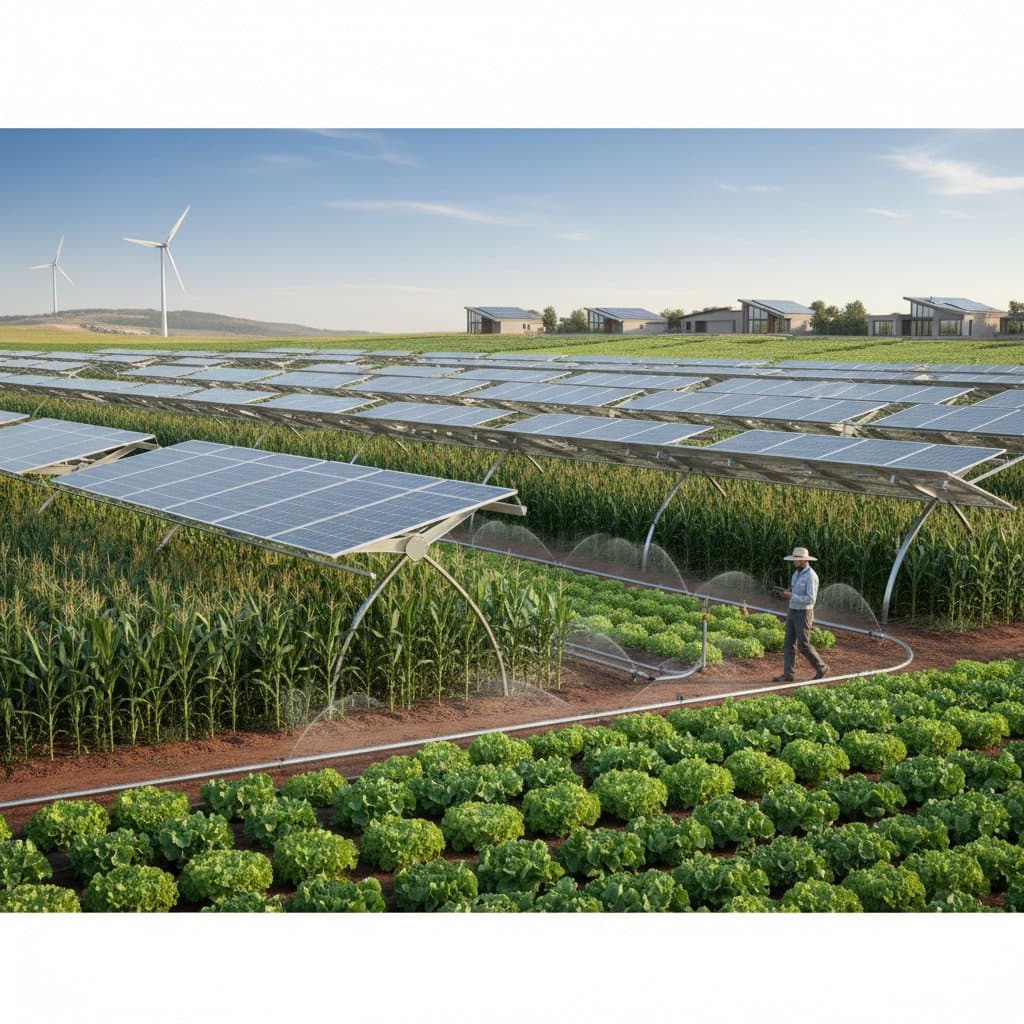
Solar Farms That Grow Food and Power Homes
Solar research often raises concerns about land use conflicts. Individuals frequently question whether large-scale solar installations require sacrificing productive farmland. Advances in agrivoltaics address this challenge by enabling solar panels and crops to coexist on the same terrain. This approach allows communities to produce clean energy and fresh produce simultaneously, eliminating the need to prioritize one over the other.
How Agrivoltaics Works
Agrivoltaics integrates elevated or strategically spaced solar panels with active agriculture. These panels permit sunlight, water, and machinery to reach the crops underneath. Photovoltaic cells in the panels capture sunlight and convert it into electricity, while the diffused light filtering through supports plant growth.
The process begins when photons strike the silicon-based solar cells, prompting electrons to flow across a semiconductor junction and generate direct current. This current travels through conductive wiring to an inverter, which transforms it into alternating current suitable for residential and commercial use. Below the panels, farmers cultivate a range of crops, including vegetables, herbs, berries, or grains, tailored to the region's climate and soil conditions.
One significant benefit involves microclimate regulation. The panels offer partial shade that reduces soil temperatures by two to five degrees Fahrenheit and minimizes water evaporation. In arid areas, this feature aids water conservation; in warmer, humid climates, it mitigates heat stress on plants, leading to more consistent crop yields and reliable energy production.
Real Numbers Behind Production and Yield
Consider a standard agrivoltaic installation spanning 10 acres with a 2-megawatt capacity. Each kilowatt typically generates approximately 1,300 kilowatt-hours annually, resulting in about 2.6 million kilowatt-hours per year from the full system. This output suffices to supply electricity to roughly 250 average households, based on an annual consumption of 10,000 kilowatt-hours per home.
Farmers retain access to 60 to 80 percent of the land for cultivation. For instance, if a conventional field yields 10,000 pounds of vegetables per acre, a 20 percent adjustment under panels still delivers 8,000 pounds per acre alongside energy generation. Revenue from crop sales combined with electricity production covers land expenses and provides income stability against market fluctuations.
Cost and Payback Example
The upfront cost for agrivoltaic panels ranges from 1.2 to 1.6 million dollars per megawatt, encompassing panels, wiring, inverters, site preparation, and fencing. A 2-megawatt setup thus approximates 3 million dollars total. Federal investment tax credits can offset up to 30 percent of this amount, while state-specific grants or low-interest loans further ease the financial burden for dual-use projects.
Assuming the system generates 2.6 million kilowatt-hours yearly and electricity sells at 12 cents per kilowatt-hour, annual gross revenue reaches 312,000 dollars. After accounting for maintenance and insurance costs, the installation recoups its investment in 8 to 10 years. Over the subsequent 20 to 25 years of service life, it delivers substantial energy and agricultural returns with minimal ongoing expenses.
Local Benefits and Community Impact
Agrivoltaics fosters energy independence while maintaining the essence of rural landscapes. Participants in community solar initiatives receive clean power without installing personal rooftop systems. Farmers benefit from diversified revenue streams that buffer against crop failures or price volatility.
Planting pollinator-friendly vegetation between panel rows enhances biodiversity, bolstering bee and butterfly populations that aid nearby agriculture. The shaded soil beneath panels supports extended growing periods for crops like lettuce and spinach that prefer cooler conditions. Shared elements, including perimeter fencing and access pathways, reduce overall upkeep expenses for both energy production and farming operations.
Key Variables That Affect Results
Performance of an agrivoltaic system depends on several elements:
- Sun hours: Locations with abundant daily sunlight maximize electricity output per panel.
- Crop type: Shade-adapted varieties, such as leafy greens, perform optimally under partial coverage.
- Panel height and spacing: Sufficient elevation and gaps allow safe passage for farming equipment.
- Utility rates: Higher local electricity prices accelerate financial returns.
- Incentives and net billing: Regional policies dictate the compensation structure for generated power.
Next Steps for Homeowners and Farmers
Prospective users should start with a comprehensive site evaluation. Assess solar exposure patterns, soil hydration levels, and proximity to the electrical grid. Consult local zoning regulations and agricultural protection guidelines to ensure compliance.
Collaborate with experienced installers versed in dual-use configurations. Post-installation, perform routine maintenance: clean panels quarterly, manage vegetation growth, and examine wiring following severe weather events. Utilize monitoring applications to oversee energy production and correlate it with crop health indicators.
Sustaining Dual Benefits Long-Term
Thoughtful implementation and ongoing care enable a property to nourish communities through food and fuel for generations. Agrivoltaics demonstrates that renewable energy and agriculture enhance one another, creating resilient systems that support environmental health and economic vitality.
FAQ
What is agrivoltaics?
Agrivoltaics combines solar electricity generation with ongoing agricultural activities on shared land.
Do crops grow well under solar panels?
Yes, shade-tolerant options like leafy greens and herbs flourish in the moderated light conditions.
Does dual-use solar reduce farm income?
Typically, no; it expands revenue sources by adding energy sales to traditional crop earnings.