
2026 Boom: Solar Farms Harvesting Power and Crops
Many communities observe a new type of solar project emerging across open fields. These installations produce more than electricity. They cultivate food as well. Referred to as agrivoltaics or dual-use solar, this method enables farmers and developers to collaborate. It advances clean energy objectives while sustaining agricultural activities.
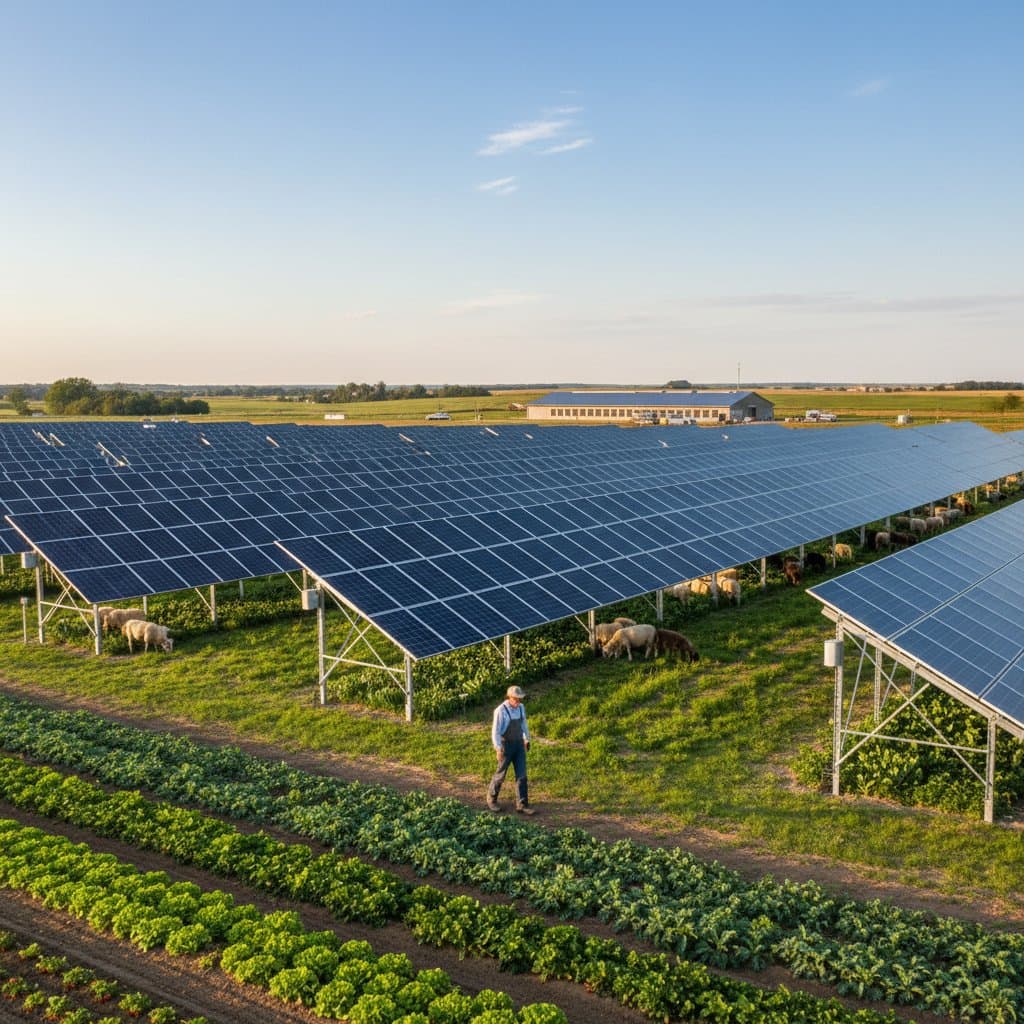
The concept proves straightforward. Solar panels mount at elevations that permit sunlight and rainfall to access the ground below. Crops flourish underneath, and livestock graze among the rows. Consequently, a single parcel of land yields two essential outputs: food and electricity.
Why Dual-Use Solar Matters
Land resources remain finite, and numerous rural regions confront the dilemma of selecting between farming and renewable energy development. Dual-use solar eliminates this conflict. It preserves local economies anchored in agriculture and introduces a dependable revenue source.
A thoughtfully engineered agrivoltaic system minimizes water consumption, shields crops from excessive heat, and generates shaded zones that retain soil moisture over extended periods. For farmers contending with erratic weather patterns, this shading often determines the outcome between robust harvests and seasonal failures. Studies indicate that partial shade can enhance crop resilience, particularly in regions prone to drought or intense sunlight.
How It Works
Solar modules elevate on structures and space farther apart compared to conventional utility-scale arrays. This configuration ensures sunlight penetrates to the vegetation at ground level. Advanced tracking mechanisms adjust panel angles throughout the day, optimizing light distribution for both crops and energy output.
Consider a 1-megawatt dual-use array spanning approximately five acres. Such a system generates about 1,300 kilowatt-hours per kilowatt annually, resulting in roughly 1.3 million kilowatt-hours total. Valued at 12 cents per kilowatt-hour, this equates to approximately 156,000 dollars in electricity revenue. Simultaneously, the underlying land supports the cultivation of vegetables, berries, or hay, potentially adding tens of thousands of dollars in agricultural value.
Shade-tolerant varieties like lettuce, spinach, and strawberries frequently excel beneath panels, exhibiting improved growth rates and quality. Sheep integrate seamlessly, grazing on the grass to control overgrowth and eliminate the need for frequent mowing, thereby lowering operational expenses.
Costs and Incentives
Constructing a dual-use solar farm incurs higher initial expenses than a standard ground-mounted setup, primarily due to elevated and reinforced racking systems. Costs typically range from 1.5 to 2 million dollars per megawatt, influenced by design specifications and site characteristics. Federal and state programs substantially offset these expenses, reducing net costs by 30 to 50 percent via tax credits, grants, and renewable energy certificates.
Payback periods generally span eight to twelve years, after which the installation delivers electricity at no additional cost for another fifteen to twenty years, requiring only routine upkeep. Developers often project internal rates of return exceeding 8 percent when factoring in both energy sales and preserved farmland productivity.
Benefits Beyond the Farm
Communities benefit from localized power generation that enhances grid stability and reduces outage risks. An agrivoltaic farm powers hundreds of households while maintaining open landscapes. These sites foster habitats for pollinators and mitigate soil erosion through integrated vegetation management.
Farmers secure consistent lease payments or retain ownership of the solar infrastructure, enabling investments in advanced irrigation, machinery, and soil enhancement practices. Utility customers experience advantages as well, including diminished transmission inefficiencies and lower expenses during peak demand periods. In aggregate, these systems contribute to diversified rural economies and accelerated transitions to sustainable energy.
Getting Started
Landowners contemplating this approach begin with a comprehensive site evaluation. Assess solar irradiance levels, soil fertility, and water resources to determine suitability. Subsequently, solicit proposals from solar developers experienced in dual-use implementations. Ensure comparisons rely on consistent parameters, such as array capacity, panel orientation, and projected energy yields.
Prior to finalizing contracts, verify compliance with local zoning regulations, grid interconnection protocols, and incentive eligibility. Certain states offer pilot initiatives that award premium tariffs for demonstrated agricultural output beneath solar installations. Engaging agricultural extension services can provide tailored guidance on crop selection and system integration.
Maintenance and Long-Term Care
Agrivoltaic systems require periodic checks on electrical components, structural supports, and ground cover. Farmers incorporate these tasks into routine field operations for efficiency. Seasonal panel cleaning sustains optimal performance levels. Given the longevity of panels, which endure for decades, owners prepare strategies for end-of-life recycling or system upgrades when efficiency falls below manufacturer guarantees.
Regular vegetation management prevents shading issues on panels and supports biodiversity. Monitoring tools, such as remote sensors, track soil health and energy production, allowing proactive adjustments to maximize dual benefits.
Advancing Local Sustainability
Homeowners and communities advance these initiatives by participating in solar cooperatives or subscribing to community solar programs. Advocate for policies that incorporate dual-use solar into agricultural preservation efforts. Each field harnessing both energy and crops propels regions toward equitable, resilient futures.
FAQ
What is agrivoltaics?
It represents the combined utilization of land for solar energy generation and agricultural production.
Do crops grow well under panels?
Yes, numerous shade-adapted crops demonstrate strong performance and may benefit from temperature moderation.
How do animals fit into these systems?
Sheep and other small livestock graze effectively among panels, managing vegetation and promoting soil vitality.
Is dual-use solar more expensive to build?
Initial costs exceed those of traditional setups, yet enhanced long-term revenues from energy and farming offset the difference.
Can existing farms convert to this model?
Numerous farms qualify, contingent upon terrain, soil composition, and proximity to electrical infrastructure.