
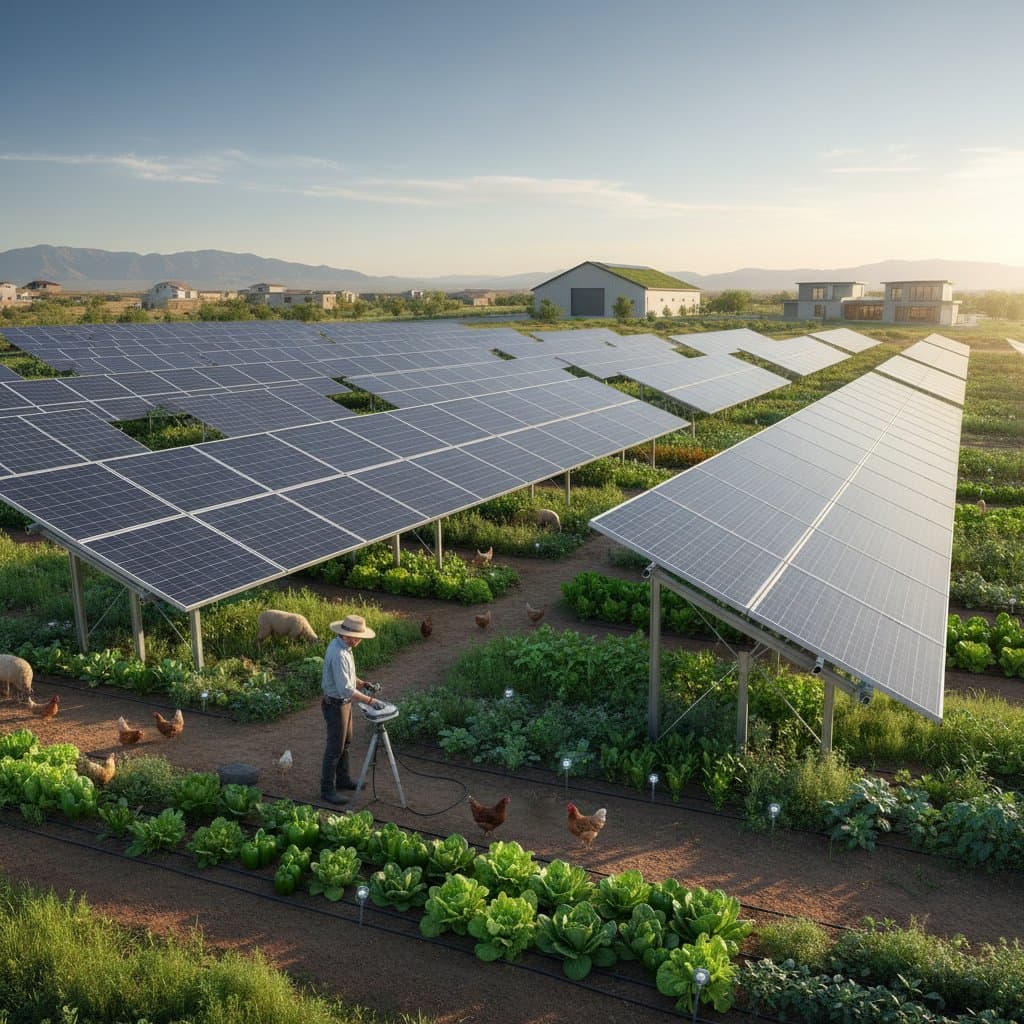
The Rise of Dual-Use Solar Farms in Agriculture
Solar power increasingly serves as a foundation for revitalizing local food systems. Throughout the United States, solar installations now coexist with crop cultivation and livestock operations on shared land. This integration, termed agrivoltaics or dual-use solar, reshapes perspectives on land utilization for energy, farming, and nutrition.
The core concept involves elevating or spacing solar panels to permit sunlight, moisture, and airflow to the soil below. This configuration supports the growth of shade-adapted vegetation or the pasturing of animals, all while the panels harvest solar energy. Such systems address dual imperatives: advancing renewable energy adoption and sustaining agricultural productivity.
For residents and authorities in the Philadelphia area, these developments illustrate the potential for harmonious solar and farming practices, fostering environmental stewardship and economic vitality.
Mechanics of Dual-Use Solar Systems
Traditional solar arrays feature panels positioned close to the earth in compact formations. Dual-use configurations elevate panels to heights of six to ten feet and expand row intervals to facilitate ground-level access to light.
Design variations align with specific agricultural objectives.
- Crop Integration: Elevated frameworks and panels with variable angles optimize the distribution of light and shadow for plant health.
- Livestock Management: Ample spacing ensures safe movement for grazing animals. Sheep prove ideal, as their size allows navigation under panels while they control undergrowth.
- Pollinator Support: Sowing native flowers and grasses beneath panels draws pollinators like bees, benefiting adjacent agricultural fields.
Implementation demands precise engineering. Specialists model annual sunlight penetration based on panel orientation and elevation. Farmers monitor soil conditions and plant responses, refining elements such as height adjustments, inter-row distances, and supplemental watering to maximize outcomes.
Community and Economic Advantages
Dual-use solar bolsters regional economies by localizing both energy and food outputs. Production occurs near points of use, minimizing transmission losses and supporting nearby markets.
Philadelphia-adjacent communities increasingly adopt these models to safeguard arable land amid renewable energy expansion. Landowners retain agricultural heritage and profitability, avoiding the conversion of fields to exclusive energy sites.
Environmental gains extend past emissions reductions.
- Soil Preservation: Vegetation cover and reduced tillage prevent erosion and nutrient depletion.
- Water Efficiency: Shade mitigates evaporation, decreasing irrigation demands for under-panel crops.
- Biodiversity Enhancement: Native flora fosters habitats for pollinators and avian species.
- Temperature Regulation: Shaded areas create moderated climates, stabilizing local ecosystems.
Funding and Incentive Opportunities
Numerous initiatives facilitate dual-use solar adoption via financial mechanisms.
- Federal and State Programs: Investment tax credits offset up to 30 percent of installation expenses, with additional incentives for agricultural integrations.
- USDA and Agricultural Agencies: Targeted grants support experimental projects blending energy and farming.
- Utility Collaborations: Providers may compensate at premium rates for output from community-oriented agrivoltaic sites.
- Sustainable Finance Options: Green banks extend low-rate loans or flexible leasing to ease initial investments for agricultural operators.
Layering these resources renders dual-use projects viable for operations of varying scales.
Evaluating Dual-Use Performance
Success metrics encompass energy generation and farming productivity.
Energy assessments consider factors like solar exposure, panel performance, conversion efficiency, and operational inefficiencies. Agricultural evaluations hinge on crop selection, weather patterns, and cultivation techniques. Optimal designs harmonize these elements.
Consider a scenario where a modest five percent dip in energy capture yields a 15 percent uplift in harvest volume. This equilibrium often elevates overall land profitability despite nuanced trade-offs.
Actionable Steps for Individuals and Land Managers
Participation extends beyond large-scale ownership.
- Investigate community solar subscriptions that draw from agrivoltaic sources.
- Advocate for zoning regulations that accommodate dual-use installations and farmland conservation.
- On modest lots, explore compact systems like solar canopies over vegetable plots.
- Consult installers on designs suitable for small-scale or communal growing areas.
- Engage with regional demonstrations by contributing to monitoring or promotion efforts.
Collective efforts accelerate the integration of renewable energy with robust agriculture.
Key Questions on Agrivoltaics
What defines agrivoltaics?
Agrivoltaics merges solar power production with farming activities on unified terrain, accommodating crops, grazing, or ecological zones alongside panels.
Can agriculture flourish beneath solar arrays?
Affirmative; shade-tolerant varieties such as greens, herbs, and fruits thrive in moderated conditions, experiencing less heat and hydration strain.
What revenue models support farmers in dual-use operations?
Operators derive earnings from power sales or leases, supplemented by ongoing agricultural yields, yielding diversified and resilient income.