
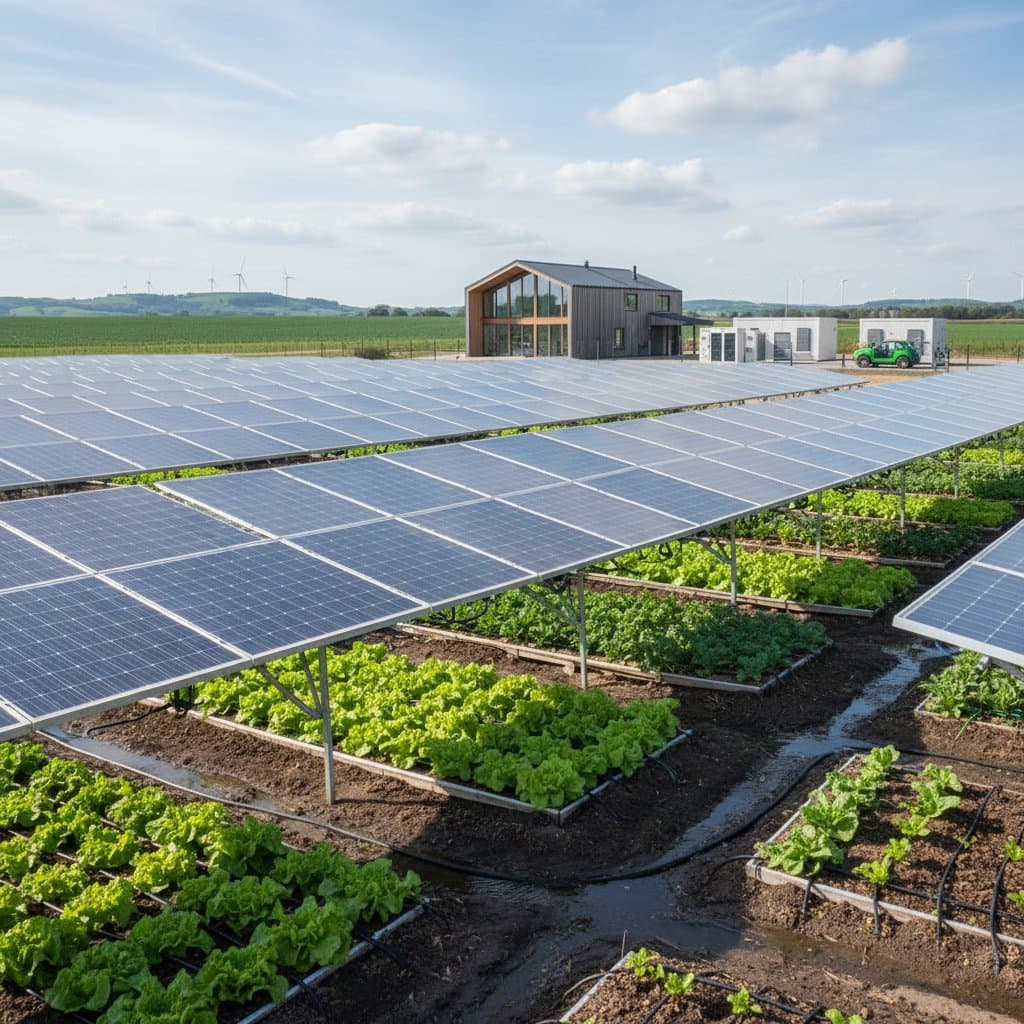
Farming Under Solar Panels Doubles Income by 2026
Solar research often overwhelms landowners at first. Many hesitate to install panels due to concerns about losing productive farmland. The notion of covering fields with solar arrays appears as a tradeoff between clean power and crop output. In reality, innovative designs demonstrate that both can coexist effectively. This approach, termed agrivoltaics or dual-use solar, transforms how farms generate energy and food.
Farmers in rural areas increasingly recognize that integrating solar panels with crops can double income within a few years. The method merges agricultural practices with renewable energy production to establish a reliable financial foundation independent of weather fluctuations or commodity prices.
How Agrivoltaics Functions
Agrivoltaic systems elevate solar panels to permit light, air, and machinery access below. Panels tilt at optimal angles to allow sunlight penetration through gaps, with spacing designed to balance shade and direct exposure.
Sunlight striking the panels excites electrons in the semiconductor material, generating direct current electricity. Inverters then convert this to alternating current for on-site use or grid export.
The sunlight fueling electricity generation also sustains plant growth beneath. Crops benefit from diffused light that reduces heat stress and evaporation rates. This effect preserves soil moisture and may prolong the growing season for select species.
Synergy Between Crops and Energy Production
Shade-tolerant varieties like lettuce, spinach, and berries excel under solar panels. Livestock operations gain advantages as panels offer shelter for grazing animals. The resulting microclimate elevates soil humidity and decreases irrigation demands by as much as 20 percent.
Consider a Pennsylvania farm installing a 250-kilowatt system over five acres. Each kilowatt typically yields 1,300 kilowatt-hours annually, totaling 325,000 kilowatt-hours. At a utility rate of 15 cents per kilowatt-hour, this offsets approximately 48,750 dollars in electricity costs each year. Retaining crop production on the same land elevates combined revenue far beyond prior single-use outcomes.
Financial Calculations Explained
Examine a straightforward example.
- System capacity: 250 kilowatts
- Annual output per kilowatt: 1,300 kilowatt-hours
- Total yearly production: 325,000 kilowatt-hours
- Value per kilowatt-hour: 0.15 dollars
- Yearly energy revenue: 48,750 dollars
Suppose traditional crop profits from the land amount to 40,000 dollars annually. The integrated system pushes total earnings to 88,750 dollars. After accounting for 3,000 dollars in maintenance and 25,000 dollars in loan repayments, net income increases by over 20,000 dollars each year.
Federal and state incentives frequently offset 30 percent or more of upfront costs, accelerating payback. Systems often recoup investments in less than ten years and generate returns for 20 to 30 years thereafter.
Considerations for Site Design and Local Factors
Agrivoltaics suits not every farm configuration equally. Essential factors include:
- Sun exposure and terrain slope. South-facing areas or level fields maximize solar output.
- Crop selection. Leafy greens and forage adapt readily, unlike corn or other tall cereals.
- Panel elevation and row spacing. Elevated structures accommodate tractors and promote ventilation.
- Soil quality and water management. Partial shade enhances moisture retention, though proper drainage remains crucial.
- Utility regulations. Net metering policies and interconnection requirements influence energy valuation.
Certified installers conduct shade assessments and soil evaluations prior to finalizing designs. These steps guarantee compatibility between solar efficiency and farming viability.
Environmental and Community Advantages
Dual-use solar sustains active farmland instead of repurposing it solely for energy. This preserves rural landscapes while contributing clean power to the grid. Reduced ground-level heat from shaded panels minimizes reflection, and diverse plantings foster biodiversity through pollinator habitats.
Local communities achieve greater energy resilience via on-site generation. Farms producing their own power decrease dependence on distant suppliers. Distributed sources also cut transmission losses by delivering electricity near points of consumption.
Policy Incentives and Support Mechanisms
Federal tax credits, state rebates, and rural energy grants promote agrivoltaic adoption. Certain areas provide performance payments for each kilowatt-hour produced. Additional options include low-interest loans or funding for preliminary assessments.
Leasing land to solar developers offers farmers stable income without relinquishing field control. Rates typically span 800 to 1,200 dollars per acre yearly. Pairing this with crop yields can double returns relative to conventional farming.
System Maintenance and Daily Operations
Agrivoltaic setups demand routine cleaning and inspections. Panels require removal of dust and debris to sustain efficiency. Electrical components undergo testing, and supports check for wear or instability.
Farmers manage vegetation through grazing with sheep or goats, avoiding intensive mowing. This practice controls growth naturally and enriches soil via manure.
Digital monitoring tracks power generation alongside metrics like temperature, humidity, and soil moisture. Alerts notify operators of deviations, enabling timely interventions to preserve performance.
Future Prospects for Agrivoltaics
Declining equipment prices will expand agrivoltaics to diverse farm scales. Dual production of food and energy secures enduring revenue to underpin land conservation. The system proves particularly valuable where rising land costs pressure traditional operations.
Beyond economics, farmers secure energy autonomy, reduced water consumption, and enhanced crop durability. Broader benefits encompass clean energy access and protected open spaces. Renewable integration with agriculture demonstrates shared land use potential.
Steps to Implement Agrivoltaics on Your Farm
- Evaluate land features. Analyze orientation, slope, and soil to verify solar potential.
- Obtain site evaluation. Engage certified professionals for yield projections and shade modeling.
- Explore funding avenues. Review loans, leases, and purchase agreements.
- Identify available incentives. Search state and federal resources for applicable grants and credits.
- Select compatible crops. Prioritize varieties suited to shaded conditions.
- Implement tracking systems. Deploy tools to oversee energy and crop metrics.
- Establish upkeep protocols. Schedule cleanings, structural checks, and vegetation control.
Thoughtful preparation and tailored design enable agrivoltaics to double farm income while upholding agricultural heritage.
FAQ
What crops perform best under solar panels?
Leafy greens, root vegetables, and berries tolerate diffused light effectively. Forage grasses support livestock grazing successfully.
Does panel shade diminish crop yields?
Partial shade often mitigates heat stress and boosts soil moisture, potentially raising yields for shade-adapted crops.
What spacing exists between panel rows?
Rows typically separate by 10 to 15 feet to optimize light access and equipment maneuverability.
Can operating farms add solar retrofits?
Yes, provided spacing and height standards align with existing activities.
What is the lifespan of agrivoltaic systems?
Panels include 25-year performance guarantees, with structures enduring longer through routine care.