
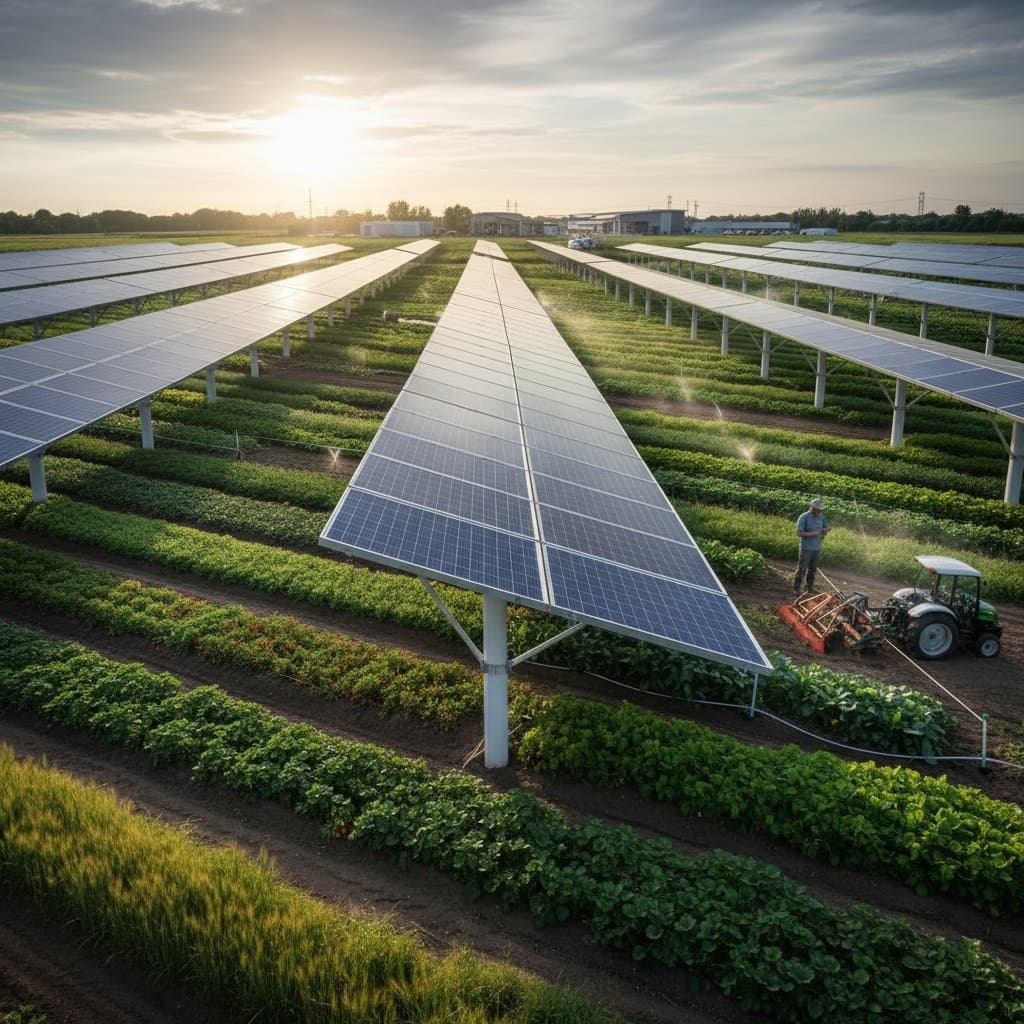
Solar Farms That Harvest Crops: The Rise of Agrivoltaics
Farmers and solar developers increasingly recognize the potential for integrating clean energy production with food cultivation. With growing demand for renewables and the need to protect arable land, agrivoltaics emerges as a viable solution that unites these priorities. Known also as dual-use solar, this method involves installing panels at sufficient height and spacing to permit crops or livestock to flourish underneath, converting fields into simultaneous sources of power and produce without sacrificing agricultural viability.
This practice reshapes discussions on land utilization. Communities no longer face the dilemma of selecting between solar development and farming; they achieve both. The outcome fosters a robust food supply chain, diversified earnings for agricultural producers, and a greener energy portfolio for regional grids.
Operational Mechanics
Agrivoltaic setups employ raised solar arrays, typically secured on sturdy steel or aluminum frameworks that accommodate machinery or animal movement below. Configurations ensure adequate intervals between rows to permit light penetration to the soil surface. Solar trackers adjust panel orientation daily to optimize both electricity yield and photosynthetic requirements.
Incident sunlight on the panels triggers the photovoltaic process to produce direct current electricity. Inverters then transform this into alternating current suitable for residential or grid applications. Underneath, vegetation or herds maintain their natural routines, augmented by tools such as drip watering systems, perimeter barriers, and ground monitors for integrated oversight.
Consider a representative agrivoltaic operation: one megawatt of capacity spread over five to seven acres. Assuming annual generation of 1,300 kilowatt-hours per kilowatt, the array yields approximately 1.3 million kilowatt-hours yearly. Valued at an average of 24 cents per kilowatt-hour, this translates to about $312,000 in potential revenue prior to deductions or subsidies.
Investment and Return Considerations
Initial expenditures for agrivoltaic ventures exceed those of conventional ground-mounted systems due to enhanced structural elevations and intricate arrangements. A one-megawatt setup may range from $1.3 million to $1.6 million. Producers frequently collaborate with solar firms via land leases or joint ventures, with annual payments varying from $700 to $1,200 per acre based on locale and infrastructure ties.
Recovery periods depend on available rebates and energy contracts. Federal and state incentives often enable positive cash flow within eight to ten years. Thereafter, property owners enjoy consistent solar-derived earnings alongside uninterrupted farming productivity.
Ecological and Societal Advantages
Agrivoltaics promotes soil conservation, enhances ecological variety, and nurtures areas for pollinators. Panel-induced shading cools the earth, potentially cutting irrigation needs by up to 20 percent, a vital factor in arid or warm climates. Integrating grazing in inter-row spaces minimizes upkeep expenses and controls undergrowth without reliance on large equipment.
Local populations tend to support agrivoltaic initiatives more than standard large-scale solar arrays. Productive land retention upholds countryside aesthetics and employment opportunities. The sight of panels above thriving fields conveys progress and continuity rather than land conversion.
Getting Started
Individuals with modest plots or collective organizations can initiate dual-use solar via experimental areas or group endeavors. Begin with an evaluation of the site, assessing solar exposure, earth composition, and suitable vegetation types. Collect a year's worth of energy consumption records to gauge needs.
Solicit proposals from specialists experienced in raised installations. Verify compliance with municipal regulations and explore rebates through your state's energy department or farm advisory programs. Smaller trials, such as erecting elevated panels over personal gardens, protected growing spaces, or animal enclosures, offer insights prior to broader implementation and often motivate surrounding participants.
Ongoing Upkeep
Dual-use systems demand attention to both photovoltaic and farming elements. Clean panels regularly to clear debris like dust or residues. Examine wiring and components annually for integrity.
Adjust soil hydration monitors and watering mechanisms to safeguard plant vitality. Track vegetation performance across varying panel positions to refine the equilibrium between harvest volume and power efficiency. Accumulated observations from these operations inform superior configurations over time.
Advancing Toward Implementation
Agrivoltaics harmonizes agricultural and energy imperatives. Producers sustain food output while incorporating supplementary earnings. Regions acquire renewable resources and fortified self-reliance. Property owners and alliances adapt scaled-down applications to their circumstances.
Identify sun-rich yet idle parcels, investigate area-specific supports, and engage experts versed in combined layouts. Each productive acre advances collective progress toward enduring energy independence.
Frequently Asked Questions
Which crops suit cultivation beneath solar panels?
Leafy greens, herbs, berries, and select root crops adapt effectively to shaded environments.