
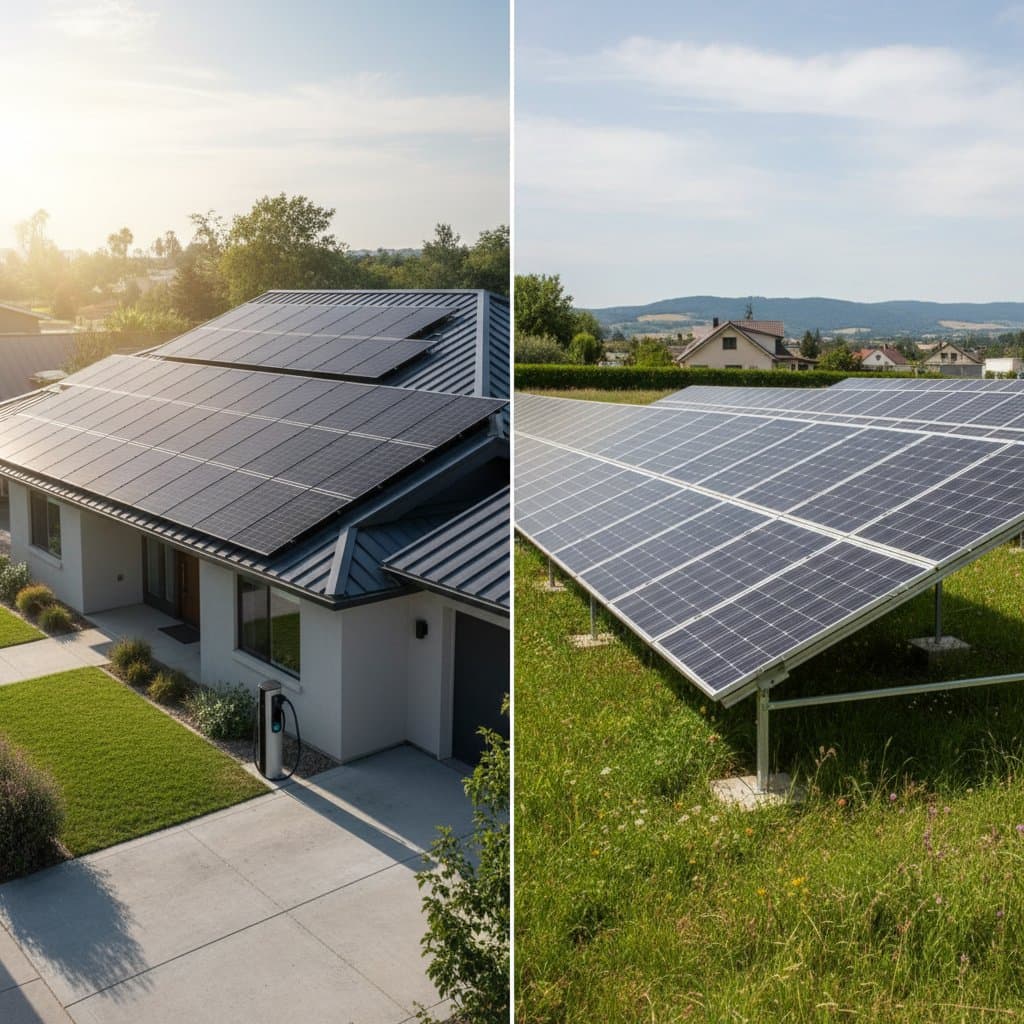
2025 Cost Comparison: Ground-Mounted vs. Rooftop Solar Installations
Solar energy decisions often begin with placement options, yet true value emerges from assessing space availability, structural suitability, and enduring performance. Homeowners in the Philadelphia region frequently encounter this choice, where both ground-mounted and rooftop systems produce renewable electricity. The distinctions in expenses, setup demands, and output become evident through careful examination, influencing overall investment outcomes.
Fundamentals of Rooftop Solar Systems
Rooftop installations secure panels to the home roof via specialized racking that maintains a consistent angle. The roof slope and direction dictate sunlight exposure levels. Within the panels, photons from sunlight interact with silicon cells, generating electron flow that forms usable direct current; an inverter then converts this to alternating current for home use or grid export.
A standard 7 kW rooftop array suits many Philadelphia residences. With regional solar irradiance yielding approximately 1,300 kilowatt-hours per kW annually, such a system generates about 9,100 kilowatt-hours each year. At Pennsylvania average electricity rates of 17 cents per kilowatt-hour, this production offsets roughly 1,550 dollars in annual utility expenses.
Key Differences in Ground-Mounted Solar Systems
Ground-mounted arrays employ sturdy metal frameworks fixed into the earth with concrete bases or ground screws. Panels elevate several feet above the surface and adjust to the ideal tilt for maximum solar capture, independent of roof geometry. This orientation, typically facing due south without obstructions, enhances energy yield per panel compared to many rooftop configurations.
Such adaptability incurs elevated initial investments. Tasks like excavating for conduits, erecting foundations, and preparing the site increase labor and materials. Ground-mounted systems generally range from 10 to 20 percent higher per watt than rooftop equivalents. However, superior efficiency often shortens the return on investment by one to two years under favorable conditions.
Detailed Cost Analysis and Return Periods
Consider a representative scenario for clarity.
- Rooftop installation: A 7 kW system at 2.60 dollars per watt totals 18,200 dollars prior to incentives.
- Ground-mounted installation: The same 7 kW capacity at 3.00 dollars per watt amounts to 21,000 dollars before incentives.
Applying the 30 percent federal investment tax credit reduces the rooftop net expense to 12,740 dollars and the ground-mounted to 14,700 dollars. Assuming each offsets 1,550 dollars in yearly electricity costs, the rooftop achieves payback in approximately eight years. The ground-mounted extends to nine or ten years, though a 10 percent higher output from optimized positioning can close this difference significantly.
Influence of Site Conditions and Utility Policies
Environmental and regulatory elements shape practical results. Roofs afflicted by tree shadows, irregular pitches, or constrained areas favor ground-mounted alternatives. Properties with expansive yards or rural settings provide ample room for optimal layout and scalability.
Utility policies further impact economics. Programs such as net billing and time-of-use pricing favor exports during high-demand periods. Ground-mounted designs permit precise panel angling to harness peak afternoon rays, amplifying credits under these frameworks.
Maintenance Practices and System Durability
Rooftop panels benefit from natural cleansing by rainfall, though accessing them for checks requires ladders or professional aid. Ground-mounted units permit straightforward cleaning with hoses or brushes from ground level. Both configurations endure 25 to 30 years, experiencing degradation rates of about 0.5 percent annually.
Monitoring applications notify owners of any underperformance, while warranties protect inverters and panels for 20 years or longer. At the conclusion of service life, disassembly supports recycling efforts. Ground-mounted setups simplify this process, avoiding elevated work.
Selecting the Optimal Configuration
Homeowners base selections on available space, roof condition, and energy objectives. Rooftop options preserve yard usage and integrate seamlessly with architecture. Ground-mounted provide superior orientation, simplified upkeep, and proximity for integrating storage solutions like batteries.
Obtain a minimum of two professional estimates, ensure installer credentials through NABCEP certification, and verify compliance with local codes for permits and grid connections. Request a thorough site evaluation encompassing shading surveys and projected yields to facilitate direct comparisons.
Optimizing Long-Term System Efficiency
Conduct visual inspections biannually to remove accumulations of dirt, avian waste, or foliage. Prune adjacent vegetation to preserve unobstructed solar access. Examine production data via your monitoring platform each month to verify consistent generation.
Arrange professional servicing if output declines beyond anticipated norms. Consistent oversight ensures rooftop and ground-mounted systems sustain high performance across their lifespan, maximizing environmental and financial benefits.
Frequently Asked Questions
Which configuration yields higher energy per panel?
Ground-mounted systems frequently outperform due to direct southern facing and customizable tilt angles.
Do ground-mounted arrays withstand flooding risks?
Professionals elevate structures and employ reinforced footings to position panels above potential flood lines.
Might rooftop installations compromise roof integrity?
Certified mounting with proper sealing materials averts water intrusion; select installers adhering to roofing standards.
Are permits necessary for ground-mounted systems?
Affirmative; they require zoning approvals and electrical inspections, akin to rooftop projects.