
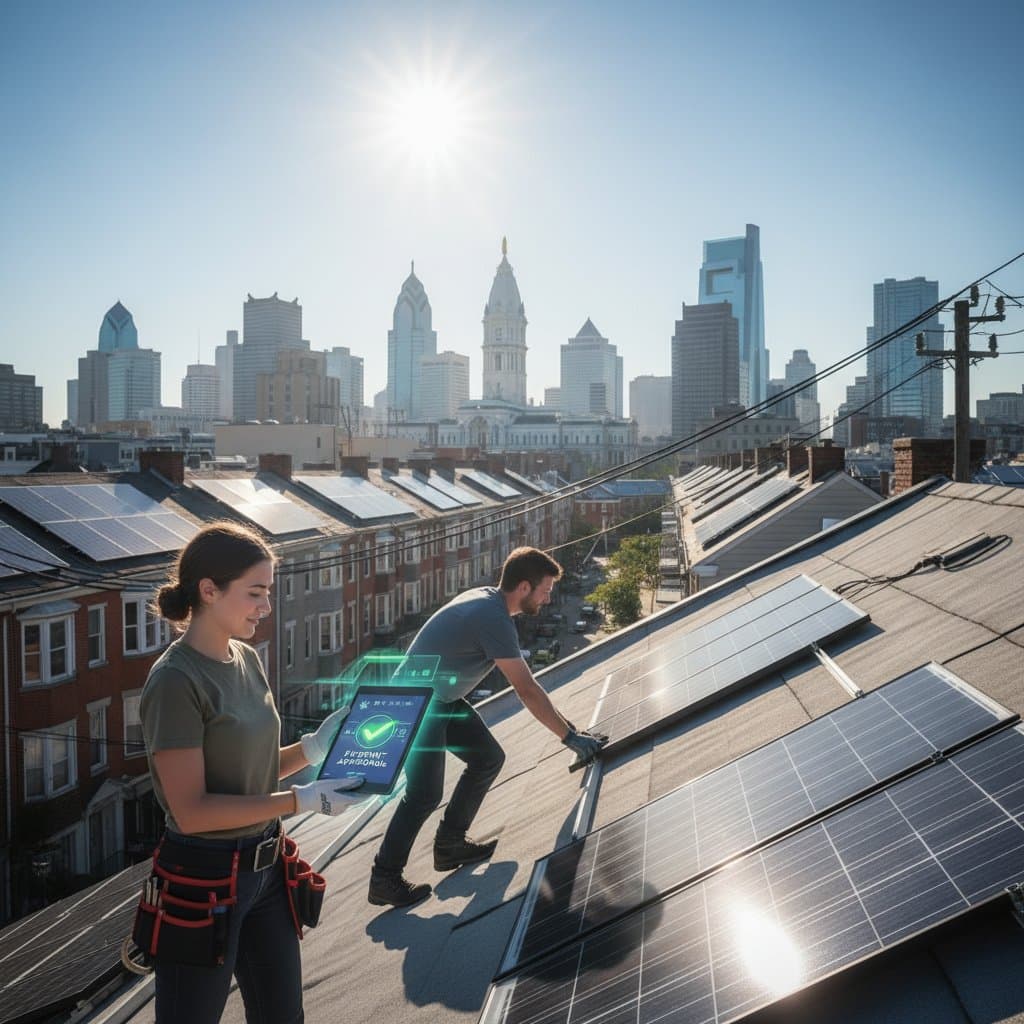
Philadelphia's 2026 Solar Permitting Reforms Accelerate DIY Installations
Philadelphia homeowners often delay solar panel installations due to lengthy permit waits that extend from weeks to months. These delays keep equipment stored and potential energy savings unrealized. Upcoming permitting reforms will transform this process, making it quicker, easier, and more cost-effective for do-it-yourself installers to generate clean power for their residences.
Each day of delay represents missed opportunities to produce kilowatt-hours of electricity. An efficient permitting system allows families to realize savings earlier and supports the city's broader clean energy targets.
The Importance of Expedited Permits
Permitting ranks among the primary obstacles for residential solar initiatives. Local reviews typically require coordination across departments, involving distinct forms, technical drawings, and inspection timelines. A single oversight, such as an incomplete signature or ambiguous wiring specification, can restart the entire application.
For individuals handling modest rooftop projects, these hurdles prove particularly daunting. A streamlined, uniform procedure eliminates such unpredictability. It lowers soft costs, which encompass expenses beyond hardware, including labor, planning, and administrative tasks. According to the National Renewable Energy Laboratory, soft costs account for almost half the total expense of a residential solar setup. Permit simplification trims these costs by minimizing time demands on applicants and reviewers alike.
Under the forthcoming regulations, most basic residential solar configurations will qualify for immediate online approval. Applicants can submit a thorough application and receive authorization the same day, assuming the proposal adheres to safety codes and standards.
Mechanics of the Updated System
The revised framework centers on a digital platform that evaluates submissions for regulatory adherence in real time. It incorporates standardized templates for single-family rooftops, preset electrical schematics, and defined constraints on system capacity. Upon uploading plans, the software scans the details against a compliance checklist. Approval occurs automatically if all elements align with safety protocols.
Consider a standard 6-kilowatt rooftop array featuring 15 to 18 panels. The applicant selects panel and inverter models from a vetted catalog. The platform then verifies structural integrity, wiring configurations, and interconnection parameters. Upon validation, an electronic permit issues without delay.
Non-standard projects, including those on multi-angled roofs or with integrated batteries, undergo expedited manual assessment. Reviewers concentrate solely on deviations from the template, reducing processing durations by over 50 percent.
Implications for Do-It-Yourself Enthusiasts
Do-it-yourself solar adoption has surged alongside declining equipment prices and enhanced online resources. Nevertheless, permitting intricacies often drive homeowners to professional services. The new guidelines alleviate this barrier significantly.
Individuals proficient in fundamental construction and electrical tasks can now develop compliant designs via an intuitive online interface. The tool offers layout guidance, regulatory references, and sequential directives. Post-installation, a virtual checklist directs the final self-assessment, followed by a concise municipal inspection to affirm adherence.
This method enables capable homeowners to manage their projects independently while upholding rigorous safety measures. It also frees small-scale local firms to prioritize intricate assignments over bureaucratic demands.
Financial Projections and Savings
To gauge economic benefits, examine a 7-kilowatt system generating approximately 9,100 kilowatt-hours annually. At a utility rate of 24 cents per kilowatt-hour, this offsets roughly 2,180 dollars in yearly electricity expenses. A complete professional installation may total 17,000 dollars prior to rebates. A do-it-yourself approach, covering equipment and fees, approximates 10,000 dollars.
Prior to these reforms, postponements and expert planning fees added 1,000 to 2,000 dollars in unforeseen costs. Accelerated approvals and automated evaluations could diminish these by up to 15 percent. Paired with federal and state rebates, payback periods shorten to five to seven years, influenced by factors like shading, roof angle, and consumption patterns.
Reduced entry hurdles expand participation. Renters or condominium residents may collaborate with property administrators on compact communal arrays. Community solar cooperatives can leverage the same efficient pathway for collective deployments.
Integration of Incentives and Utility Connections
The permitting platform links seamlessly to incentive repositories and utility interconnection services. Permit approval triggers automatic preparation of rebate and tax credit documentation, averting redundant inputs and deadline oversights.
Philadelphia's utility offers net metering, compensating surplus solar output at retail rates. Standard system interconnections process within days under the new rules. By pre-verifying inverter capabilities and export thresholds, the system guarantees grid compatibility prior to issuance.
Ongoing Management and Longevity
The efficient permitting extends beyond setup. Users access a digital record that monitors output, warranties, and inspection records. This facilitates maintenance scheduling and compliance documentation during property transfers.
Basic upkeep involves annual panel rinsing, debris clearance around conduits, and inverter output checks. Contemporary inverters feature app-based surveillance that notifies of anomalies promptly. Properly executed systems endure over 20 years, degrading by less than 0.5 percent annually.
Remaining Challenges and Solutions
Despite permit accelerations, obstacles persist. Roof integrity, obstructions, and electrical enhancements influence budgets. Begin with a shade analysis or digital solar assessment tools to verify sufficient exposure. If the roof nears replacement, address it beforehand to avoid future disruptions.
Self-assurance poses another issue, particularly with electrical components. Adhere strictly to codes and engage a certified electrician for terminal wiring. The platform includes a roster of specialists providing targeted assistance for do-it-yourself efforts.
Citywide Benefits
These reforms propel Philadelphia's clean energy expansion. Increased residential adoption fortifies grid stability and retains economic value locally. Projections indicate a potential doubling of installations in coming years, yielding thousands of tons in carbon reductions and hundreds of sustainable employment opportunities.
Equity improves as well. Lower thresholds aid middle-income families facing affordability constraints from delays and administrative fees. Community groups can deploy shared solar via the simplified protocol, benefiting multiple households.
Preparing for Your Solar Project
Prospective installers should prepare promptly. Reforms ease the journey, yet groundwork remains essential. Collect 12 months of utility statements to profile usage. Evaluate roof alignment and shadows; south orientations excel, though east or west suffice with adjustments.
Research components: prioritize efficient panels from established manufacturers and durable inverters. Preview designs on the impending platform. Submission post-launch requires mere minutes.
Monitor post-installation via apps and update records. Address variances by consulting providers or experts. Vigilance ensures reliable output over decades, contributing to a sustainable urban energy landscape.
FAQ
1. Will the new permit rules apply to all types of solar systems?
No. The reforms primarily target standard rooftop arrays on single-family dwellings. Expansive or intricate configurations require thorough evaluation, albeit with abbreviated schedules.