
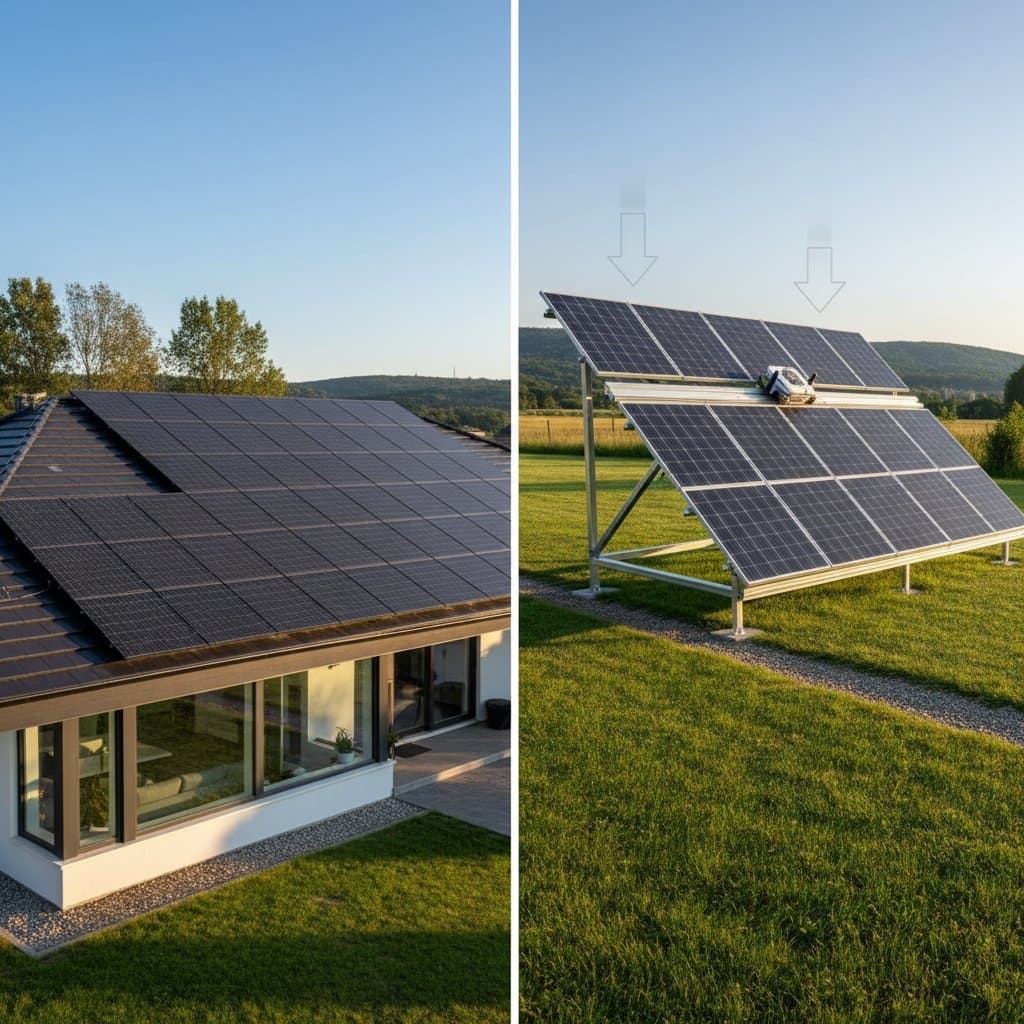
2026 ROI Comparison: Roof-Mounted or Ground-Mount Solar?
Solar energy options can present challenges for homeowners. Conflicting recommendations often arise regarding whether roof-mounted or ground-mount systems yield the superior return on investment. Each approach generates renewable power and lowers electricity expenses, but variations in expenses, output, and upkeep influence financial results. Grasping these distinctions enables informed choices ahead of installation.
Fundamentals of Each System
Roof-mounted solar panels secure to the home's rafters or trusses. Installers use mounting brackets that penetrate the roof, sealed with flashing to avoid water intrusion. Electrical connections lead to an inverter, which transforms direct current to alternating current for home appliances. The array aligns with the roof's pitch and direction, determining solar capture.
Ground-mount systems employ steel or aluminum frames fixed into the earth or concrete bases. Panels elevate above ground level, typically oriented south with adjustable angles for optimal sunlight. This setup demands extra space and underground wiring, yet permits future expansions. Separation from the house enhances scalability.
Both configurations utilize identical photovoltaic technology. Sunlight excites electrons in the cells, creating current for home or grid use. Variations emerge in sunlight optimization and setup expenses.
Installation and Labor Expenses
Roof-mounted installations leverage the existing structure, reducing overall costs. Teams affix racks, panels, and conduits without foundational work. For a 7 kW system, expenses range from $2.50 to $3.25 per watt, totaling $17,500 to $22,750 prior to incentives, based on size and region.
Ground-mount setups involve additional components like posts, concrete, and excavation. These elements increase complexity and labor. The equivalent 7 kW system costs $3.25 to $4.25 per watt, amounting to $22,750 to $29,750. While initial outlays differ, long-term benefits from output and maintenance often balance the equation for budget-conscious owners.
Energy Output and Efficiency
Output hinges on alignment, angle, and obstructions. Roof arrays conform to the home's slope, which may deviate from south-facing ideals. Steep or shallow pitches diminish seasonal performance, while vents, chimneys, or foliage introduce shadows that cut efficiency.
Ground-mount designs allow precise positioning. In high-sun areas, a 7 kW ground system produces approximately 1,400 kWh per kW annually, yielding 9,800 kWh total. A comparable roof setup on suboptimal surfaces generates 1,200 kWh per kW, or 8,400 kWh yearly. With electricity at $0.16 per kWh, the 1,400 kWh gap translates to $224 in additional yearly savings.
Cumulative gains from enhanced production recoup higher upfront costs. Extra 1,400 kWh annually accumulates to $2,240 over ten years and $4,480 over twenty years. Incentives like tax credits further close or invert the ROI disparity.
Upkeep and Access Considerations
Accessing roof arrays demands ladders and safety equipment for cleaning or repairs. Snow accumulation in colder regions complicates removal. Moreover, roof integrity affects longevity; replacement during the system's life requires panel removal and reinstallation, incurring extra fees.
Ground-mount arrays position at convenient heights for routine tasks. Inspections and cleaning occur effortlessly, with snow clearance taking minimal time. The framework endures independently of roof cycles, though it consumes 400 to 500 square feet for a 7 kW array, limiting suitability for small lots.
Return on Investment Analysis
ROI balances expenses against savings. Consider these scenarios for a 7 kW system.
Roof-Mounted Scenario:
- Cost: $20,000
- Annual Output: 8,400 kWh
- Savings at $0.16/kWh: $1,344
- Net After 30% Tax Credit: $14,000
- Payback: 10.4 years
Ground-Mount Scenario:
- Cost: $26,000
- Annual Output: 9,800 kWh
- Savings at $0.16/kWh: $1,568
- Net After 30% Tax Credit: $18,200
- Payback: 11.6 years
The roof option appears quicker initially, but ground mounts generate superior lifetime value through sustained output and reduced degradation. Total earnings favor ground systems after 20 years, depending on space availability and owner preferences.
Durability, Warranties, and Performance Decline
Panels feature 25-year warranties, degrading at 0.5% annually to retain 87% efficiency by end. Inverters warrant 10 to 15 years, with extensions available.
Ground-mount components benefit from better ventilation, minimizing heat-related wear. Roof panels face higher temperatures from restricted airflow, potentially accelerating decline slightly. This edge yields hundreds of extra kWh yearly for ground systems over decades.
Regulatory and Utility Aspects
Permits and grid connections apply to both. Roof systems streamline approvals under established codes. Ground mounts may require soil evaluations and setback compliance.
Utilities apply uniform net metering. Ground designs accommodate larger arrays than roof limits, supporting growth in demands from EVs or heat pumps.
Site and Visual Influences
Roof installations blend seamlessly, preserving yard aesthetics. Ground mounts prioritize functionality, leaving roofs intact but using land.
Environmentally, both reduce emissions proportionally to output. Ground setups enhance biodiversity with under-panel native plants for pollinators.
Selecting the Optimal System
Site evaluation dictates the choice. Constrained yards or aesthetic guidelines suit roof arrays. Ample land favors ground mounts for adaptability.
Consider roof age, shading, budget, and rebates. New roofs pair well with rooftop panels; older ones benefit from ground avoidance of re-roofing costs. Declining prices narrow financial divides.
Practical Steps Forward
Engage certified assessors for dual-option proposals at equal capacity. Demand kWh-based production forecasts and dollar-value savings projections. For ground options, verify soil stability and zoning.
Maintain systems through app monitoring and yearly checks. Roof owners schedule seal inspections; ground users manage vegetation. Proper care ensures decades of dependable energy.
Frequently Asked Questions
Which system generates more energy per panel?
Ground-mount systems typically produce more due to customizable orientation and tilt for peak sunlight.
Is a ground-mount system worth the extra cost?
Yes, if space allows, as higher output and easier maintenance often yield better long-term ROI.
How does shading affect each option?
Roof arrays suffer more from home-based shadows; ground mounts position away to minimize impacts.
What about snow and weather resilience?
Ground mounts clear faster; both perform well with proper design, but roofs risk leaks if not sealed correctly.