
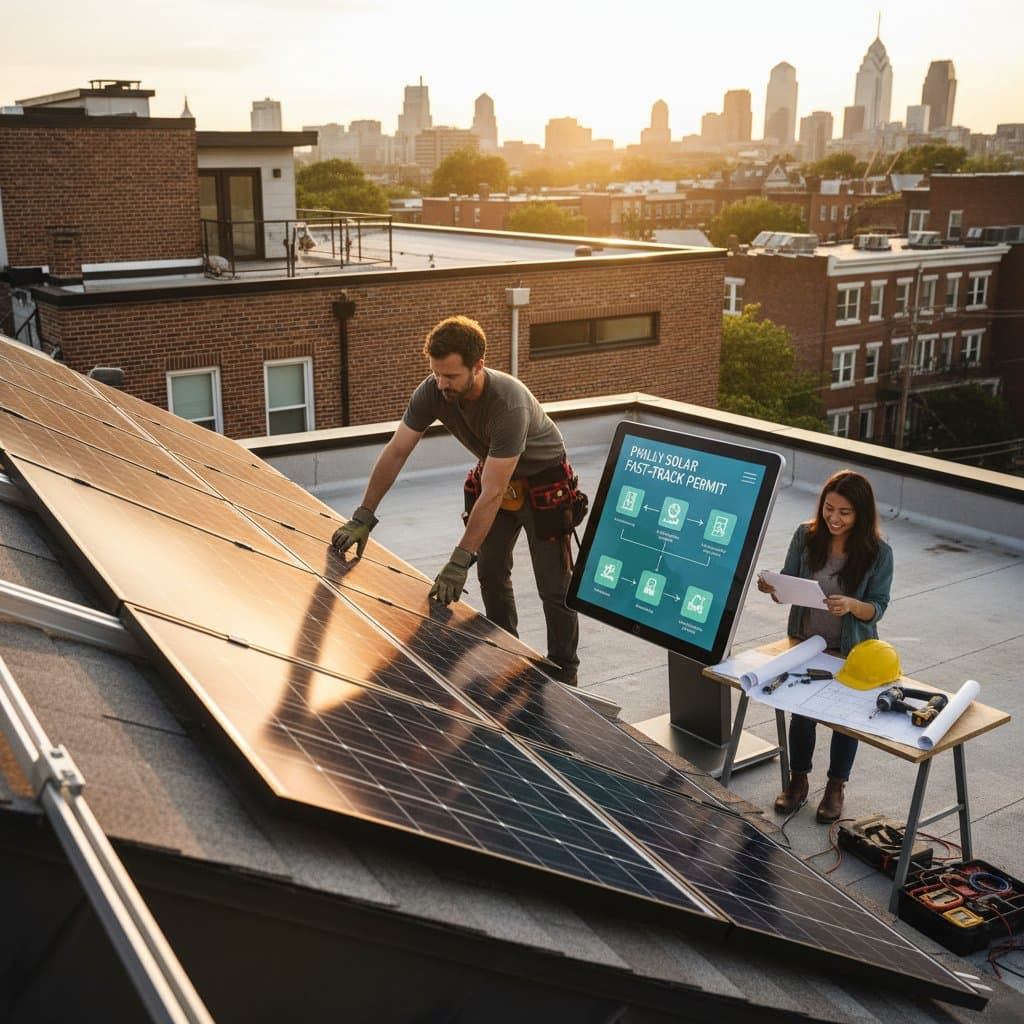
Save $5,000 on DIY Solar Installations with Philadelphia's Fast-Track Permit Process
Philadelphia homeowners often delay solar panel installations due to prolonged permit waits and intricate utility documentation. These barriers increase expenses and deter self-directed projects. The introduction of a fast-track permit program changes this dynamic, enabling qualified individuals to complete safe, legal installations at reduced costs. With thorough preparation and adherence to electrical safety protocols, participants can achieve savings of about five thousand dollars over conventional contractor-based approaches.
This resource details the mechanics of the streamlined permitting system, outlines necessary procedural steps, and identifies moments to consult a licensed electrician. It further addresses required inspections, code mandates, and documentation essentials prior to grid interconnection.
Understanding the Fast-Track Permit Pathway
The fast-track initiative targets straightforward residential solar setups within specified size limits. Eligibility hinges on designs that satisfy precise criteria:
- Roof-mounted arrays affixed directly to the surface without elevation.
- Employment of equipment and racking systems certified to withstand structural demands.
- Integration of inverters certified for grid-tied operations.
- Adherence to wiring practices outlined in NEC Article 690.
- Absence of significant structural alterations or roof reinforcements.
Designs meeting these standards allow submission of drawings and manufacturer data via the municipal online platform. Reviewers prioritize confirmation against established code templates. Consequently, numerous compact systems secure provisional approval in mere days, yielding savings on administrative charges and eliminating weeks of downtime.
To maximize efficiency, homeowners should prepare scaled diagrams illustrating panel layout, inverter placement, and wiring routes. Including photos of the existing roof and electrical panel aids reviewers in assessing compatibility. This proactive approach minimizes revision requests and accelerates the timeline.
Essential Safety and Code Compliance for DIY Solar Projects
Prioritizing electrical safety remains paramount in any installation. Homeowners must deactivate the main breaker and verify absence of voltage using a non-contact tester before handling wires. Compliance with NEC provisions for grounding and bonding proves essential. Select components exclusively listed for outdoor photovoltaic applications.
Critical safety protocols encompass:
- Selecting compatible connectors. Employ MC4 types from a single manufacturer to guarantee reliable, watertight connections.
- Applying correct torque to terminals. Inadequate tightness generates heat and fire risks; utilize a torque screwdriver calibrated to manual specifications.
- Affixing clear circuit labels. NEC mandates prominent identification at the service panel and disconnect points.
- Positioning accessible disconnects. Install both AC and DC variants within arm's reach, with explicit labeling.
- Preserving adequate clearances. Maintain a minimum three-foot zone in front of panels and disconnects.
Homeowners encountering unlabeled conductors, deteriorated terminals, or overloaded breakers must halt work immediately and engage a licensed electrician. Such issues signal potential code infractions or hazards beyond amateur resolution. Professional assessment ensures systemic integrity without compromising the fast-track benefits.
Beyond electrical concerns, roof safety demands attention. Secure ladders to stable bases and don personal protective equipment, including harnesses for elevated tasks. Inspect shingles for integrity to prevent leaks during mounting. These measures safeguard against falls and weather-related damage, aligning with broader code expectations.
Comprehensive Tools and Materials Inventory
A successful DIY solar endeavor requires specialized implements for precision and security:
- Torque screwdriver for secure fastenings.
- Non-contact voltage tester for hazard detection.
- Digital multimeter for circuit verification.
- Conduit bender for neat pathway formation.
- Height-appropriate rated ladder.
- Fall arrest harness with anchorage points.
- Sealing flashing kits for roof entries.
- Certified wire connectors and strain relief hardware.
Steer clear of domestic extension leads or incompatible fittings. Route all conductors through sunlight- and heat-resistant conduit or raceway to endure environmental stresses. Stocking extras of consumables like sealants and labels prevents mid-project interruptions.
Organizing a dedicated workspace streamlines assembly. Pre-cut wires to measured lengths and test connections on the ground before rooftop elevation. This methodical preparation enhances accuracy and reduces error likelihood.
Anticipating and Resolving Common Inspection Pitfalls
Municipal inspectors frequently identify recurring deficiencies. Proactive remediation prior to appointment scheduling enhances pass rates:
- Omitted or erroneous labeling on disconnects.
- Undersized conductors linking inverter to breaker.
- Insufficient roof mount anchoring against wind loads.
- Lack of equipment certification evidence or datasheets.
- Inadequate sealing around conduit entries.
Retain hard copies of listings, torque logs, and installation schematics. Present these in a binder for inspector convenience. A meticulously arranged site with visible compliance markers typically clears initial scrutiny, avoiding rescheduling fees.
To further prepare, conduct a self-audit using a checklist derived from NEC guidelines. Verify grounding continuity with the multimeter and simulate inspector walkthroughs. Addressing oversights in advance fortifies the installation against scrutiny.
How the Fast-Track Initiative Boosts Solar Integration in Philadelphia
City administrators crafted the fast-track framework to foster secure, standards-aligned solar expansion. Eliminating redundant documentation for routine setups accelerates uptake while upholding rigorous safety benchmarks. This balance democratizes access for those inclined toward personal involvement.
Solar advocacy groups in the region report that permitting simplifications slash indirect expenses by as much as thirty percent. These reductions benefit not only self-installers but also modest-scale professionals leveraging template designs. The policy evolution thus broadens participation across installation spectra.
Moreover, the program bolsters grid stability. Standardized evaluations confirm adherence to grounding, bonding, and isolation norms. This uniformity curtails inspection revisions and elevates collective safety profiles.
By streamlining administrative layers, Philadelphia positions itself as a leader in residential renewable adoption. Homeowners gain empowerment to contribute to sustainability goals without prohibitive barriers.
Actionable Steps to Launch Your DIY Solar Project
Prospective DIY solar adopters under the fast-track guidelines should commence with a roof evaluation for load-bearing capacity and orientation. Assess electrical panel amperage to confirm interconnection feasibility. Compile documentation from equipment producers attesting to listings.
Delve into NEC Articles 690 and 705 for foundational insights on grounding and grid ties. Sketch preliminary designs incorporating local incentives or rebates to optimize returns.
Recognize boundaries: elevated work, energized systems, and waterproofing demand vigilance. Engage professionals for complexities exceeding personal expertise. Through diligent preparation, requisite implements, and code reverence, Philadelphia's fast-track provisions render solar viable and economical for residents poised to harness sunlight for home energy needs.