
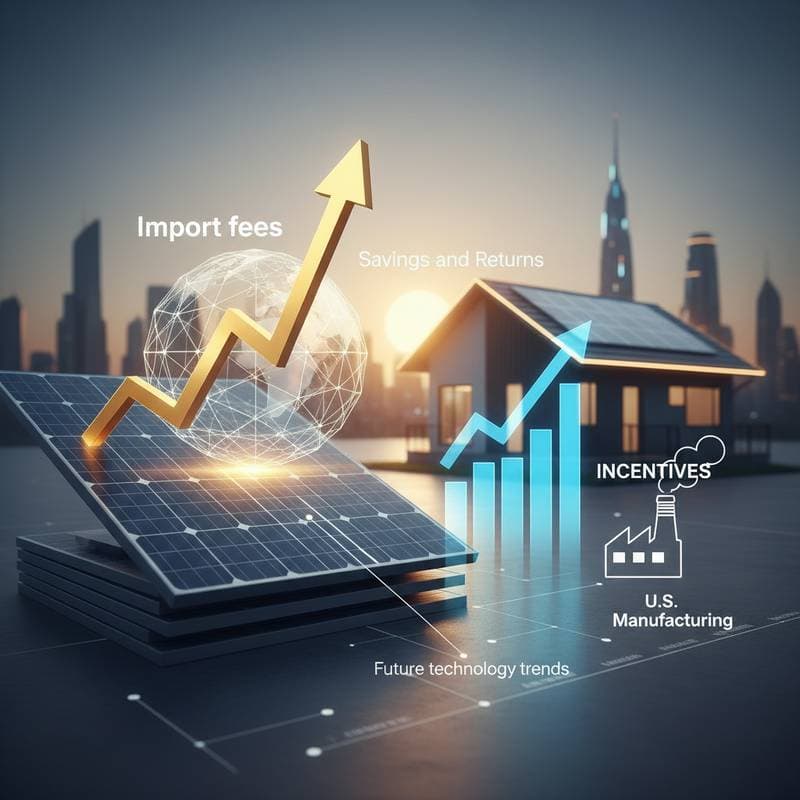
What 2026 Tariffs Mean for Solar Panel Prices
Homeowners frequently express concern that new tariffs will render solar panels prohibitively expensive. The reality proves more nuanced. Tariffs increase import costs, but they also stimulate domestic production and innovation. The effects on homeowners hinge on market adaptations, equipment sourcing by installers, and the mitigating role of incentives.
This guide examines the implications of the 2026 tariffs for solar panel prices, their influence on installation costs, and practical steps for homeowners to navigate these changes effectively.
How Import Fees Translate to System Costs
Understanding the impact of tariffs on overall system prices requires a straightforward numerical breakdown.
Consider a standard residential solar system with a 7-kilowatt capacity. Panels typically account for 40 to 50 percent of the total system expense. For a system priced at $18,000 prior to incentives, the panel portion approximates $8,000.
A 15 percent tariff-induced increase in panel prices adds approximately $1,200 to the system cost, resulting in a new total of about $19,200 before any credits or rebates. The federal tax credit applies as a percentage of the installed cost, providing relief on the elevated amount. After incentives, the net increase for the homeowner might amount to roughly $850.
Expected Market Reactions
The solar industry responds dynamically to tariff announcements. Installers and distributors adjust by diversifying sourcing, stockpiling inventory, or renegotiating contracts with suppliers.
In the immediate aftermath, panel prices may rise as businesses expedite imports ahead of the tariff implementation. As the market stabilizes, prices tend to level out, although they seldom revert fully to prior benchmarks.
Longer-term, expanded domestic manufacturing facilities decrease dependence on imports. These developments foster price stability and reduce delivery delays. The pace of facility scaling and the competitiveness of local products, measured in cost per watt, determine the extent of these benefits.
How Tariffs Could Influence Panel Technology
Tariffs apply variably across product categories. High-efficiency modules, bifacial designs, and thin-film variants may encounter distinct regulations. Elevated costs on specific imports prompt shifts in research toward locally producible alternatives.
For instance, if tariffs inflate the price of imported monocrystalline panels, U.S. producers may prioritize advancements in polycrystalline or hybrid technologies using domestic materials. Such innovations could introduce new panel options to the market within a couple of years, providing homeowners with performant choices at competitive prices.
The Role of Incentives in Balancing Costs
Federal and state incentives serve as significant offsets to tariff effects. The federal investment tax credit reduces upfront costs by approximately 30 percent. States like Pennsylvania provide supplementary rebates or performance incentives.
For a 7-kilowatt system at $19,200 before incentives, the federal credit yields a reduction of about $5,760. Eligible homeowners might receive additional state rebates, such as $300 per kilowatt, bringing the net cost down to around $12,500.
These measures ensure that tariff-related increases do not overwhelm affordability. Incentives preserve robust returns on investment for solar adopters.
Payback and Savings Outlook
Payback periods for solar systems depend on installation costs, local electricity rates, and annual energy output. In Philadelphia, a 7-kilowatt system generates approximately 9,100 kilowatt-hours yearly, based on 1,300 kilowatt-hours per kilowatt installed.
With utility rates averaging 18 cents per kilowatt-hour, the system offsets roughly $1,640 in annual electricity expenses. At a net cost of $12,500, the payback period spans about 7.6 years. A $1,000 tariff-driven cost increase extends this by merely six months.
This analysis demonstrates that tariffs marginally affect upfront expenses, yet the enduring financial advantages of solar persist. Post-payback, homeowners enjoy decades of substantial electricity savings.
Domestic Manufacturing Potential
Experts anticipate that tariff policies will spur investments in U.S. solar manufacturing. Establishing new plants demands time and resources, but operational facilities offer panels with lower transportation expenses and expedited delivery.
Domestic production enhances quality control and streamlines warranty processes. Local suppliers provide superior support, enabling installers to ensure dependable system performance.
As multiple factories activate, inter-manufacturer competition may drive prices downward over time. The trajectory typically involves initial cost elevations followed by a resilient supply chain.
How Installers Are Preparing
Solar installers proactively refine their procurement approaches. Many cultivate relationships with both international and U.S. suppliers to broaden options. Others secure long-term panel agreements to lock in pre-tariff rates.
Installers also integrate components like microinverters or power optimizers, which enhance energy yield and counteract panel cost rises. Greater efficiency per watt maximizes system value despite modest price adjustments.
These preparations benefit homeowners by sustaining project affordability and schedule reliability.
Planning a Purchase Before or After Tariffs
Homeowners debate whether to proceed with installation prior to tariff enactment or await market equilibrium. The optimal choice aligns with personal circumstances.
For those with suitable roofs and long-term residency plans, early installation secures current incentives and sidesteps interim price surges. Individuals requiring time for roof maintenance or financing arrangements may find delays inconsequential, particularly if domestic output stabilizes costs subsequently.
Obtaining quotes promptly establishes a reference point. Installers frequently guarantee pricing for a defined duration, affording decision-making flexibility.
Maintenance and Long-Term Care After Installation
Tariffs exert no influence on system functionality or upkeep requirements. Installed panels deliver consistent energy production for decades with routine maintenance.
Essential tasks encompass occasional cleaning, inspections for obstructions or shading, and output monitoring via apps or inverter interfaces. Tracking performance patterns facilitates early issue identification.
Standard warranties protect equipment for 25 years, with production warranties guaranteeing no more than 0.5 percent annual degradation. After 20 years, panels retain about 90 percent of initial capacity. Shifts in manufacturing origins do not alter the technology's inherent durability.
Next Steps for Homeowners
- Request multiple quotes. Evaluate proposals from installers offering domestic and imported panels.
- Inquire about sourcing strategies. Determine each firm's approach to tariff adjustments.
- Verify incentive eligibility. Ensure alignment with federal and state credit deadlines based on installation timing.
- Assess local energy rates. Elevated utility costs amplify solar's financial appeal amid equipment price changes.
- Explore system enhancements. Options like battery storage or advanced inverters bolster energy independence and value.
Strategic timing, combined with incentives, upholds solar's profitability amid evolving tariffs.
FAQ
Will tariffs make solar panels unaffordable? No. Modest price elevations occur, but incentives and expanding domestic production mitigate impacts. Solar's overall value endures.
Should I install solar before the tariffs take effect? If prepared, pre-tariff installation avoids potential short-term hikes. Early quotes provide planning leeway.
How much could tariffs increase panel costs? Projections indicate 10 to 20 percent panel price rises, equating to 5 to 8 percent system cost increases. Incentives absorb a substantial portion.
Will domestic panels be as efficient as imported ones? U.S. manufacturers produce high-efficiency modules, with performance gaps diminishing through technological progress.
Can tariffs cause equipment shortages? Initial disruptions may arise from import hesitations, but domestic growth and varied sourcing restore supply equilibrium.
Will my solar savings drop if prices rise? Upfront cost extensions delay payback by months, yet energy output and lifetime savings remain unchanged.
Are commercial projects affected differently? Yes, larger projects experience amplified effects due to higher equipment proportions in total costs. Residential installations prove more resilient.