
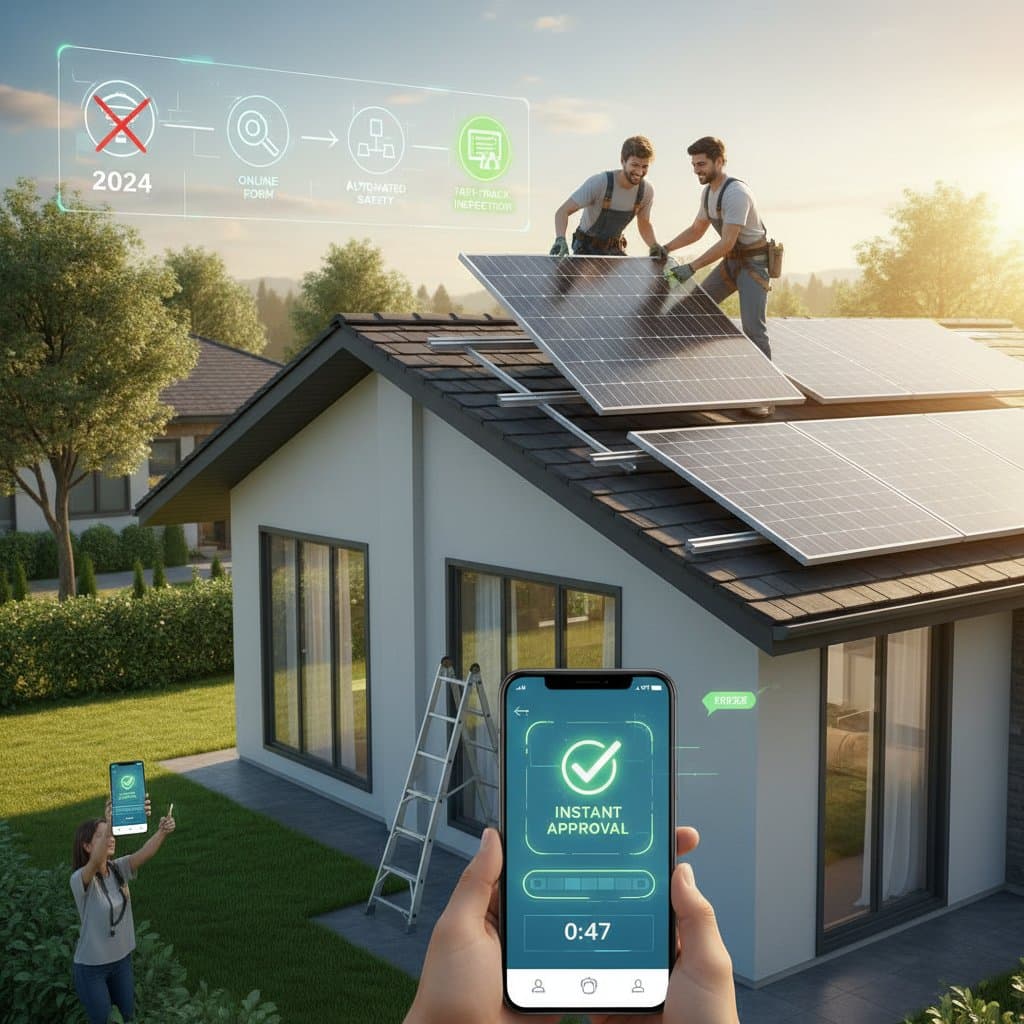
Fast-Track DIY Solar Permits: 2025 Rules Reduce Wait Times
Solar projects often present challenges for homeowners, from selecting designs and equipment to navigating local approvals. Lengthy permit processes have historically deterred many from proceeding. The 2025 fast-track rules address this barrier directly. They streamline paperwork, eliminate redundant inspections, and accelerate approvals for do-it-yourself solar installations. The objective remains straightforward: facilitate dependable solar setups that activate quickly and efficiently.
These reforms form part of a broader national initiative to update solar permitting practices. The focus targets homeowners installing modest rooftop systems independently, without engaging full-service contractors. The modifications prove substantive rather than superficial. They eliminate redundant procedures, incorporate validated templates, and enable inspectors to prioritize substantive quality assessments over administrative duties. Consequently, the journey from initial submission to operational panels shortens considerably.
Reasons for Past Delays in Solar Permitting
Conventional solar permitting required coordination across several municipal departments, including electrical, structural, and zoning offices. Each entity examined identical drawings, leading to repeated reviews if revisions arose. Even straightforward rooftop installations endured weeks of delays. For independent installers, such postponements disrupted financial benefits and project enthusiasm.
Jurisdictions maintained distinct forms and criteria, exacerbating the issue. Certain areas demanded professional engineer seals for minor setups. Others insisted on elaborate load analyses disproportionate to typical residential roofs. This variability bred uncertainty and necessitated extensive revisions. Homeowners intent on compliance frequently allocated more effort to documentation than to the physical assembly.
Key Changes Introduced by Fast-Track Rules
The fast-track framework establishes a centralized online submission process with built-in automated validations. Systems adhering to predefined residential scale limits and featuring certified components receive immediate preliminary approval. Homeowners submit a basic diagram illustrating panel positions, inverter placement, and wiring routes. The system cross-references these against embedded compliance templates to confirm adherence to codes.
Following approval, a temporary permit issues promptly. Installation precedes a solitary on-site verification to ensure alignment between the submitted design and executed work. This method supplants multiple iterative manual evaluations. For typical DIY configurations below ten kilowatts, the entire approval sequence concludes in hours rather than weeks.
Principal enhancements encompass:
- Standardized electronic forms that supplant physical documents
- Automated verifications of equipment certifications for safety
- Streamlined assessments of electrical loads for prevalent roof configurations
- Digital handling of fees and real-time status monitoring
- Consolidated final inspection in lieu of repeated visits
Operations of the Fast-Track Submission Portal
Consider a Philadelphia resident planning a 6.5-kilowatt rooftop array. In this locale, annual energy yield averages 1,250 kilowatt-hours per kilowatt installed, yielding approximately 8,100 kilowatt-hours yearly for the system. At a utility rate of 18 cents per kilowatt-hour, this production equates to 1,458 dollars in annual value. Prior to fast-track implementation, a three-week permit delay forfeited roughly 84 dollars in forgone energy credits.
With the updated procedure, the individual accesses the portal, chooses an appropriate system archetype, and attaches roof imagery. The interface evaluates panel orientation, directional alignment, and clearance margins relative to regulatory standards. It ascertains compatibility of selected inverters and panels with established national safety certifications. Upon validation, approval grants on the same day. The user then arranges weekend installation and books the concluding inspection digitally. The evaluator ascertains fidelity to the blueprint, granting operational clearance via utility integration.
Advantages for Independent Solar Installers
Individuals inclined toward self-directed endeavors gain tangible benefits from these efficiencies. Expedited timelines mitigate installation weariness. The framework promotes sound planning, as templates exclusively accommodate configurations satisfying electrical and fire safety mandates. It further diminishes ancillary expenses by obviating needs for bespoke engineering consultations and bureaucratic overheads.
A compact setup previously necessitating a 2,000-dollar expert design appraisal now advances via complimentary algorithmic reviews. Redirected funds support premium-efficiency modules or enhanced performance trackers. Accelerated permissions also optimize capture of optimal seasonal irradiance. Delays spanning initial months could otherwise extend return-on-investment periods by almost twelve months.
Cost Breakdown and Return Analysis
Examine a 7-kilowatt independent system assembled with intermediate-grade elements at 1.60 dollars per watt. Equipment expenses total 11,200 dollars. Incorporate 500 dollars for mounting hardware and cabling, alongside 250 dollars for permitting. The aggregate outlay reaches 11,950 dollars. Assuming 9,100 kilowatt-hours of yearly generation and an 18-cent blended electricity tariff, annual offsets amount to 1,638 dollars.
Compute payback by dividing total investment by yearly gains: 11,950 divided by 1,638 yields approximately 7.3 years. Application of a 30-percent federal tax incentive reduces the net cost to 8,365 dollars, compressing payback to about 5.1 years. Prompt permitting initiates these financial returns shortly post-completion.
Coordination with Local Inspectors and Utilities
Philadelphia and similar municipalities adopting this approach retain a single physical inspection. Evaluators concentrate on essentials such as grounding integrity, labeling accuracy, and circuit breaker adequacy. Pre-validated designs expedite the process. Utilities obtain electronic affirmations via the portal, prompting meter recalibrations and grid-tie permissions. This integration averts protracted post-installation waits for ultimate endorsements.
Adherence to prevailing electrical standards remains obligatory. The portal streamlines record-keeping and procedural order, empowering capable independent builders to proceed methodically without compromising protocols.
Selecting Durable Equipment and Warranties
Expedited approvals underscore the necessity of robust components. Opt for photovoltaic modules backed by at least 25-year performance guarantees and inverters warrantied for 10 to 15 years. The portal catalogs approved variants to inform choices. Selection from verified inventories assures regulatory alignment and circumvents inspection hurdles.
Integration of monitoring solutions simplifies oversight. Numerous inverters incorporate native telemetry viewable via smartphone applications. These interfaces log output metrics daily, facilitating confirmation of anticipated efficacy.
Managing System Lifecycle and Recycling
Solar arrays endure finite operational spans. Over decades, modules degrade at roughly 0.5 percent annually. Contemporary recycling initiatives process silicon-based panels, reclaiming glass, aluminum casings, and precious metals. During permit registration, reference an end-of-life disposal strategy. Such foresight may evolve into mandatory stipulations and underscores ecological stewardship.
Practical Steps to Launch Your Project
Homeowners preparing to initiate should assemble key preliminaries.
- Assess roof condition and integrity; reinforce or replace as needed prior to panel mounting.
- Consult local utility guidelines for grid interconnection.
- Compile precise dimensional data and shading profiles for the roof.
- Experiment with configurations within the fast-track interface.
- Retain electronic records of sanctioned designs and verification outcomes.
Post-installation, perform biannual cleanings with deionized water and non-abrasive tools. Monitor production on a monthly basis. Investigate causes if yields fall below 90 percent of projections, checking for accumulations, obstructions, or converter malfunctions. Consistent maintenance sustains reliability and safeguards enduring economic gains.
Frequently Asked Questions
Who qualifies for fast-track solar permits?
Homeowners constructing compact rooftop arrays below designated capacity caps with approved parts meet eligibility. Thresholds differ by municipality.
Can independent systems interconnect with the grid?
Yes. Utilities confirm eligibility via the portal upon successful final evaluation.
Is a licensed engineer required?
No, for routine residential layouts matching template parameters. Intricate structural demands might necessitate professional input.
What is the duration of the updated permit procedure?
Approvals typically finalize within one day, assuming complete and accurate submissions.