
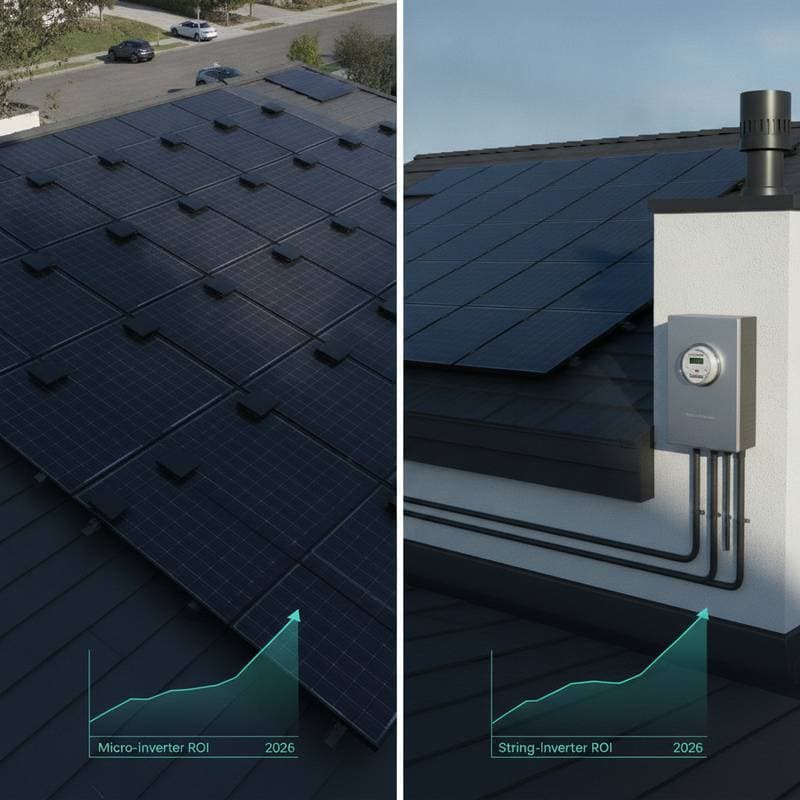
Comparing Inverter Options for Home Solar Systems
Selecting the right inverter technology shapes the financial return on a residential solar installation. Microinverters and string inverters each carry distinct cost structures, output behaviors, and maintenance profiles that influence how quickly the system recovers its initial investment.
Homeowners evaluating options for 2026 installations benefit from examining real performance differences rather than marketing claims. The following sections break down the variables that determine payback speed.
Upfront Costs and Installation Factors
Microinverters attach to each panel and require more hardware per unit. This raises equipment expenses by 15 to 25 percent compared with a single string inverter sized for the full array.
String inverters mount in one location and connect multiple panels in series. Installation labor stays lower because fewer components need mounting and wiring.
Labor savings with string inverters can offset 8 to 12 percent of the total project cost on arrays under 8 kilowatts. Larger roofs may narrow that gap when additional string inverters become necessary.
Energy Production Under Real Conditions
Microinverters allow each panel to operate independently. Partial shade on one module does not reduce output from the remaining panels.
String inverters limit the entire string to the current of the weakest panel. Even brief shading from trees or chimneys can cut daily yield by 10 to 30 percent on affected strings.
In regions with frequent morning or evening shade, microinverters often deliver 5 to 12 percent more annual kilowatt hours. That added production shortens payback when electricity rates exceed 18 cents per kilowatt hour.
Reliability, Maintenance, and Warranties
String inverters typically carry 10 to 12 year warranties and sit at ground level for easy replacement. Failure of the central unit stops production from the entire array until service occurs.
Microinverters usually receive 20 to 25 year warranties. Individual unit failure affects only one panel, and replacement involves roof access.
Replacement costs for a failed microinverter average 180 to 250 dollars plus labor. Over 25 years, the probability of at least one replacement rises, yet the impact on total output remains limited.
Payback Timeline Calculations for 2026
Assume a 7 kilowatt system in a location with 1,300 kilowatt hours per kilowatt of annual production and net metering at 20 cents per kilowatt hour.
A string inverter system priced at 2.40 dollars per watt reaches payback in 7.8 years after incentives. The same array with microinverters at 2.85 dollars per watt reaches payback in 8.9 years.
When shading reduces string output by 9 percent annually, the microinverter system recovers its higher cost in 8.1 years while the string system extends to 8.6 years.
Future Expansion and Monitoring Needs
Homeowners who plan to add panels later gain flexibility with microinverters. New modules operate at their own maximum power point without string length constraints.
String systems require careful matching of new panels to existing voltage windows or the addition of a second inverter.
Monitoring granularity also differs. Microinverter platforms report output per panel, which speeds diagnosis of underperforming modules. String platforms report combined output, requiring additional tools to isolate issues.
Selecting the Faster Payoff Path
Properties with minimal shading and simple roof geometry favor string inverters for quicker cost recovery. Homes with complex rooflines, nearby trees, or plans for future expansion lean toward microinverters when annual production gains outweigh the added upfront expense.
Review local utility rates, shading patterns, and long term ownership plans before final selection. Accurate site data produces the clearest projection of which technology returns its investment first.