
2026 ROI Breakdown: Micro Inverters Versus String Inverters
Many homeowners in Philadelphia explore solar energy to reduce electric bills and achieve independence from rising utility rates. One frequent point of confusion involves the choice between micro inverters and string inverters. Both devices convert direct current from solar panels into alternating current for household use. They differ in design, performance, and long term return on investment.
Understanding these distinctions supports a confident decision that aligns with roof conditions, budget constraints, and energy objectives.
Importance of Inverter Selection
Inverters function as the control center of any solar installation. They influence total power production, ease of performance tracking, and required maintenance across the system lifespan. An unsuitable inverter configuration can reduce annual energy yield by several percent. Such losses accumulate over two decades of operation.
Inverters represent 10 to 15 percent of overall system expense. Their efficiency therefore affects both payback period and cumulative return.
Operational Principles of Each Option
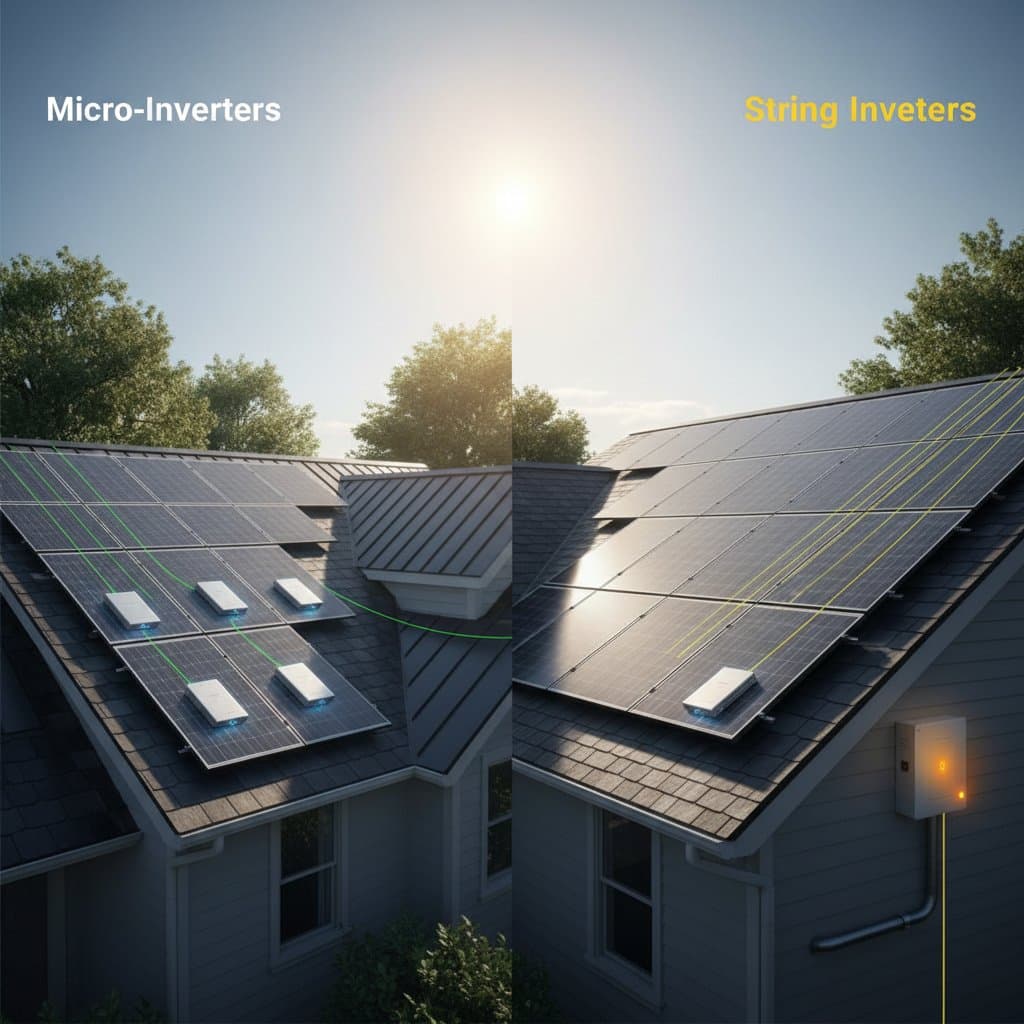
String inverters link multiple panels in a single series circuit. Power flows through one pathway, so reduced output from any panel due to shade, debris, or wear lowers production for the entire string. This approach suits wide, unshaded roofs that receive uniform sunlight.
Micro inverters connect to individual panels. Each unit converts power separately, allowing unaffected panels to maintain full output. This arrangement benefits roofs with partial shade or irregular shapes. It also simplifies future additions of panels.
Energy Production Comparison
Consider a 7 kilowatt system that generates 1,300 kilowatt hours per kilowatt annually, for a total near 9,100 kilowatt hours. At an average rate of 24 cents per kilowatt hour, annual savings reach approximately 2,180 dollars. Shading that cuts production by 10 percent causes a string inverter system to lose roughly 910 kilowatt hours, or 218 dollars, each year.
Micro inverters recover most of that energy and increase overall output by 5 to 8 percent. Over ten years the added value equals 1,500 to 1,700 dollars before maintenance considerations.
Upfront Costs and Payback Periods
A string inverter installation for a typical residence costs about 2.60 dollars per watt. Micro inverters raise the price to approximately 2.75 dollars per watt. On a 7 kilowatt system the difference totals roughly 1,050 dollars at the outset.
Unshaded roofs with simple layouts allow string inverters to achieve payback in 8 or 9 years. Micro inverter systems reach similar payback when higher yields and reduced service needs are included. Shaded or complex roofs favor micro inverters because they prevent losses that string inverters cannot avoid.
Service Requirements and Durability
String inverters mount in garages or basements for straightforward replacement, yet they encounter heat and dust. Warranties usually cover 10 years with optional extensions. Micro inverters mount behind each panel and carry 20 to 25 year warranties that align with panel lifespans. Failure of one unit affects only its panel.
Distributed operation reduces heat concentration in micro inverters. String inverters process all current through a single device and experience faster wear during peak production.
Performance Tracking and System Expansion
Micro inverters supply panel level monitoring that reveals the output of each unit. Homeowners can detect shade, dirt, or damage without delay. String inverters deliver system level data that offers less granularity.
Expansion or battery integration proves simpler with micro inverters. New panels operate independently, whereas string systems may require additional wiring or equipment.
Philadelphia Specific Considerations
Local incentives and net metering credits improve the economics of both inverter types. Homes with trees or multiple roof planes typically gain more from micro inverters. Properties with clear southern exposure maximize returns through lower cost string inverters.
Assessing Roof Conditions and Budget
- Collect 12 months of utility statements to establish average consumption.
- Request a professional shade analysis to identify periods of full sunlight.
- Obtain installer models that compare both inverter types under identical production estimates.
- Confirm eligibility for state and local rebates prior to contract signing.
- Schedule annual panel cleaning and monthly output reviews to address problems promptly.
Matching inverter type to specific site conditions produces reliable savings and supports grid stability over the full system life.