
Microinverters Versus String Inverters: A 2026 Performance Analysis
Homeowners in Philadelphia who consider solar installations often encounter uncertainty regarding inverters. Solar panels receive much attention, yet inverters play a crucial role in transforming sunlight into practical electricity for the home. Residential solar setups primarily feature two inverter varieties: microinverters and string inverters. Both convert direct current from panels into alternating current suitable for household appliances, but they vary in expenses, efficiency, and enduring financial benefits.
The Importance of Selecting the Appropriate Inverter
An inverter influences both energy production and system dependability. Even a well-designed solar array risks losing substantial annual kilowatt-hours due to shading or panel mismatches that diminish output. Philadelphia's urban landscape, with its row houses, mature trees, and diverse roof orientations, underscores the value of choosing an inverter that maintains consistent performance and delivers reliable cost reductions.
Operational Principles of Each Inverter Type
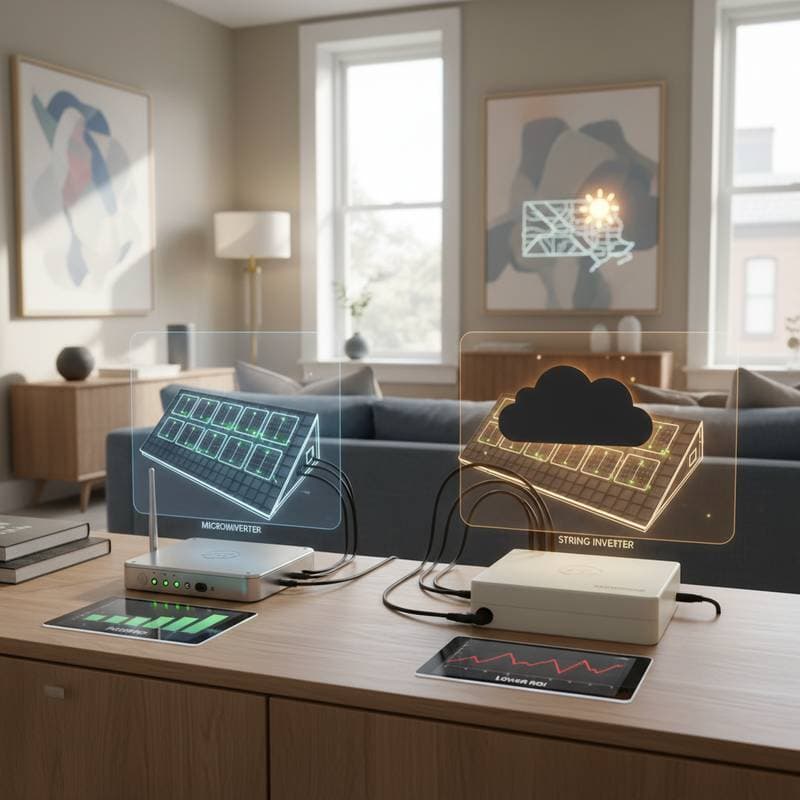
String inverters link several panels together in a series. Electricity passes through a single central unit, typically positioned close to the electrical service panel. This configuration offers straightforward design and lower initial expenses. However, if shading affects one panel or if performance varies, the output from the entire string decreases accordingly.
Microinverters attach directly beneath individual panels. Each unit processes power conversion separately, which prevents issues in one area from impacting others. For instance, a panel obscured by a chimney or experiencing intermittent shade operates independently, allowing adjacent panels to maintain optimal production levels.
Evaluating Costs and Return on Investment
Consider a standard 7-kilowatt solar system for a Philadelphia residence, which generates approximately 9,100 kilowatt-hours annually. With local utility rates averaging 24 cents per kilowatt-hour, this setup offsets about 2,180 dollars in yearly electricity expenses.
A string inverter installation for such a system totals around 13,000 dollars prior to any rebates or tax credits. In contrast, a microinverter configuration may cost 14,500 dollars. The additional investment frequently recoups through increased energy harvest, as microinverters improve yield by 5 to 10 percent under fluctuating conditions like partial cloud cover or urban shadows. Across a decade, this enhancement equates to 455 to 910 extra kilowatt-hours per year, yielding over 1,000 dollars in additional savings.
String inverters generally require a single replacement after roughly ten years of service. Microinverters, however, come with extended warranties that align with panel lifespans, often 25 years, thereby minimizing long-term upkeep expenses.
Factoring in federal incentives, state rebates, and steady utility pricing, payback periods for both options range from seven to nine years, influenced by site-specific elements such as roof pitch and obstruction levels. In scenarios with notable shading or multi-directional panel arrays, microinverters accelerate this timeline by ensuring more consistent energy capture.
Aspects of Installation, Monitoring, and Upkeep
String inverters streamline the installation process due to their consolidated components. Microinverters demand greater effort, as technicians must secure a unit per panel. Post-installation, however, microinverter systems provide granular monitoring capabilities, displaying real-time data for each panel to pinpoint variations in production swiftly.
Upkeep requirements also diverge. Accessing a string inverter proves simpler, but any malfunction halts the entire system's operation until repairs occur. With microinverters, a defective unit impacts solely its associated panel, preserving overall functionality during troubleshooting.
Determining the Ideal Option for Your Residence
For roofs that receive uniform sunlight exposure and support uniformly oriented panels, string inverters deliver excellent cost-effectiveness. Properties featuring intricate rooflines, such as gables, skylights, or areas prone to tree shadows throughout the year, benefit substantially from microinverters. The higher initial outlay translates into expedited returns and more predictable energy generation.
Practical Steps to Proceed
Gather your utility statements from the past year to establish baseline consumption. Consult certified installers for quotes on both inverter types, specifying identical system capacities and projected outputs. Verify warranty durations and associated replacement fees. Evaluate monitoring platforms, as accessible performance metrics enable proactive adjustments and build confidence in your investment.
Unique property characteristics ultimately guide the optimal selection. By obtaining precise projections and prioritizing thoughtful system planning, homeowners secure substantial financial advantages and reliable access to renewable energy.
Frequently Asked Questions
What function does an inverter serve?
It transforms direct currentpanels into alternating current compatible with standard home electrical systems.
Do microinverters require regular maintenance?
They demand minimal attention. Units feature sealed designs and integrate digital oversight for early issue detection.
Is it possible to combine microinverters and string inverters?
Certain advanced setups incorporate both, though most installations adhere to a single type for operational ease.
What is the typical lifespan of a string inverter?
These units endure approximately ten to twelve years prior to needing replacement.
Do microinverters manage shading more effectively?
Yes, their per-panel operation ensures that shading on one element does not compromise the system's total output.
How do warranties compare between the two?
String inverters usually offer shorter terms, while microinverters provide coverage that parallels the longevity of the solar panels.