
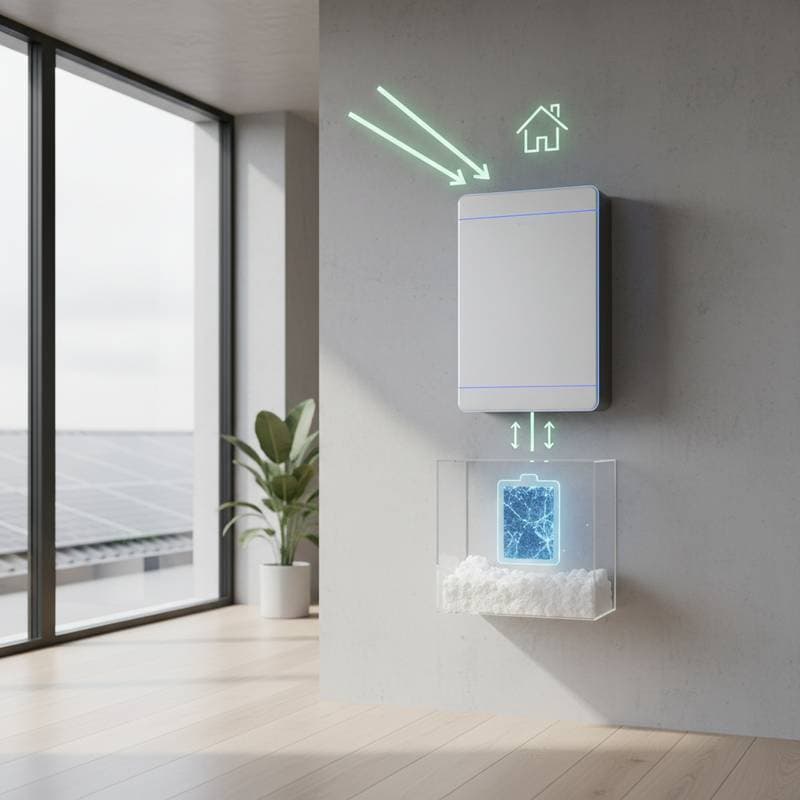
Sodium-Ion Batteries: A More Affordable Route to Solar Energy Storage
Homeowners venturing into solar power often face a key challenge: storing generated energy without excessive expense. Lithium-ion batteries lead the residential sector, yet their costs and material dependencies have fueled exploration of alternatives. Sodium-ion batteries emerge as a viable, budget-friendly solution for solar storage, offering dependable operation alongside reduced supply vulnerabilities.
The Case for Sodium Over Lithium
Lithium delivers high efficiency, but its reliance on intricate mining and international supply networks poses limitations. Sodium ranks among Earth's most plentiful elements, extractable from everyday salts in seawater and subterranean reserves. This abundance lowers material expenses and mitigates supply disruptions.
For homeowners, such accessibility translates to greater price consistency. Sodium-ion systems can decrease battery pack prices by 20 to 40 percent relative to lithium-ion equivalents. Moreover, the technology avoids cobalt and nickel, materials linked to ethical dilemmas and ecological impacts.
Although sodium-ion batteries currently lag in energy density, advancements are closing the divide rapidly. In stationary applications like solar storage, where space constraints play a minor role, cost per kilowatt-hour takes precedence over density. Homeowners prioritize economical storage and retrieval of power.
The Mechanics of Sodium-Ion Batteries
Sodium-ion batteries operate on principles akin to lithium-ion designs. Upon charging, sodium ions shuttle from the cathode to the anode via a liquid electrolyte. Discharge reverses this flow, generating electricity.
These cells employ layered metal oxides or polyanionic compounds in the cathode and hard carbon in the anode, substituting for lithium variants. The sodium ions' greater size yields marginally lower voltage yet bolsters thermal resilience. Consequently, the batteries resist overheating and degradation during demanding conditions.
This thermal advantage proves essential for home installations. Sodium-ion units function securely over broader temperature ranges than lithium-ion batteries, which demand advanced cooling mechanisms. Such robustness streamlines setup and curtails ongoing maintenance demands.
Performance and Cost Breakdown
Consider a typical 7-kilowatt solar array in a Philadelphia-area location with ample sunlight. Each kilowatt produces approximately 1,300 kilowatt-hours annually, yielding about 9,100 kilowatt-hours total.
A 10-kilowatt-hour battery captures a day's solar yield. An installed lithium-ion system of this size might total $9,000. As manufacturing scales, a sodium-ion counterpart could approach $6,000.
Suppose the household consumes 30 kilowatt-hours daily at 18 cents per kilowatt-hour. Storage enables evening use of solar power, displacing roughly 5,000 kilowatt-hours from the grid each year and saving $900.
Under these conditions, the lithium-ion setup achieves payback in about 10 years, whereas the sodium-ion version shortens to 7 years. These calculations underscore the impact of reduced costs. Faster returns encourage broader adoption of storage solutions.
Environmental and Supply Chain Benefits
Sodium-ion batteries incorporate plentiful elements that facilitate recycling. Production sidesteps rare mineral extraction and intensive processing, shrinking the manufacturing carbon footprint and securing future availability.
Widespread sodium resources support domestic production, cutting transport expenses and enhancing energy self-reliance. This development supports initiatives for localized clean energy networks.
Recycling processes for sodium-ion designs recover active materials more straightforwardly, potentially decreasing disposal costs. These attributes pave the way for widespread implementation.
Seamless Integration into Solar Systems
Installation of sodium-ion batteries parallels lithium-ion procedures, utilizing identical inverters, charge controllers, and monitoring tools. Differences reside in the internal cell composition, not external connections or interfaces.
Emerging sodium-ion models feature modular designs for scalable stacking. Homeowners can increment capacity incrementally, accommodating future additions like electric vehicles or heat pumps without overhauling the setup.
Maintenance and Durability Considerations
Sodium-ion batteries exhibit gradual capacity fade across cycles. Lithium-ion packs typically hold 80 percent capacity after 4,000 cycles; sodium-ion prototypes match or exceed this threshold. The design also withstands deep discharges with minimal degradation, optimizing energy utilization.
Maintenance remains straightforward. Ensure the enclosure stays dry, provide adequate ventilation, and track output via app or inverter interfaces. Capacity declines often resolve through software updates or targeted module replacements, avoiding complete overhauls.
Practical Guidance for Homeowners
Begin with a professional site assessment to gauge storage needs based on roof alignment, consumption patterns, and utility tariffs. Inquire about sodium-ion availability or hybrid configurations blending battery types.
As commercialization advances, sodium-ion options will integrate into mainstream offerings. Select certified providers and review warranty details for assurance. Proper configuration and oversight ensure enduring reliability and cost efficiency in solar storage.
Frequently Asked Questions
Are sodium-ion batteries suitable for home use?
Yes, their inherent stability minimizes overheating risks, rendering them highly secure for residential applications.
What is the expected lifespan of sodium-ion batteries?
Initial versions suggest longevity comparable to lithium-ion, spanning thousands of charge cycles.
Can sodium-ion batteries substitute for lithium-ion in current solar installations?
Often, yes; they pair with conventional inverters and controllers, pending installer verification.
How do sodium-ion batteries fare in cold weather?
They outperform lithium-ion in low temperatures, preserving capacity during colder months.