
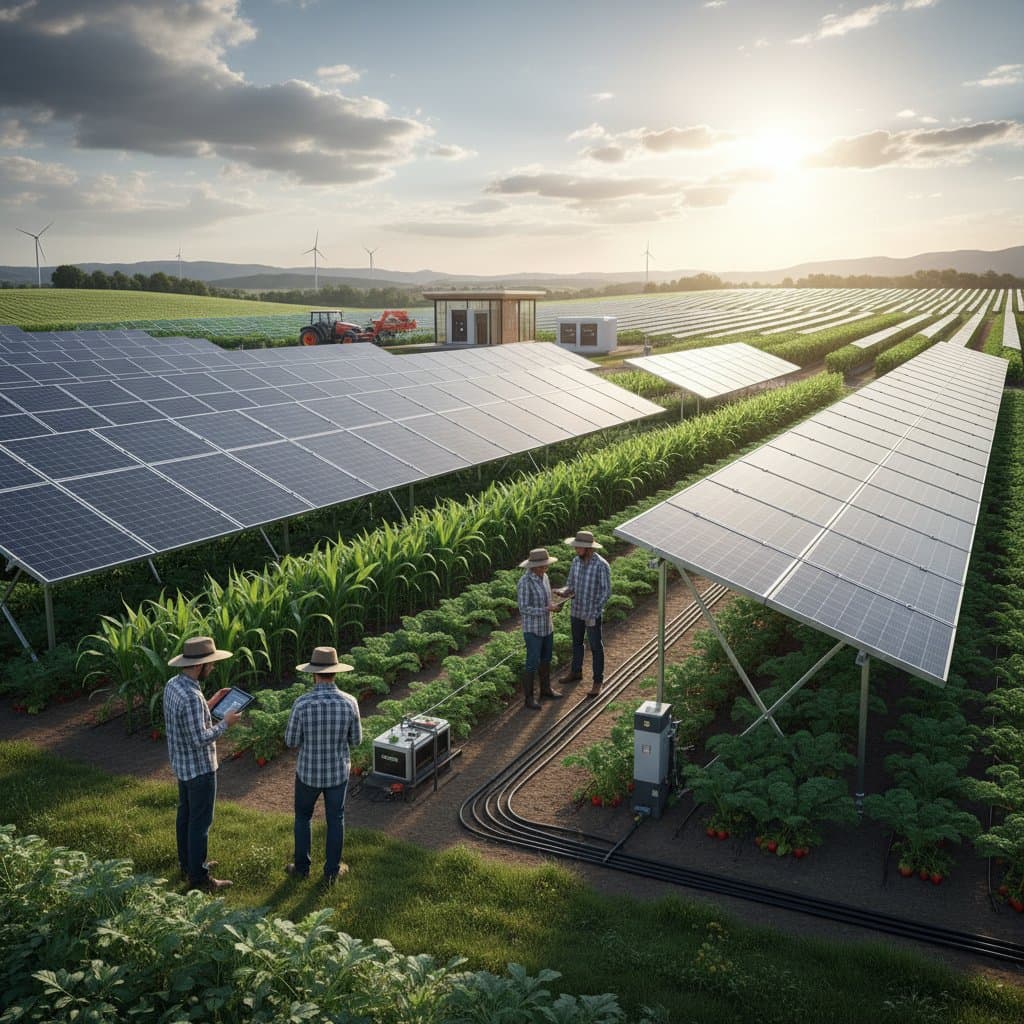
Agrivoltaics: Enhancing Crop Yields by 30 Percent by 2026
Farmers and landowners face mounting pressures from escalating energy costs, erratic weather patterns, and rising global food demands. These challenges compel the agricultural sector to innovate. Agrivoltaics emerges as a viable strategy, enabling crops and solar panels to coexist on the same land. Pilot studies nationwide demonstrate that such integrations can elevate crop yields by as much as 30 percent, alongside the production of clean electricity and enhancements to soil quality.
This innovative framework, known as dual-use solar farming, addresses dual imperatives of renewable energy generation and food security. Solar panels serve functions beyond electricity production. They foster microclimates that promote plant vitality, reduce water consumption, and shield crops from extreme weather conditions.
Small-scale farmers and community cooperatives stand to gain as much as larger operations. Shared solar installations complement crop cultivation or livestock grazing. Success hinges on comprehending the interplay of light, temperature, and shade with respect to plant development and energy efficiency.
Principles of Agrivoltaic Design
Agrivoltaic configurations balance sunlight distribution between panels and vegetation. Designs vary based on crop species, regional climate, and panel arrangement.
Essential Components
- Panel Elevation: Position panels at heights of eight to ten feet to accommodate farm machinery and personnel movement below.
- Row Intervals: Implement broader spacing between rows to permit adequate sunlight penetration for crops without undue obstruction.
- Inclination Adjustments: Optimize tilt angles to channel light toward plants while optimizing solar capture for power output.
- Tracking Mechanisms: Incorporate single-axis trackers on select farms to gradually orient panels throughout the day. This method maintains uniform light exposure and enhances both agricultural and energy yields.
Consider a half-acre installation featuring approximately 250 kilowatts of panels, which supports vegetable cultivation or animal grazing. Annual production might reach 1,300 kilowatt-hours per kilowatt, yielding about 325,000 kilowatt-hours total. Valued at an average rate of 20 cents per kilowatt-hour, this translates to roughly 65,000 dollars in annual revenue prior to operational expenses and incentives.
Financial Support and Regional Initiatives
Numerous states provide backing for dual-use solar via targeted grants, favorable loans, or demonstration programs. Farmers may pair renewable energy credits with conservation initiatives for agriculture. Utilities often facilitate net metering or community solar options, allowing surplus energy to offset on-site or adjacent consumption.
Prospective participants should:
- Examine local zoning regulations and land-use policies applicable to dual-use installations.
- Verify adherence to agricultural preservation standards.
- Investigate federal and state incentives tailored to solar agricultural projects.
- Consult regional cooperatives or extension services for expert advice.
Suitable Crops and Performance Improvements
Partial shading from panels benefits certain crops more than others, as evidenced by field trials.
- Lettuce and Spinach: Yields increase by up to 30 percent thanks to moderated soil temperatures.
- Tomatoes and Peppers: Enhanced fruit development occurs during peak summer heat.
- Berries: Fruit quality improves with protection against solar damage to skins.
- Herbs and Flowers: Growth remains steady, extending viable harvest periods.
- Pasture for Grazing: Grass distribution evens out, benefiting livestock welfare.
In arid areas, panel-induced shade minimizes evaporation rates, conserving thousands of gallons of water per acre annually.
Environmental and Operational Advantages
Agrivoltaic setups yield advantages that extend past energy production, bolstering ecosystems and operational stability.
- Soil Conservation: Wind and rainfall erosion diminish under panel cover.
- Pollinator Habitats: Farms often sow wildflowers or clover in under-panel areas to support biodiversity.
- Temperature Regulation: Shaded zones reduce ambient heat, easing labor conditions.
- System Reliability: On-site solar powers critical tools like irrigation pumps and cooling units during grid failures.
- Asset Appreciation: Properties equipped with energy systems typically command higher valuations due to revenue potential.
These improvements ripple outward, contributing to regional air quality and decentralized energy supply.
Steps to Implement an Agrivoltaic System
Initiate the process by compiling essential information. Review electric bills from the past year to determine typical usage patterns. Survey available land or rooftops offering optimal solar access with limited obstructions. Then, engage a solar provider experienced in agrivoltaics for a comprehensive site assessment, covering crop suitability, soil analysis, and installation needs.
Evaluate proposals with precision. Ensure consistency in projections for solar irradiance, hardware specifications, and electricity tariffs. Scrutinize warranties for panels and mounting systems. Verify that existing insurance policies encompass solar additions alongside farm operations.
Post-installation, utilize monitoring tools to log crop productivity and energy output. Fine-tune irrigation schedules and planting arrangements for optimal outcomes. Accumulated insights will inform subsequent optimizations, driving superior results over time.
Sustaining Performance Over Time
Solar arrays endure for 25 years or longer with proper upkeep, ensuring reliability and safety.
- Clean panels periodically to remove accumulations of dust or pollen that impair efficiency.
- Conduct seasonal checks on mounts, electrical connections, and structural integrity.
- Manage undergrowth to avoid unintended shading.
- Monitor inverter data to detect potential declines early.
- Arrange expert evaluations biennially or as required.
For agricultural elements, employ crop rotation to preserve soil fertility. Alternate between grazing and horticultural uses to equilibrate nutrient levels. This integrated management fosters enduring stability, securing reliable harvests and energy yields for generations.
Realizing Long-Term Gains
Adopting agrivoltaics positions farms to thrive amid evolving environmental and economic landscapes. Enhanced yields, water savings, and energy independence fortify operations against uncertainties. As adoption grows, this practice not only sustains livelihoods but also advances broader goals of ecological stewardship and energy innovation.
Frequently Asked Questions
What defines agrivoltaics?
Agrivoltaics combines solar power generation with ongoing agricultural activities on shared land.
In what ways do solar panels elevate crop yields?
Panels provide shade that cools the soil, curbs water loss, and mitigates heat stress, fostering improved plant growth and produce quality.
Do solar panels excessively limit light for crops?
Proper engineering ensures spacing and angles deliver sufficient light for photosynthesis alongside effective energy collection.
Which crops thrive beneath solar panels?
Leafy greens, root crops, berries, herbs, and grazing forages generally excel in shaded conditions.
What minimum land area supports a dual-use solar setup?
A half-acre suffices to accommodate a functional array while preserving space for cultivation or animals.