
Solid-State Batteries: Revolutionizing Home Energy Storage by 2026
Solar energy storage often raises questions for homeowners, particularly regarding safety and future advancements beyond lithium-ion batteries. Solid-state batteries address these concerns directly by providing enhanced safety, extended lifespan, and superior efficiency. By 2026, these innovations will transition from research labs to commercial products, enabling households to store solar power more effectively and reliably.
Understanding Solid-State Battery Design
Solid-state batteries differ from conventional lithium-ion types by employing a solid electrolyte in place of liquid or gel components. This substitution eliminates flammable materials that pose risks of thermal runaway or physical swelling. The solid electrolyte facilitates the movement of lithium ions between the anode and cathode, maintaining functionality while minimizing energy losses and improving overall stability.
Visualize the battery as a layered structure: the anode stores lithium ions, the solid electrolyte conducts them, and the cathode accepts them to generate electrical energy. Without liquids, these batteries withstand higher voltages and enable more compact arrangements. Consequently, they achieve greater energy density, storing substantially more power within a reduced volume.
Benefits for Residential Solar Storage
Current lithium-ion batteries for home solar systems typically offer energy densities of approximately 200 watt-hours per kilogram. Solid-state alternatives project densities exceeding 400 watt-hours per kilogram, effectively doubling capacity. For instance, a 10 kWh lithium-ion setup could be substituted with a 5 kWh solid-state unit delivering equivalent performance, allowing for more compact installations and optimized space usage in homes.
Safety improvements stand out as a key advantage. Lithium-ion batteries necessitate active cooling and vigilant monitoring due to their flammable electrolytes. In contrast, solid-state batteries function safely at elevated temperatures, reducing the likelihood of fires. This reliability lowers insurance premiums and simplifies ongoing maintenance for residential applications.
Enhanced Efficiency and Durability
Battery capacity diminishes gradually with each charge-discharge cycle. Lithium-ion systems experience an annual degradation of 2 to 3 percent, retaining about 80 percent capacity after a decade. Solid-state batteries, however, are anticipated to preserve over 90 percent capacity throughout that timeframe, thanks to the solid electrolyte's resistance to dendrite formation, which prevents internal short circuits.
Round-trip efficiency also advances significantly. Lithium-ion batteries recover roughly 92 percent of input energy. Solid-state versions aim for 97 percent recovery, a difference that accumulates over numerous cycles. For a system undergoing thousands of cycles, this improvement yields hundreds of additional usable kilowatt-hours, maximizing the value of stored solar energy.
Analyzing Costs and Return on Investment
Initial costs for solid-state batteries will exceed those of lithium-ion options, though economies of scale will drive prices downward rapidly. Consider a 10 kWh solid-state installation priced at 800 dollars per kWh, totaling 8,000 dollars. A comparable lithium-ion system might cost 6,000 dollars. Assuming daily cycling, the battery handles approximately 3,650 kWh annually; at an average utility rate of 20 cents per kWh, this equates to 730 dollars in annual energy value.
Projecting a 15-year lifespan for the solid-state battery with 90 percent capacity retention results in roughly 50,000 kWh of total output, or 16 cents per stored kilowatt-hour. A lithium-ion battery enduring 10 years at 80 percent retention produces about 33,000 kWh, or 18 cents per kilowatt-hour. Thus, the solid-state option proves cost-competitive over time, despite the higher upfront investment.
Seamless Integration with Solar and Home Automation
Solid-state batteries complement rooftop solar panels effectively. Excess midday generation charges the battery without excessive heat accumulation. In the evening, it supplies power to lighting, appliances, and heating, ventilation, and air conditioning systems. When integrated with intelligent inverters, users can optimize consumption to evade peak pricing or participate in grid-stabilizing demand response initiatives.
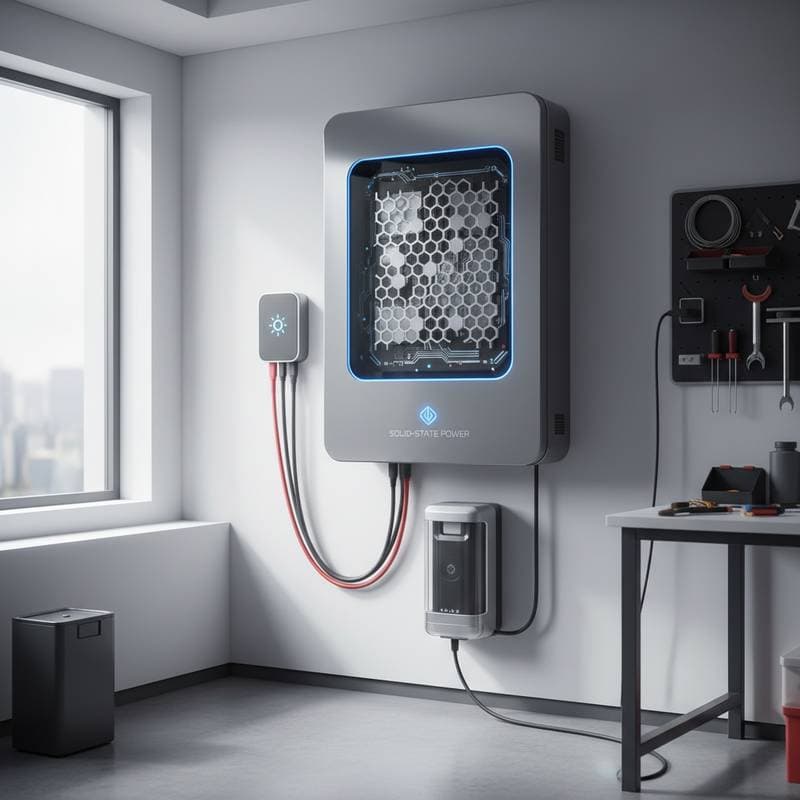
Their reduced footprint enhances installation versatility. A wall-mounted solid-state unit occupies minimal space in a garage or utility area, requiring no dedicated cooling. Emerging models incorporate built-in inverters and diagnostic software, simplifying deployment as a straightforward, all-in-one solution.
Positive Environmental and Recycling Outcomes
Recycling lithium-ion batteries involves intricate processes to manage liquid electrolytes and diverse materials. Solid-state batteries streamline this by incorporating fewer binders and volatile substances, yielding purer waste for processing. Ceramic or polymer-based electrolytes facilitate easier separation and material recovery. Additionally, diminished fire hazards improve safety during transportation and handling at recycling facilities.
Strategies for Future-Proofing Solar Installations
Homeowners initiating solar projects today should prioritize compatibility with solid-state technology. Opt for hybrid inverters and scalable wiring to accommodate battery swaps without extensive modifications. Select installation sites that remain protected from direct sunlight, moisture, and obstruction to simplify eventual upgrades.
These batteries will typically include warranties spanning 15 years. Firmware updates will monitor health metrics and forecast service requirements. Essential maintenance involves ensuring adequate airflow and reviewing charge status via dedicated applications.
Practical Steps for Homeowners
- Assess energy consumption patterns. Monitor usage across days and seasons to determine appropriate storage capacity.
- Verify inverter capabilities. Select units compatible with both lithium-ion and emerging solid-state technologies.
- Design for scalability. Allocate space and infrastructure for modular battery additions.
- Explore available incentives. Investigate federal tax credits and state rebates applicable to energy storage.
- Examine warranty terms. Seek guarantees covering at least 10 years of capacity performance.
Solid-state batteries will elevate home energy management beyond mere storage, fostering safer, more efficient, and sustainable solar integration. Proactive preparation positions households to capitalize on these advancements fully.
FAQ
What enhances the safety of solid-state batteries?
The solid electrolyte replaces flammable liquids, minimizing fire risks and thermal issues.
What is the expected lifespan of a residential solid-state battery?
These units should deliver reliable performance for approximately 15 years with limited degradation.
Will a solid-state battery integrate with my existing solar setup?
Yes, provided the inverter accommodates hybrid or direct current-coupled systems.
What efficiency levels do solid-state batteries achieve?
They recover up to 97 percent of stored energy, surpassing the 92 percent of lithium-ion batteries.
Do solid-state batteries carry a higher initial cost?
Yes, yet their extended durability and efficiency justify the premium over time.
Are solid-state batteries easier to recycle?
Their straightforward composition supports more efficient and secure recycling compared to conventional types.
What space requirements apply to a 10 kWh solid-state battery?
It occupies about half the area needed for an equivalent lithium-ion system.
What maintenance do solid-state batteries require?
Minimal effort suffices: maintain dryness, remove dust, and utilize monitoring applications.
Is indoor installation feasible for solid-state batteries?
Yes, their low-heat, sealed construction permits safe placement indoors.
When is the ideal time to prepare for a solid-state upgrade?
Start immediately by selecting adaptable equipment for seamless future integration.