
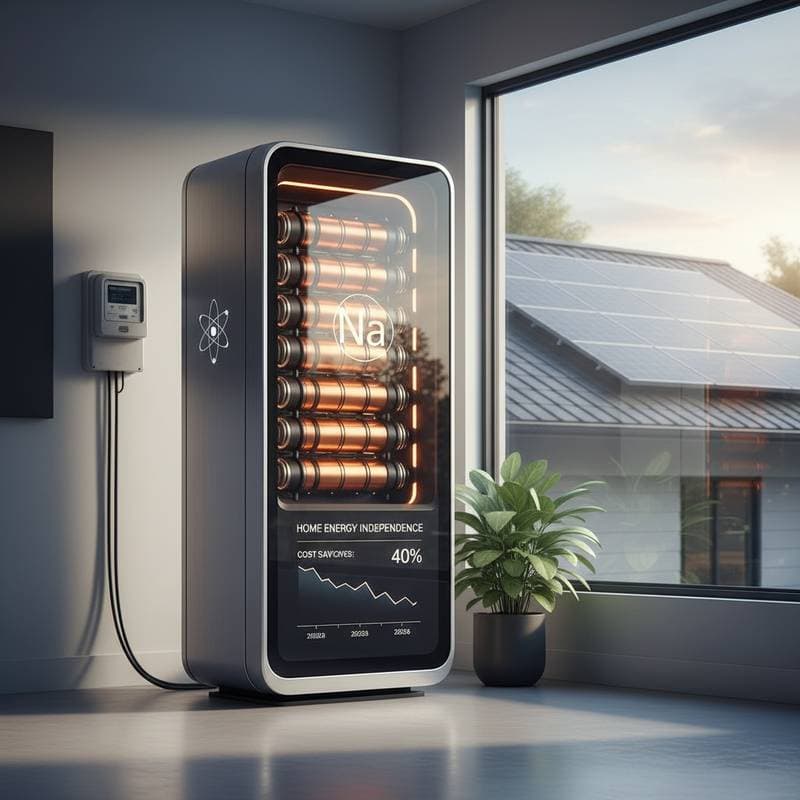
Sodium-Ion Batteries: Cheaper Power Storage by 2026
Solar research often overwhelms homeowners at first glance. Many question whether a battery exists that stores solar power affordably, without the steep upfront expenses of lithium systems. The industry approaches a solution sooner than expected. Sodium-ion batteries emerge as a viable, cost-effective alternative poised to transform residential renewable energy storage. These batteries utilize readily available materials, leverage proven manufacturing techniques, and position large-scale storage within reach for numerous households by 2026.
Why Sodium Instead of Lithium
Lithium-ion batteries lead solar storage today due to their robust performance in compact designs. However, lithium scarcity in certain regions and the environmental impacts of mining elevate prices and constrain supply. Sodium, derived from abundant salt and minerals worldwide, incurs far lower costs and requires less specialized refining equipment.
Sodium-ion battery chemistry parallels lithium-ion in fundamental operations. Both technologies shuttle ions between positive and negative electrodes via an electrolyte. The primary distinction lies in the ion type. Sodium ions, larger and heavier than lithium ions, deliver marginally lower energy per unit weight. Despite this, sodium systems satisfy most residential and commercial storage demands, particularly when prioritizing cost and safety.
How Sodium-Ion Batteries Work
In a sodium-ion cell, sodium ions migrate from the cathode (positive electrode) to the anode (negative electrode) during charging. Upon discharge, ions reverse direction across a separator, generating electric current. This reversible process enables thousands of cycles.
A standard sodium-ion cell employs layered oxide or phosphate for the cathode and hard carbon for the anode. The electrolyte consists of a sodium salt in an organic solvent. This configuration withstands broader temperature ranges compared to lithium-ion setups. It also minimizes thermal runaway risks, the overheating phenomenon that can ignite fires in mismanaged lithium batteries.
Sodium-ion batteries retain 80 to 90 percent of the energy density found in lithium iron phosphate, a secure lithium variant. Consequently, units require modest size increases to match energy capacity, offset by reduced costs, enhanced safety, and simplified recycling.
Real-World Numbers and Comparisons
To grasp sodium's appeal, examine a typical residential solar installation. A 7-kilowatt array generates approximately 9,100 kilowatt-hours annually, assuming 1,300 kilowatt-hours per kilowatt. A 10-kilowatt-hour lithium-ion battery bank might cost 10,000 dollars installed. Projections indicate a equivalent sodium-ion system at 6,000 to 7,000 dollars upon scaled production.
For a homeowner storing 9 kilowatt-hours daily for self-use, annual storage totals about 3,300 kilowatt-hours. At 18 cents per kilowatt-hour utility rates, this yields 600 dollars in yearly savings. A 7,000-dollar system recoups investment in roughly 12 years absent incentives. Should prices fall below 5,000 dollars, payback shortens to 8 years or fewer. These estimates simplify variables yet illustrate affordability's impact on home energy economics.
Advantages for Homeowners
Beyond cost, sodium-ion batteries offer compelling attributes. They perform reliably across wide temperature spans, ideal for regions with harsh winters or intense summers. Free from dependence on nickel, cobalt, or supply-volatile metals, they ensure stable pricing for replacements and foster diverse regional production.
Certain designs exhibit lower internal resistance, enabling faster charging. Paired with management software, they achieve 80 percent capacity in under an hour. Homeowners on time-of-use rates benefit by charging during low-cost off-peak periods and discharging during high-cost peaks.
Recyclability further enhances appeal. Materials in sodium-ion cells recover more readily than lithium counterparts. Lacking toxic metals, end-of-life processing proves straightforward, aligning with sustainability objectives that motivate solar adoption.
Challenges Still to Solve
Energy density presents the chief technical hurdle. Sodium-ion batteries store less energy per kilogram than lithium-ion variants. In stationary applications, where space constraints matter less, this poses minimal issues. For electric vehicles, it limits viability, though research narrows the disparity.
Cycle life warrants attention. Initial prototypes endured 1,000 cycles before capacity fell below 80 percent. Advanced iterations now achieve 3,000 to 5,000 cycles, rivaling select lithium options. Electrode coatings and electrolyte enhancements promise further longevity.
Supply chains for sodium components evolve gradually. Establishing mass production demands time, yet raw material simplicity aids progress. Sodium and aluminum substitute for lithium and copper in key parts, curbing expenses and manufacturing complexities.
Cost Drivers and Market Outlook
Battery pricing hinges on materials, scale, and efficiency. Lithium-ion costs plummeted post-mass production. Sodium-ion follows suit, with forecasts of sub-50 dollars per kilowatt-hour at cell level upon expansion. This positions them 30 to 40 percent below lithium equivalents.
In home systems, such reductions shave thousands from installations. Coupled with incentives and credits, complete solar-plus-storage arrays could cost half of today's setups. Declining prices unlock opportunities like community batteries or microgrids.
Sodium-ion aligns seamlessly with grid-scale renewables. Utilities require economical storage to manage solar and wind variability. These batteries deliver without lithium's supply constraints.
How to Prepare for Sodium Storage
Prospective solar storage buyers over the coming years should prepare strategically. Select inverters compatible with diverse chemistries; hybrid models from leading brands support firmware updates for varied batteries. This choice averts future integration hurdles.
Assess installation space and ventilation needs. Sodium systems may demand marginally larger enclosures. Allocating additional wall or floor area facilitates seamless upgrades. Their temperature tolerance permits placement in garages or basements with minimal climate controls.
Monitor warranty details and recycling options. Initial products might offer 8- to 10-year terms with 70- to 80-percent capacity retention. Improvements will follow. As adoption grows, recycling networks expand to reclaim components efficiently.
Environmental and Economic Benefits
Substituting sodium for lithium diminishes dependence on scarce minerals. Locally sourced materials in many nations cut transport emissions and spur domestic manufacturing, generating employment while minimizing supply-chain waste.
Environmentally, sodium-ion avoids cobalt and nickel mining hazards. Superior partial-discharge tolerance boosts daily solar efficiency, curbing energy loss and ensuring steady performance over time.
Economically, savings extend past upfront reductions. Storage enables energy autonomy, minimizing grid reliance during peaks. Widespread adoption eases grid loads, potentially steadying local rates.
The Path Ahead
Sodium-ion advances swiftly. Pilot facilities produce cells for stationary and light-duty uses. Scaling drives cost drops, while cathode and electrolyte refinements elevate density and durability. Experts anticipate complementarity with lithium: the former for high-performance mobility, the latter for stationary, budget-conscious roles.
Maintenance and Monitoring Tips
Maintenance for home sodium-ion batteries mirrors lithium protocols. Inverter apps or portals track charge, cycles, and temperatures. Maintain cleanliness and dryness around units to preserve efficiency. Though less temperature-sensitive, avoid excessive humidity.
Apply manufacturer software updates to optimize performance and safety. Arrange biennial professional checks for secure connections and corrosion absence. At end-of-life, utilize certified programs for responsible material recovery.
FAQ
What makes sodium-ion batteries cheaper than lithium-ion?
Sodium's abundance and extraction ease lower costs. Cells incorporate affordable aluminum and hard carbon, streamlining production.
Will sodium-ion batteries work with existing solar systems?
Yes, contemporary hybrid inverters accommodate various chemistries via updates. Verify with installers for compatibility.
How long will a sodium-ion battery last?
Designs project 3,000 to 5,000 cycles, translating to 8 to 15 years in residential scenarios.
Are sodium-ion batteries safe?
They exhibit greater stability against heat and overcharge. Reduced thermal runaway risk suits home environments.