
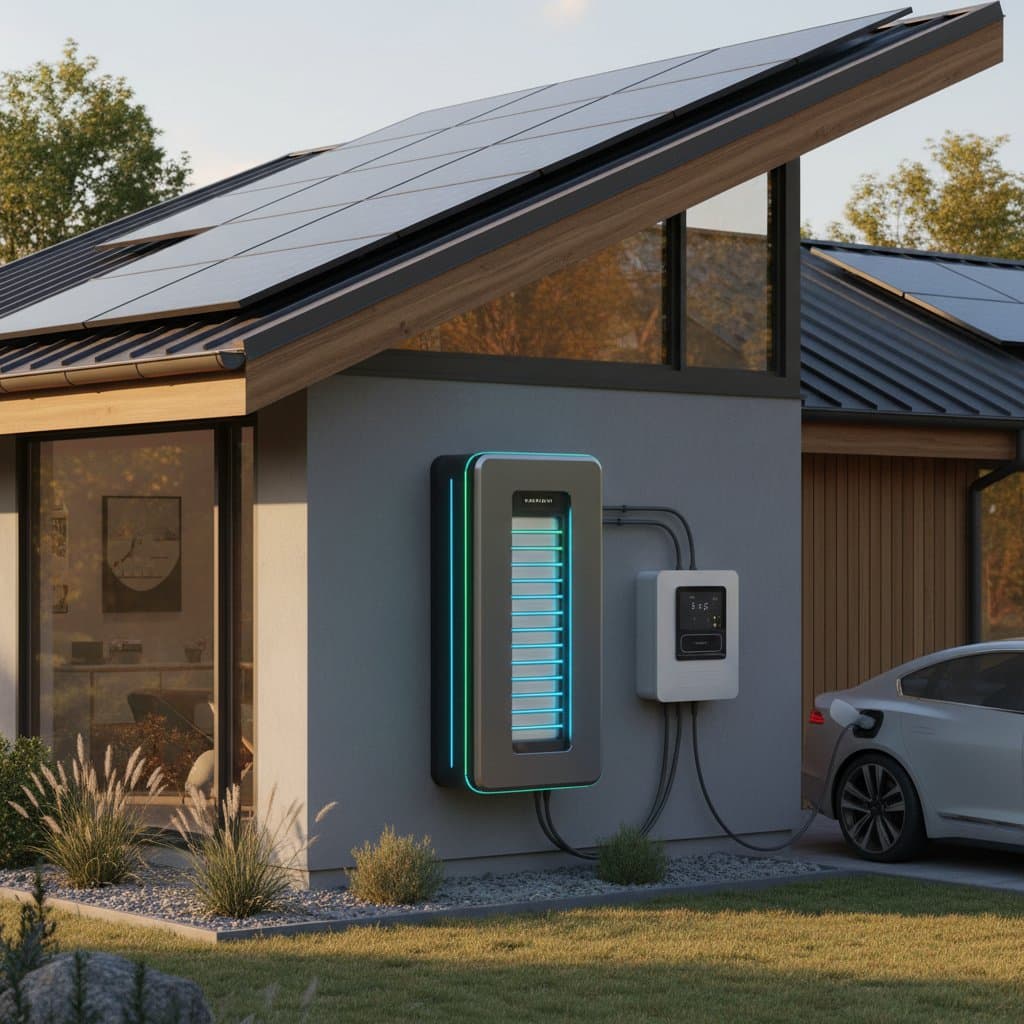
Solid-State Batteries: The 2026 Revolution in Home Energy Storage
Solar technology advances rapidly, often leaving homeowners uncertain about optimal investment timing. Panels, inverters, and batteries each demand consideration amid constant innovations. Solid-state batteries emerge as a pivotal advancement, poised to enhance solar power storage, outage resilience, and grid independence.
This technology transitions from research labs to commercial availability, with widespread adoption projected for homeowners by 2026. Grasping the distinctions of solid-state batteries enables informed decisions for solar and storage system planning.
Key Differences from Lithium-Ion Batteries
Lithium-ion batteries employ a liquid or gel electrolyte to facilitate ion movement between electrodes. Solid-state batteries substitute this with a solid ceramic or polymer electrolyte. This shift addresses critical limitations in safety, longevity, and energy density.
In operation, lithium ions traverse the solid electrolyte during charge and discharge cycles, generating electron flow to power households or devices. The absence of flammable liquids significantly lowers fire and thermal runaway risks. Compact designs result, accommodating greater energy in reduced volumes.
Higher cell voltages and reduced degradation rates characterize the chemistry. Lithium-ion systems typically lose 2 to 3 percent capacity annually, whereas solid-state variants target under 1 percent. Over ten years, this preserves more storage capacity and defers replacement expenses.
Practical Energy Storage Estimates for Homes
A standard 7-kilowatt solar array generates approximately 9,100 kilowatt-hours yearly, assuming 1,300 kilowatt-hours per kilowatt. A 15-kilowatt-hour solid-state battery stores sufficient energy for overnight use or multi-day cloud cover in average homes.
Households averaging 30 kilowatt-hours daily consumption benefit from batteries covering evening peaks. Paired with solar output, self-consumption increases while grid reliance decreases. At 20 cents per kilowatt-hour utility rates, daily offsets of 15 kilowatt-hours yield 3 dollars in savings, totaling 1,095 dollars annually.
Manufacturers anticipate over 10,000 cycles, equating to more than 25 years of daily operation. Initial replacement costs may elevate, yet prolonged service offsets them through sustained performance.
Operational Mechanics in Residential Settings
Each solid-state cell comprises an anode for lithium storage during charging, a cathode for release during discharge, and the intervening solid electrolyte. Solar-generated direct current, converted by the inverter, charges the battery. Discharge occurs during high-demand periods or outages.
The stable solid electrolyte enables broad temperature tolerance without extensive cooling. This eliminates fans and complex monitoring, yielding compact, silent, and efficient units.
Charging speeds surpass lithium-ion counterparts, with prototypes achieving 80 percent capacity in under 30 minutes. For time-of-use pricing, this facilitates low-rate charging and peak-time discharge. Advanced software optimizes cycles to maximize economic benefits.
Cost Analysis, Payback Periods, and Incentives
Initial pricing for solid-state batteries projects 30 to 40 percent above lithium-ion equivalents. A 15-kilowatt-hour lithium-ion installation at 10,000 dollars might parallel a solid-state system at 13,000 to 14,000 dollars.
Extended lifespan and efficiency mitigate higher upfront costs. Systems retaining 90 percent capacity over extended periods lower per-kilowatt-hour expenses. Long-term residents prioritizing reliability realize superior returns compared to faster-degrading alternatives.
Federal tax credits cover storage charged mainly by solar, often reducing costs by 30 percent. State rebates and performance incentives further bridge gaps, potentially cutting effective prices by 25 percent or more.
Integration Strategies for Home Systems
Pre-installation assessments evaluate electrical panels, inverters, and metering for bidirectional flow compatibility. Professionals analyze roof orientation, shading, and generation potential to determine battery sizing.
Homes exporting midday solar excess but importing evenings maximize storage value. Matching battery capacity to evening loads optimizes returns. Proper sizing avoids prolonged paybacks from oversizing or curtailed savings from undersizing.
Compliance with fire codes and utility rules remains essential. Solid-state designs ease these through lower thermal risks and minimal ventilation needs, potentially accelerating installations as market supply grows.
Environmental Benefits and End-of-Life Management
Solid-state batteries incorporate fewer flammables and toxics, easing recycling processes. Electrolytes separate readily for reuse. Slower degradation reduces replacement frequency and overall waste.
Leakage and fire risks diminish, enhancing indoor safety for garage or basement placements. Performance holds steady in these environments.
Actionable Steps for Homeowners
Consult certified installers for designs accommodating solid-state upgrades. Select hybrid inverters compatible with varied battery types for seamless transitions.
Prioritize warranties covering cycle counts and capacity retention. Schedule firmware updates to sustain peak efficiency.
Maintain systems by cleaning enclosures, clearing vents, and tracking cycles via monitoring apps. These practices ensure longevity and reliability in energy storage.
Frequently Asked Questions
What defines a solid-state battery?
A rechargeable battery that uses a solid electrolyte instead of liquid or gel, enhancing safety, density, and endurance.
What advantages do solid-state batteries offer in safety?
The lack of flammable liquids minimizes overheating and fire risks during operation.
What storage capacity suits residential solid-state batteries?
Units typically range from 10 to 20 kilowatt-hours, sufficient for overnight essential loads.
Do solid-state batteries carry higher initial costs?
Early units may cost one-third more than lithium-ion, though longevity offsets the premium.