
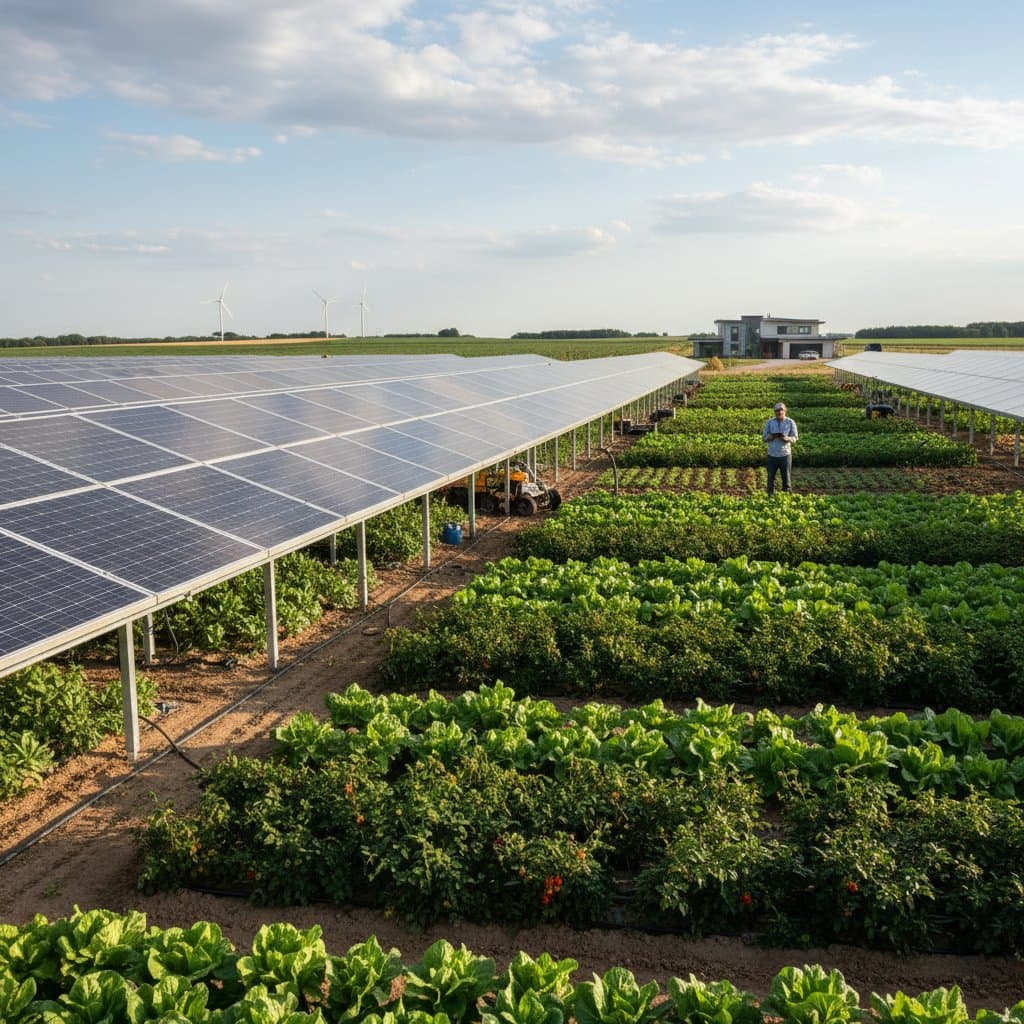
Agrivoltaics: Solar Panels Enhance Crop Yields by 30 Percent by 2026
Solar innovations often intersect with agriculture in unexpected ways. Agrivoltaics, also known as dual-use solar, enables farmers to produce clean electricity alongside improved crop yields and enhanced water efficiency. Proper design allows solar panels and crops to coexist productively.
Trial sites nationwide demonstrate that partial shading from solar panels can increase crop yields by up to 30 percent. This gain arises from optimized light exposure, temperature regulation, and soil moisture levels. The integration of energy and food production redefines solar adoption in rural areas.
Defining Agrivoltaics for Contemporary Agriculture
Agrivoltaics merges photovoltaic panels with working farmland. Elevated solar structures accommodate tractors, irrigation systems, and crop rows beneath them. Panels feature strategic tilting and spacing to permit diffused sunlight to reach the vegetation below.
This configuration generates a microclimate that cools the soil and minimizes evaporation. Plants experience reduced heat stress, while the panels benefit from cooler ambient air, which enhances their electrical output. Panels typically lose approximately 0.5 percent efficiency per degree Celsius temperature increase, so modest cooling yields tangible improvements.
Concerns about solar installations displacing prime farmland prove unfounded with agrivoltaics. The approach maintains land productivity and introduces a supplementary revenue source. Generated electricity powers farm operations such as irrigation pumps, cooling units, and electric vehicles, with surplus sold via net billing or community solar initiatives.
Practical Implementation of Agrivoltaics
Consider a 10-acre field dedicated to lettuce, peppers, or berries. A standard array positions panels 10 feet above ground with generous row spacing. Each acre supports about 150 kilowatts of solar capacity, yielding 1.5 megawatts across the site.
In sunny regions, each kilowatt generates roughly 1,300 kilowatt-hours annually. The 10-acre setup thus produces approximately 1.95 million kilowatt-hours per year. At an average retail rate of 14 cents per kilowatt-hour, this translates to 273,000 dollars in gross energy revenue annually.
After accounting for utility fees and upkeep, net income from energy could reach 200,000 dollars yearly. Crop production persists, often with elevated yields due to shelter from extreme heat. This synergy elevates farm profitability without requiring additional land.
Mechanisms Behind Yield Improvements Under Solar
Plants require sunlight, yet excessive intensity can cause stress. Filtering 20 to 40 percent of direct light via panels maintains cooler ground temperatures and higher moisture retention. Photosynthesis proceeds effectively, avoiding growth disruptions from peak heat.
Studies of combined solar-crop areas reveal more uniform development in leafy greens, tomatoes, and peppers under partial shade. Soil sensors indicate 15 to 25 percent greater moisture retention. Decreased evaporation lowers irrigation demands and associated expenses.
Shading also safeguards pollinators and curbs weed growth. The stabilized ecosystem fosters better pollination and soil vitality. These elements collectively drive yield gains of up to 30 percent in suitable crops.
Investment Costs and Return Timeline
Agrivoltaic installations incur modestly higher expenses than conventional ground-mounted systems due to elevated supports and expanded spacing. Costs generally fall between 1.40 and 1.70 dollars per watt. For a 1.5-megawatt project, the total approaches 2.4 million dollars.
Federal tax credits and state rebates substantially lower the effective cost, potentially to under 1.6 million dollars. With 200,000 dollars in yearly energy benefits, the return period spans about eight years. Thereafter, the system delivers ongoing power and agricultural advantages for at least 20 years.
Panels include 25-year warranties with degradation below 0.5 percent annually. Inverters require replacement after 10 to 12 years but constitute a small fraction of costs. Solar revenue provides market stability, offsetting fluctuations in crop prices for steadier finances.
Broader Ecological and Societal Advantages
Agrivoltaics advances sustainability by maximizing land efficiency. Farms produce food and energy simultaneously, alleviating land-use conflicts that hinder rural solar projects.
The method conserves water by curbing irrigation needs, preserving aquifers. Soil shading prevents erosion and bolsters organic content. Reduced ground heat creates milder conditions for animals and personnel.
Localities benefit from on-site power, minimized transmission losses, and expanded job opportunities in agriculture. Small operations can secure leases with developers for reliable income, safeguarding family-run enterprises against financial strains.
Essential Design Elements
Crop selection influences performance under panels. High-light crops such as corn or wheat derive minimal advantages. Shade-adapted options like lettuce, spinach, beans, or berries exhibit stronger responses.
Panel orientation and separation align with solar trajectories and regional weather. Excessive shading diminishes yields, while insufficient coverage reduces cooling. Ideal designs ensure at least 40 percent direct sunlight reaches the soil.
Account for equipment access, irrigation paths, and ground compaction. Adjustable mounts that vary height or angle optimize seasonal conditions.
Utility integration demands attention. Farms with basic electrical service may require upgrades for substantial arrays. Early utility consultation prevents expensive setbacks.
Data-Driven Management and Oversight
Success in agrivoltaics relies on ongoing evaluation. Sensors track solar generation, soil hydration, temperatures, and plant progress. This information informs precise irrigation and nutrient applications.
Integrated dashboards display energy and crop metrics. Deviations trigger notifications for prompt corrections. Iterative adjustments over time enhance both outputs.
Getting Started with Agrivoltaics
- Evaluate solar viability, including insolation, obstructions, and terrain.
- Identify shade-compatible crops for optimal results.
- Collaborate with specialists in dual-use configurations to match infrastructure needs.
- Verify utility policies on metering and grid connections.
- Layer financial supports, from federal incentives to regional farm programs.
- Analyze financial projections, balancing energy returns, upfront costs, and yield shifts.
- Outline upkeep protocols for panels, grounds, and equipment.
Sustaining Performance Over Time
Agrivoltaic setups demand routine care akin to solar arrays and cultivated fields. Clean panels biannually to clear debris and residues. Inspect frameworks for secure fastenings, cabling, and earthing.
Manage vegetation without harming crops or panel surfaces; opt for mechanical or cover crop methods. Review monitoring data regularly to address minor issues like partial shading or equipment glitches. Consistent maintenance ensures maximal energy yield and agricultural gains.
Frequently Asked Questions
What defines agrivoltaics?
The integration of solar power production with agricultural activities, such as crop cultivation or animal husbandry, on shared land.
Do solar panels obstruct sunlight excessively for plants?
Panels are positioned and oriented to diffuse rather than fully block light, preserving sufficient illumination for robust growth.
Which crops thrive beneath solar installations?
Leafy greens, peppers, tomatoes, beans, and berries typically excel in moderated light environments.
Does agrivoltaics lessen irrigation requirements?
Shaded soils hold moisture longer, cutting water needs by up to 25 percent in various studies.
Is retrofitting possible for established farms?
Many existing solar setups can incorporate taller frames and broader gaps to support crop integration.