
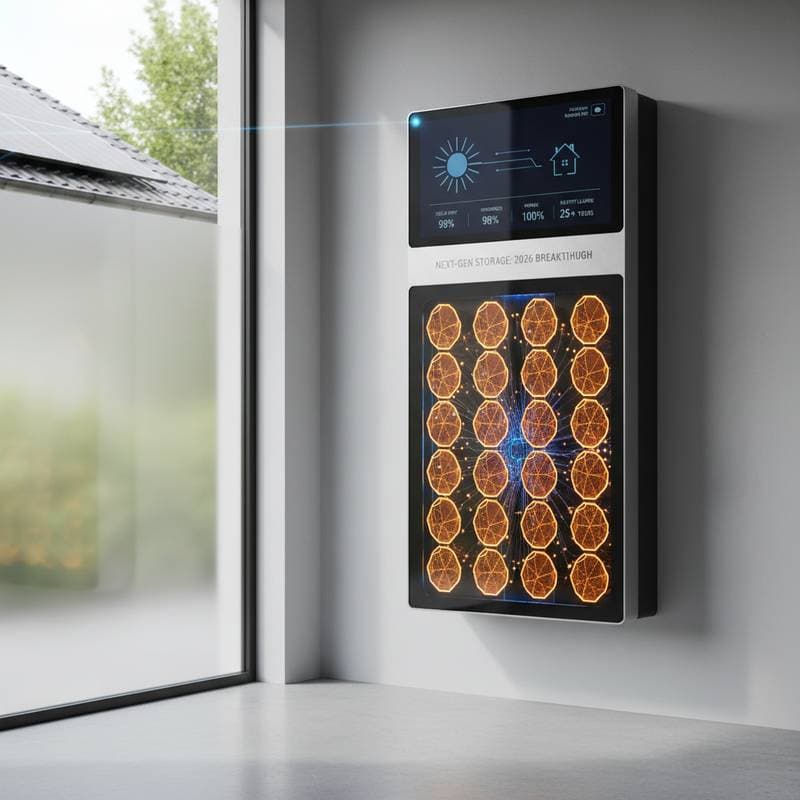
Solid-State Batteries: 2026 Home Storage Game-Changer
Solar research often overwhelms newcomers, particularly with storage technologies evolving rapidly. Homeowners encounter discussions on lithium-ion enhancements, hybrid inverters, and emerging options like solid-state batteries. These batteries substitute the liquid electrolyte in conventional lithium-ion cells with a solid material that facilitates safe and efficient ion movement. This innovation promises to transform residential solar power storage, enhancing reliability and compactness.
Why Homeowners Are Paying Attention
Numerous solar system owners possess batteries or contemplate adding one for grid outage protection and optimized solar energy utilization. Existing lithium-ion batteries degrade over time, generate heat during heavy loads, and restrict discharge rates. Solid-state batteries address these issues through superior energy density, enhanced safety, and extended durability.
The solid electrolyte eliminates flammable liquids responsible for thermal runaway risks. It supports broader voltage tolerances and quicker charging cycles. Homeowners benefit from greater energy storage within identical spaces, prolonged operational life, and reduced safety hazards.
How Solid-State Batteries Work
Batteries function by shuttling ions between positive and negative electrodes via an electrolyte medium. Traditional lithium-ion designs employ liquid or gel electrolytes, whereas solid-state variants utilize ceramic, glass, or polymer solids. Solar-generated electricity charges the battery by directing lithium ions to one electrode; household demand reverses this flow to generate power.
The solid electrolyte minimizes internal resistance, curbing heat production and boosting efficiency. Liquid cells dissipate a small percentage of energy as heat per cycle, but solid-state batteries recover nearly the full input. Across thousands of cycles, this efficiency yields substantial cost savings.
Comparing Energy Density and Lifespan
Contemporary residential batteries hold 5 to 15 kilowatt-hours. An equivalent-sized solid-state battery might accommodate 30 to 50 percent additional energy. This allows for a reduced physical footprint or expanded capacity without enlarging the enclosure.
Cycle life represents the most significant advancement. Standard lithium-ion batteries endure 4,000 to 6,000 cycles before substantial capacity decline. Solid-state batteries may surpass 10,000 cycles. Daily discharges could sustain performance for over 20 years prior to major degradation.
Safety improvements stand out as well. Absent liquid electrolytes, fire probabilities diminish considerably. Solid components remain stable amid elevated temperatures or mechanical impacts, permitting installations nearer to occupied areas with minimal ventilation needs.
Cost and Payback Outlook
Initial solid-state batteries command higher prices per kilowatt-hour than lithium-ion counterparts, projected at 25 to 40 percent premiums during market entry. However, lifetime ownership costs may decrease owing to extended longevity and superior efficiency.
Examine a 10-kilowatt-hour lithium-ion installation at $10,000, lasting 10 years across 5,000 cycles; the effective cost per stored kilowatt-hour reaches approximately $2. A $13,000 solid-state alternative enduring 20 years and 10,000 cycles reduces this to about $1.30 per stored kilowatt-hour.
This calculation presumes comparable inverter and installation expenses, a valid assumption given identical solar array integrations. Prolonged warranties and infrequent replacements amplify long-term savings.
Integration with Solar and Smart Grids
Solid-state batteries integrate seamlessly with advanced solar setups featuring smart inverters and load management tools. Their rapid discharge capabilities satisfy peak demands or contribute to grid stability through frequency regulation. Emerging designs also preserve efficacy in low temperatures, where conventional batteries falter.
In standard solar households, batteries capture excess daytime generation for evening release. Paired with time-of-use pricing, solid-state storage optimizes savings by aligning usage with premium rate periods. Expanding net billing and demand response initiatives favor batteries enabling swift charge-discharge operations.
Technical Challenges Ahead
Scaling production and curbing material expenses pose primary obstacles. Fabricating uniform solid electrolytes proves intricate; ceramic variants require thin, resilient layers, while polymers must withstand repeated flexing without fractures. As manufacturing advances and supply chains stabilize, prices should decline swiftly.
Temperature sensitivity affects certain electrolytes, which excel only within specific ranges. Researchers develop hybrid materials enhancing conductivity across diverse conditions, suiting installations in garages, basements, or exterior housings.
Environmental and Recycling Benefits
Solid-state batteries incorporate fewer liquids and volatile substances, simplifying recycling processes. They concentrate recoverable elements such as lithium and nickel. Extended lifespans curtail replacement frequency, mitigating waste generation.
Designers incorporate modular enclosures for disassembly and refurbishment, prolonging utility. This strategy diminishes ecological footprints and operational expenses. Environmentally conscious homeowners pairing solar with such storage realize tangible advantages.
What This Means for Home Energy Independence
Solar homes equipped with solid-state batteries achieve prolonged off-grid operation. Elevated capacity and charging speeds manage extended blackouts or overnight electric vehicle recharging. The technology facilitates community microgrids, enabling shared energy among neighbors.
Market expansion will introduce these batteries in high-end configurations before broader availability. Price parity with lithium-ion models could spur widespread adoption.
Practical Steps for Homeowners
- Assess your existing or prospective solar setup, analyzing consumption patterns and backup requirements.
- Consult installers on compatibility; hybrid inverters generally accommodate solid-state units, but verify firmware and voltage alignment.
- Weigh lifetime expenses, prioritizing warranties, degradation profiles, and effective capacity over initial outlays.
- Explore incentives; federal and state rebates frequently cover storage additions.
- Allocate space thoughtfully; despite cooler operation, strategic placement safeguards longevity.
Monitoring remains crucial. Applications track charge states, temperatures, and voltages in real time. Integrated alerts forecast maintenance needs, such as cell balancing.
Maintenance and Long-Term Care
Solid-state batteries demand minimal upkeep compared to liquid variants. Ensure unobstructed airflow, prevent complete discharges, and update monitoring software regularly. Arrange biennial professional reviews to inspect connections and insulation integrity.
Low degradation rates reduce recalibration frequency. Logging performance data supports warranty validations and efficiency assessments.
FAQ
What distinguishes solid-state batteries from lithium-ion?
They employ a solid electrolyte for ion transport, enhancing energy density and safety over liquid-based designs.
How much additional energy do they store?
They offer 30 to 50 percent greater capacity within comparable volumes to lithium-ion equivalents.
Are solid-state batteries safer?
Yes; the absence of flammable liquids substantially lowers overheating and fire risks.
Will initial costs exceed those of lithium-ion?
Yes, but extended durability and efficiency reduce overall expenses across the system's life.
Do they integrate with current solar installations?
Most do, particularly with inverters handling varied voltages; installer verification is essential.
What is their expected lifespan?
They may achieve over 10,000 cycles, equating to 20-plus years of daily cycling.
How do they fare in cold conditions?
Advanced composites enhance low-temperature performance, broadening climate suitability.
What maintenance do they require?
Maintain cleanliness, oversee data via apps, and conduct periodic professional checks.
When might upgrading make sense?
Consider it if your battery approaches warranty expiration or if expanding storage needs arise.