
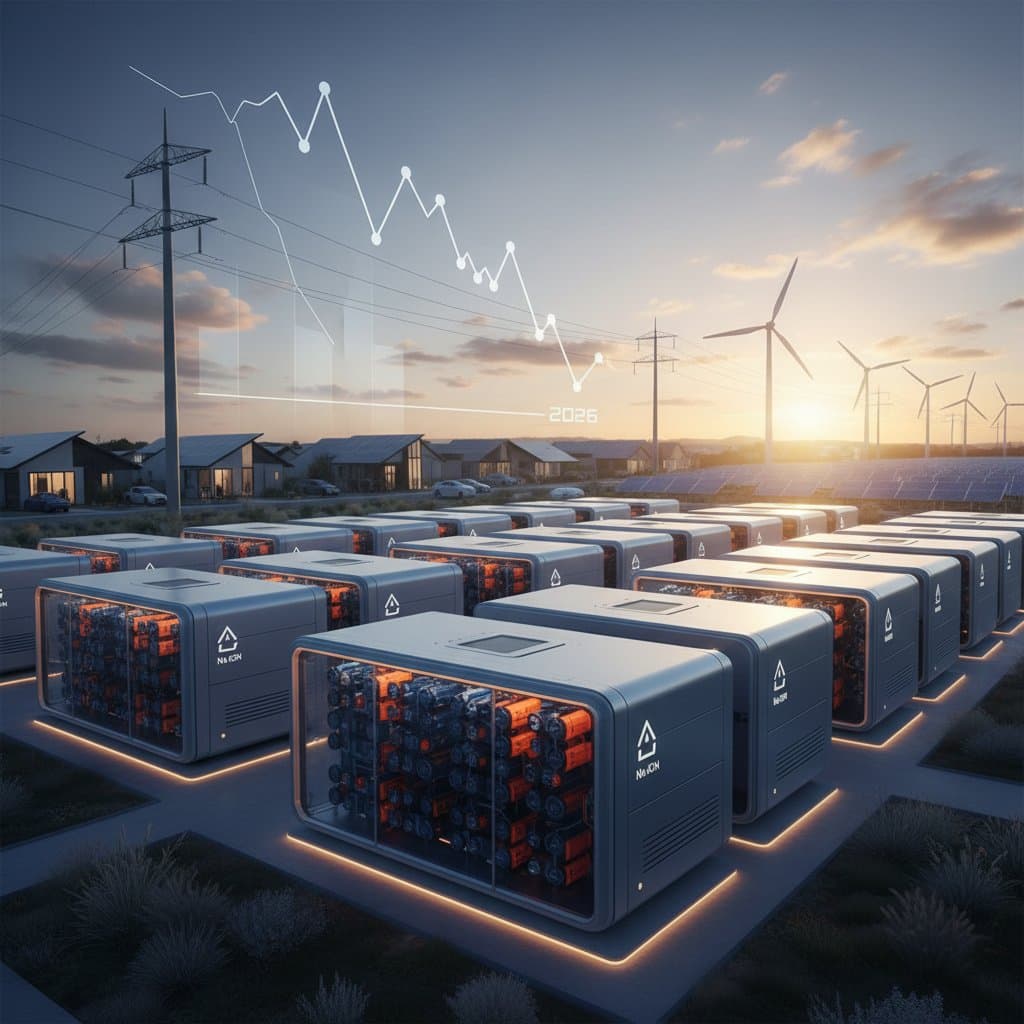
Why Sodium-Ion Batteries Will Reduce Grid Storage Costs by 2026
Solar energy research often presents a complex landscape, particularly with emerging battery technologies. Homeowners and clean energy supporters recognize lithium-ion batteries as the current benchmark for solar storage. Sodium-ion batteries, however, emerge as a promising alternative that lowers grid storage costs without compromising performance for large-scale renewable energy systems.
The significance of sodium-ion technology becomes clear through direct comparisons. Lithium serves as an efficient energy carrier, yet its extraction and refinement drive up expenses. Sodium offers abundance and simpler processing, which shifts the economics of grid-scale storage in favor of affordability.
Fundamentals of Sodium-Ion Battery Operation
Sodium-ion batteries facilitate the movement of sodium ions between cathode and anode during charge and discharge cycles. This mechanism mirrors lithium-ion chemistry, though the materials vary. Sodium atoms, larger and heavier than lithium, result in slightly reduced energy density, meaning less energy storage per unit of weight. In stationary grid applications, where space and weight pose minimal concerns, this limitation proves negligible.
Within each cell, sodium ions navigate an electrolyte solution. During charging, ions embed into the anode, commonly constructed from hard carbon. Upon discharge, ions return to the cathode, generating usable energy. The system employs plentiful compounds such as sodium carbonate or sodium sulfate, which remain inexpensive and safe for handling.
This approach circumvents supply chain vulnerabilities associated with lithium, cobalt, and nickel. Those metals concentrate in limited geographic areas, elevating costs and risks. Sodium, sourced from salt and soda ash, becomes accessible globally. Such widespread availability minimizes price fluctuations and transportation costs.
Detailed Cost Analysis
Installed lithium-ion battery packs for grid storage presently average 150 dollars per kilowatt-hour. Forecasts indicate sodium-ion systems may achieve 80 dollars per kilowatt-hour at scale. This 70-dollar reduction per kilowatt-hour equates to a 47 percent cost decrease.
To illustrate, examine a municipal solar initiative requiring 100 megawatt-hours of storage. Under lithium-ion pricing, batteries alone cost approximately 15 million dollars. Sodium-ion projections lower this to 8 million dollars, freeing 7 million dollars for additional solar panels, inverters, or community charging infrastructure.
These savings stem from material efficiencies and production methods. Sodium demands minimal purification, while electrodes incorporate affordable metals like iron or manganese rather than pricier nickel or cobalt. Manufacturers can repurpose existing lithium-ion production facilities, sidestepping complete overhauls.
Key Performance and Longevity Attributes
Although sodium-ion batteries exhibit lower energy density by mass, they excel in temperature tolerance compared to lithium-ion counterparts. Grid storage in climates with intense summer heat or harsh winter cold benefits from this resilience. Cycle life aligns with reliable lithium-ion options, surpassing 3,000 full cycles before capacity falls below 80 percent.
Grid operators gain a projected lifespan of 10 to 15 years under standard conditions. Lower energy density notwithstanding, lifetime cost per kilowatt-hour delivered often decreases due to economical materials and enhanced stability.
Sodium-ion designs also eliminate thermal runaway risks, the overheating that triggers fires in lithium systems. This safety profile eases regulatory approvals for installations proximate to residential zones.
Implications of Reduced Storage Expenses
Affordable storage reshapes utility and community strategies for renewable energy management. Solar generation peaks midday, while demand surges evenings. Batteries bridge this mismatch. Declining costs enable expanded capacity, stabilizing supply and diminishing dependence on fossil fuel plants.
Homeowners experience indirect benefits through reduced electricity rates. Utilities passing savings via improved net billing or community solar programs lower overall expenses. In urban areas like Philadelphia, with ample rooftop solar opportunities yet constrained space, neighborhood batteries optimize local energy balance.
Production Scaling and Resource Factors
Adopting sodium-ion requires building manufacturing capacity and securing raw materials. Sodium production already supports industries like glass and chemicals at massive scales, eliminating supply shortages. Efforts center on retrofitting battery facilities.
Initial output targets stationary storage over vehicles, prioritizing applications indifferent to weight. Proven grid demand will accelerate scale, further eroding costs.
Contributing elements include cost-effective inputs, streamlined supply chains, and flexible manufacturing, all converging to diminish per-kilowatt-hour expenses.
Advantages in Recycling and Lifecycle Management
Sodium-ion battery recycling surpasses lithium-ion processes in simplicity. Sodium compounds separate readily, and cobalt absence removes a primary toxicant from waste streams. These factors cut end-of-life costs and ecological harm.
Retrieved materials reintegrate into fresh cells or convert to benign industrial products. This closed-loop practice shrinks environmental impact and bolsters energy independence.
Actionable Strategies for Homeowners and Communities
Homeowners prepare for sodium-ion integration by selecting solar setups with modular inverters and versatile protocols. These choices ensure seamless future battery additions.
Community advocates collaborate with utilities on pilot projects at substations or microgrids. Such trials generate localized performance insights, informing broader energy strategies. Maintenance protocols encompass regular capacity assessments, thermal oversight, and control system updates to optimize cycle management.
As scaling advances, sodium-ion options integrate into standard solar-storage offerings. Evaluate warranties, degradation projections, and compatibility to facilitate adoption.
FAQ
What factors make sodium-ion batteries more affordable than lithium-ion?
Abundant raw materials drive down prices. Sodium derives from salt, and electrodes employ cost-effective metals.
Do sodium-ion batteries suit residential applications?
Yes. Reduced overheating risks and non-flammable electrolytes bolster safety.
What is the typical lifespan of sodium-ion batteries?
They withstand around 3,000 charge cycles, supporting a decade or longer of daily operation.
Will sodium-ion batteries supplant lithium-ion in electric vehicles?
Possible in select designs, though emphasis persists on grid and fixed storage where mass matters less.