
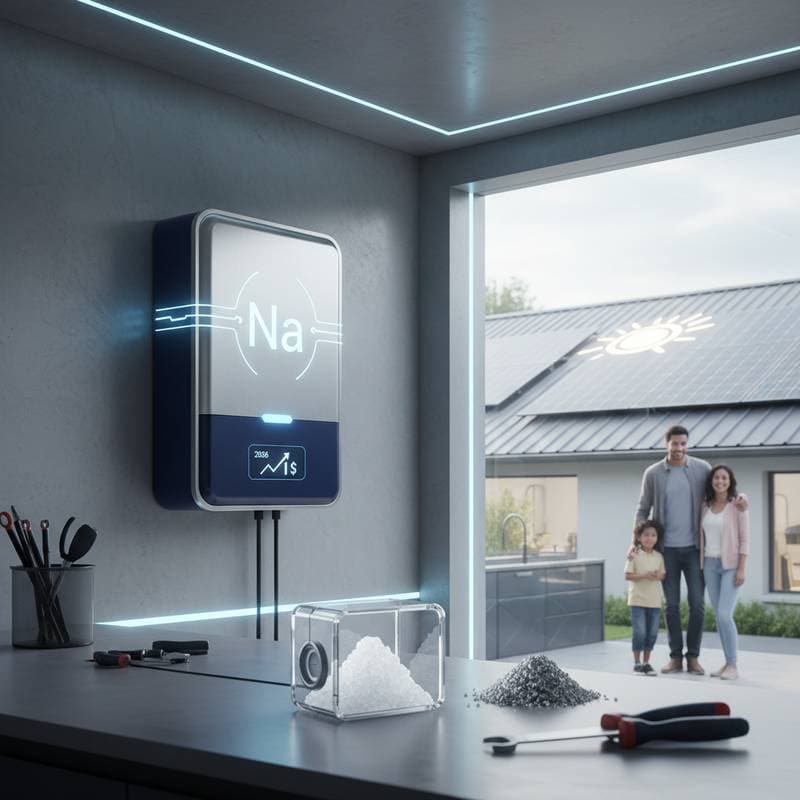
Why Sodium-Ion Batteries Outperform Lithium for Solar Savings in 2026
Solar technology presents numerous options for homeowners. Lithium batteries often receive primary focus as the standard for energy storage. However, sodium-ion batteries gain prominence due to their reduced expenses, enhanced safety profile, and reliable sourcing. As Philadelphia residents and others evaluate integrated solar and storage solutions, sodium-ion technology emerges as a pivotal advancement for accessible energy self-sufficiency.
This article examines the advantages of sodium-ion batteries over lithium counterparts in terms of expense and usability for residential solar applications. It details their operational principles, installation processes, maintenance requirements, and essential metrics for performance evaluation.
How Sodium-Ion Batteries Function
Solar panels convert sunlight into direct current electricity upon exposure. This electricity passes through an inverter to supply household needs or recharge the battery. Within a sodium-ion battery, sodium ions migrate from the cathode to the anode, while electrons traverse the external circuit to maintain charge equilibrium.
The discharge phase reverses this movement. Sodium ions return to the cathode, and electrons deliver power to the residence. The battery employs layered oxide or phosphate compounds that facilitate the insertion and extraction of sodium ions. Such design supports an extended cycle life, typically surpassing thousands of complete charge and discharge operations prior to notable capacity decline.
Consider the analogy of a sponge absorbing water. The electrode acts as the sponge, and sodium ions resemble the water. This material endures repeated absorption and release cycles without structural degradation, ensuring sustained operational durability.
Cost Analysis and Savings Illustration
Homeowners prioritize financial projections for solar investments. The following calculation outlines a practical example for a moderate-scale solar and storage installation in Philadelphia.
Key Assumptions:
- 7-kilowatt solar array
- Annual production of 1,300 kilowatt-hours per kilowatt
- Total yearly output of 9,100 kilowatt-hours
- Electricity rate of 18 cents per kilowatt-hour
- Battery capacity of 10 kilowatt-hours
Step-by-Step Calculation:
- Annual solar generation: 7 multiplied by 1,300 equals 9,100 kilowatt-hours
- Monetary value of generation: 9,100 multiplied by 0.18 equals 1,638 dollars annually
- Battery storage assumes one daily cycle over 300 days, yielding 3,000 kilowatt-hours stored and utilized yearly
- With 90 percent efficiency, effective stored energy reaches 2,700 kilowatt-hours
- Value of stored energy: 2,700 multiplied by 0.18 equals 486 dollars per year
A lithium battery installation at 6,000 dollars yields a storage payback period of approximately 12 years. A sodium-ion alternative at 4,000 dollars, with comparable capacity, reduces this to about 8 years. Federal tax credits and state incentives further accelerate the financial recovery.
The Role of Affordability in Expanding Solar Adoption
Initial expenses deter many from solar storage. While panel costs have decreased significantly, storage solutions have not followed suit as rapidly. Sodium-ion technology addresses this gap, allowing more households to store excess daytime production for nighttime consumption.
This capability diminishes reliance on the grid during high-demand periods with elevated rates. Affordable storage also bolsters local energy security. Communities equipped with distributed sodium-ion setups can sustain essential functions during disruptions, independent of fossil fuel backups. Such features prove particularly valuable in dense urban environments like Philadelphia, where space constraints and grid infrastructure pose distinct hurdles.
Sustainability and End-of-Life Advantages
Lithium extraction and processing demand substantial energy and can generate problematic waste. Sodium-ion batteries incorporate widely available, lower-toxicity components. Cathodes frequently utilize iron, manganese, or similar elements, avoiding scarce or contentious materials like cobalt and nickel.
These batteries support straightforward recycling protocols. Designs permit disassembly compatible with established facilities, eliminating intricate separation processes. Consequently, the environmental footprint diminishes, and long-term disposal expenses decrease.
Setup and System Integration
Sodium-ion batteries integrate similarly to lithium models. They pair with hybrid inverters that oversee energy transfer. Multiple producers provide units compatible with leading solar equipment.
The dimensions align closely, although sodium-ion variants might occupy marginally more space for equivalent capacity. Professionals secure them via wall mounts or floor enclosures. Their resilience to temperature fluctuations permits placement in varied locations, reducing the need for specialized climate controls and thereby cutting setup expenses.
Performance Tracking and Upkeep
Installed sodium-ion systems demand little ongoing intervention. Users access real-time data via mobile applications or online portals, including energy throughput, charge levels, and financial benefits. The inherent stability of the chemistry minimizes the frequency of software adjustments or cell equalization.
Annual visual checks confirm the integrity of connections and airflow. Warranties typically span ten years or longer, paralleling lithium offerings. Consistent monitoring enables proactive planning for future upgrades, avoiding unexpected expenditures.
Adoption Roadmap
Production scales increase to satisfy rising interest. Utility-scale trials refine sodium-ion efficiency and pricing. Residential products gain from these developments through cost efficiencies.
By the point when many seek to install or upgrade storage, sodium-ion solutions will prevail in accessible price categories. Certified options already satisfy rigorous safety and efficacy benchmarks for domestic applications.
Investment Recovery Projections
Pairing solar panels with sodium-ion storage shortens the overall payback compared to lithium configurations. In the prior scenario, an 8-year storage recovery alongside a 6- to 7-year panel return results in under 10 years total, factoring in rebates.
Indirect benefits include protection from power interruptions and escalating utility costs. Post-payback, stored energy incurs no additional expense. Across 15 years, this approach yields thousands in cumulative savings relative to sole grid dependence.
Steps to Advance Your Solar Strategy
Sodium-ion batteries provide a viable, progressive option for solar storage seekers. They deliver consistent power, elevated safety, and economic viability. The abundance of raw materials ensures enduring ecological benefits.
Solicit proposals encompassing both lithium and sodium-ion systems for your solar initiative. Evaluate comprehensive pricing, coverage details, and anticipated returns. Verify alignment with current inverters or oversight tools through your provider. As this technology evolves, its economic superiority will intensify.
Maintain optimal function by cleaning contacts and verifying airflow regularly. Manufacturer firmware enhancements can optimize operations periodically. Expanding recycling initiatives accommodate sodium-ion components effectively.
Frequently Asked Questions
Are sodium-ion batteries suitable for residential applications?
Yes. They employ nonflammable electrolytes and function reliably in diverse temperatures.
What is the expected lifespan of sodium-ion batteries?
Designs accommodate thousands of cycles, supporting 10 years or more of typical operation.
Do sodium-ion batteries integrate with current solar installations?
Numerous models work with hybrid inverters designed for lithium. Consult installers for precise compatibility.
Are sodium-ion batteries notably heavier than lithium?
They carry slightly more weight, yet this has negligible impact on fixed installations.