
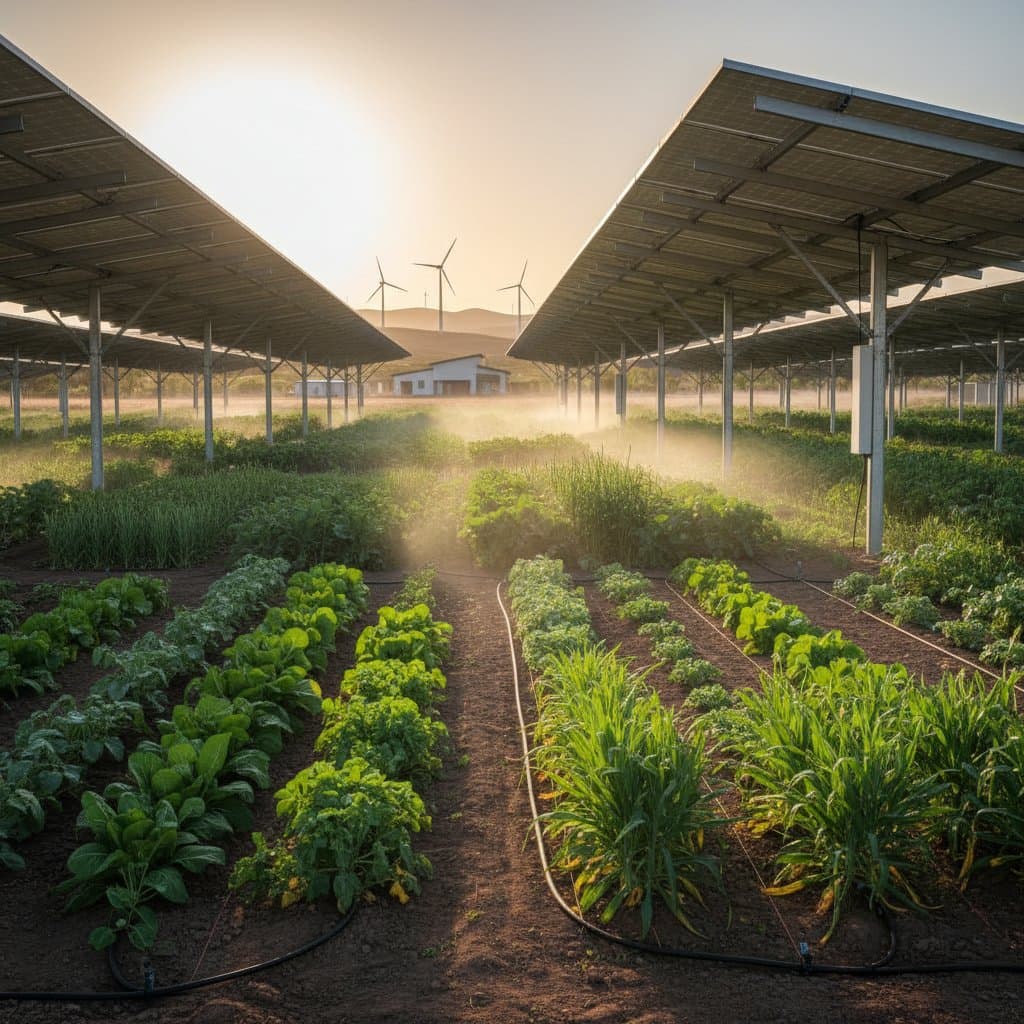
The Rise of Agrivoltaics by 2026: Solar Energy Fuels Agricultural Growth
Discussions about solar energy often raise concerns over farmland competition. Agrivoltaics addresses this by integrating photovoltaic systems with crop or livestock production on shared land. This practical innovation advances clean energy goals while sustaining agricultural output.
Benefits for Farmers and Local Communities
Agrivoltaic setups feature raised solar arrays that permit sunlight to filter to the soil below. Panels are positioned with gaps or angles to support plant growth and electricity generation. Farmers cultivate shade-tolerant vegetables, fruits, or forage, or allow grazing by sheep and goats that navigate support structures easily.
This approach diversifies revenue: a single acre yields income from crops or livestock alongside power sales. Well-designed systems create synergies; panels offer shade to curb soil moisture loss, while vegetation cools panels for improved efficiency. Communities retain productive landscapes, balancing local food supplies with renewable energy progress.
Core Technology and Operations
Systems employ standard photovoltaic panels elevated six to ten feet and spaced for ground access. Key elements include:
- Panel Configuration: Single-axis trackers adjust to track the sun, maximizing light for both panels and crops.
- Suitable Crops: Options like lettuce, spinach, peppers, berries, and pollinator plants thrive in partial shade, enhancing soil health.
- Power Generation: Arrays typically produce 1,200 to 1,400 kilowatt-hours per installed kilowatt annually, varying by sunlight exposure.
- Resource Efficiency: Shade reduces evaporation by up to 20 percent, promoting better soil retention and lower irrigation needs.
Vegetation absorbs minor heat from panels, cooling them and slightly boosting output. This mutual benefit optimizes land use.
Real-World Production Example
A 7-kilowatt system on a quarter-acre farm generates approximately 9,100 kilowatt-hours yearly at 1,300 kilowatt-hours per kilowatt. Valued at 17 cents per kilowatt-hour, this yields about $1,550 in annual electricity revenue.
The same area, planted with specialty greens valued at $9,000 per harvest, supports two seasons for $18,000 in crop income. Solar incentives and energy savings provide additional stability, with the system potentially returning over $15,000 in ten years, net of maintenance.
Economic and Ecological Gains
Agrivoltaics safeguards farmland from urban sprawl, maintaining agricultural viability while adding renewable output. Notable benefits encompass:
- Enhanced Property Value: Combined productivity ensures reliable long-term earnings, increasing appraisals.
- Water Savings: Decreased evaporation eases drought pressures and cuts irrigation expenses.
- Temperature Moderation: Reduced heat stress improves crop and livestock health.
- Emission Reductions: Farm-generated power displaces fossil fuels, supporting cleaner grids.
Financially, payback occurs in eight to twelve years, accelerated by federal tax credits, state grants, and net billing. Post-payoff, electricity costs drop to minimal upkeep.
Essential Site and Utility Factors
Ideal sites align physical and regulatory conditions for success:
- Solar Exposure: At least four peak sun hours daily maximizes returns; avoid tree or building shadows.
- Panel Alignment: Ground mounts should optimize tilt and direction for regional sun patterns.
- Rate Structures: Favorable net billing or time-of-use pricing elevates per-kilowatt-hour value.
- Panel Types: Bifacial models capture reflected light from ground cover for higher yields.
- Operational Access: Ensure space for machinery, irrigation, and harvesting to prevent disruptions.
Zoning often favors agrivoltaics as a land-conserving practice, streamlining permits when agricultural continuity is demonstrated.
Strengthening Food Security Through Agrivoltaics
Agrivoltaics builds resilience against climate variability, including heat waves and erratic rain. Shaded areas mitigate thermal stress and preserve soil moisture, stabilizing yields.
Extended seasons become possible for crops like lettuce and herbs, which resist bolting in cooler conditions, enabling additional harvests or premium produce. Profitable local farms resist conversion, sustaining community food access and economic ties to markets.
System Longevity and Upkeep
Agrivoltaic installations mirror conventional solar in maintenance: periodic cleaning sustains output, with rain handling much of the work. Grazing livestock simplifies weed control.
Panels carry 20-plus-year warranties; inverters last 10 to 15 years. Structures withstand decades of weather. At end-of-life, recycling recovers materials like silicon, aluminum, glass, and wiring, promoting circular sustainability.
Implementation Guide for Small-Scale Users
Homeowners or small farmers can adopt agrivoltaics with these steps:
- Evaluate Conditions: Verify ample sunlight and suitable soil for target crops.
- Design Layout: Position panels to accommodate growth or animal movement.
- Identify Incentives: Explore federal, state, and local renewable programs for farms.
- Choose Durable Gear: Select efficient panels and robust frames for field conditions.
- Engage Experts: Partner with installers versed in solar-agriculture integration.
- Track Results: Use tools to monitor energy and environmental performance.
Maintain by checking mounts, cleaning surfaces, and preventing crop or animal contact with electrics. Adjust plantings seasonally for optimal balance.
Future Outlook for Integrated Land Use
Agrivoltaics redefines land as a unified resource for energy and agriculture, aligning with sustainability targets. Adoption will drive cost reductions through scale and refined crop pairings.
This evolution fosters adaptable, profitable rural systems resilient to change.
Practical Implementation and Ongoing Management
Begin with pilot plots to test crops and gather data over one or two seasons, then scale up. Position irrigation away from supports and protect electrics from grazers.
Conduct yearly checks on wiring, mounts, and inverters; clean panels as needed to counter dust. Proper oversight ensures decades of dual productivity, shielding against cost hikes and weather risks.
FAQ
What crops suit solar panel understories?
Shade-tolerant varieties like leafy greens, peppers, berries, and herbs adapt well to the moderated light and moisture.
Is grazing compatible with solar arrays?
Yes; sheep and goats excel due to their agility around structures, though cattle need broader spacing.
Does agrivoltaics compromise power generation?
No; strategic design and cooling effects often maintain or enhance output alongside crop viability.
What land size is required?
Small setups fit a quarter acre; larger operations span multiple acres, prioritizing balanced spacing.