
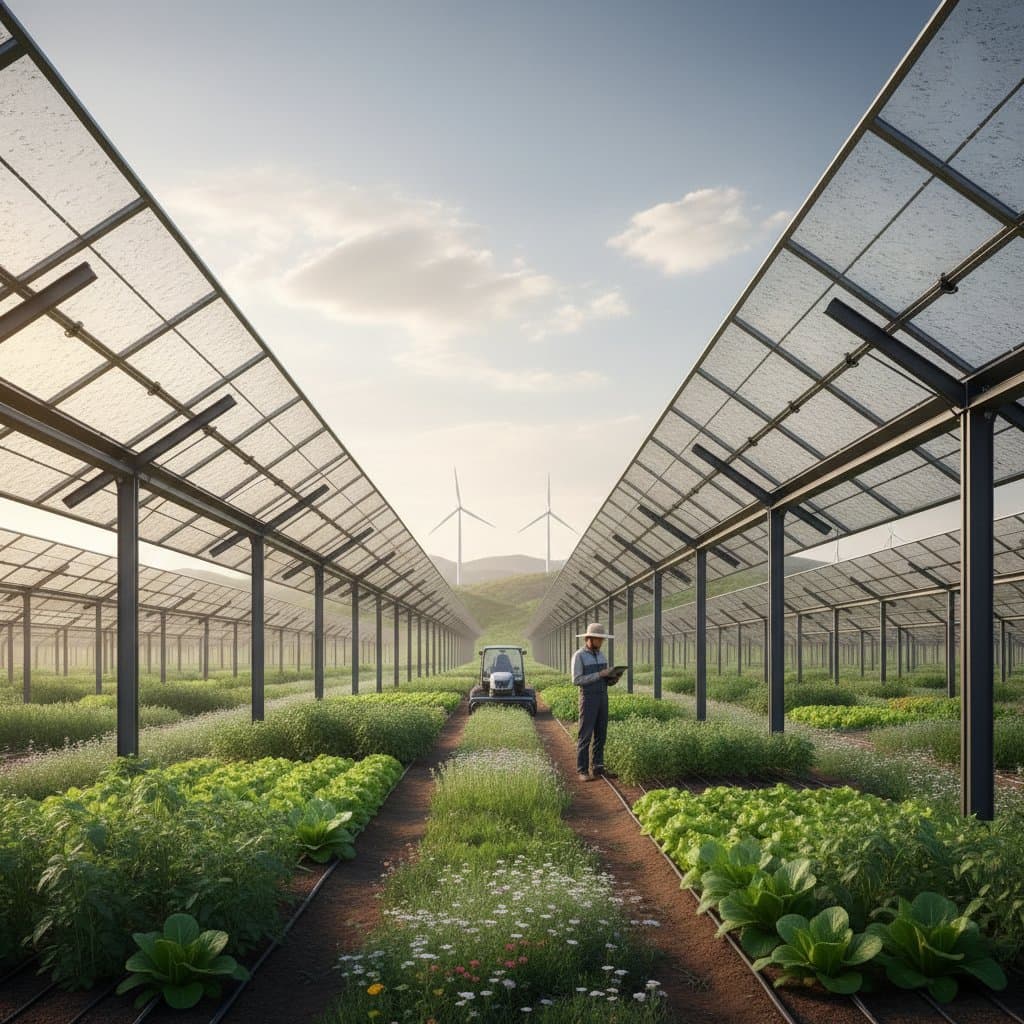
Agrivoltaics: Integrating Solar Farms with Food Production
Solar energy concepts often present initial challenges, from panel specifications to installation timelines. Agrivoltaics introduces an innovative solution by combining crop cultivation with electricity generation. This approach, also known as dual-use solar, allows farmland to support both harvests and renewable power without conflict.
Farmers and solar experts nationwide collaborate to optimize open spaces for multiple purposes. The primary objective remains straightforward: sustain agricultural output, ensure food security, and produce clean energy while preserving farmland integrity.
Core Principles of Agrivoltaic Systems
Agrivoltaics employs elevated or strategically spaced solar panels positioned over or amid crop rows. The design promotes shared access to sunlight rather than competition. Photons absorbed by silicon panels generate electricity via electron movement across P-N junctions, which inverters then convert for grid integration. The remaining light reaches the soil to foster plant development.
Panels typically mount at heights of 8 to 12 feet, accommodating standard farm equipment below. Wider row spacing facilitates light penetration. Monitoring tools assess soil temperature, humidity, and illumination to optimize conditions. Shade-adapted crops, including lettuce, strawberries, and forage grasses, demonstrate strong performance in these environments.
Livestock integration proves feasible as well. Sheep graze beneath panels to manage undergrowth and minimize maintenance expenses. Beekeepers occasionally install hives in adjacent areas, enhancing pollination services that support crop yields and regional ecosystems.
Optimizing Productivity Across Sectors
System effectiveness varies by site-specific factors. Consider a 10-acre parcel equipped with a 1-megawatt solar array. Each kilowatt generates approximately 1,200 kilowatt-hours annually, yielding 1.2 million kilowatt-hours total. At a 15-cent-per-kilowatt-hour grid rate, this equates to roughly 180,000 dollars in annual energy value.
If the land yields crops at 3,000 dollars per acre, combined revenues could surpass 200,000 dollars yearly. Proper crop selection and panel configuration limit yield reductions to under 10 percent, with solar earnings offsetting any shortfall. This revenue diversification shields farmers from climate variability and price fluctuations. Solar projects gain viability on agriculturally protected lands through such integrations.
Essential Design Considerations
Site evaluations form the foundation of every agrivoltaic installation. Critical elements include:
- Daily sun hours, which directly influence energy yields.
- Crop varieties, favoring those resilient to reduced light.
- Soil characteristics, where shade aids moisture preservation.
- Panel orientation and gaps, balancing electricity output with crop illumination.
- Regional energy tariffs and subsidies, determining economic viability.
A standard 1-megawatt dual-use array requires 1 to 1.5 million dollars in upfront investment. Federal incentives, such as the 30 percent tax credit, lower this figure substantially. State-level support, including grants and favorable financing, often shortens payback to 7 through 10 years. Systems then deliver reliable power for over 25 years.
Broader Environmental and Societal Advantages
Benefits surpass emissions reductions from renewable sources. Panels mitigate soil evaporation, maintaining cooler and more consistent ground temperatures. Shade-covered crops require reduced watering, particularly in arid periods, while robust roots prevent soil degradation.
Local communities experience improved air quality, dependable agricultural earnings, and enhanced energy independence. Rural utilities procure power from proximate sources, fostering economic retention and network reliability.
These installations also spur learning initiatives. Educational institutions leverage them for curricula in energy systems, agronomy, and eco-friendly farming techniques.
Practical Applications for Smaller Properties
Agrivoltaics extends to modest operations beyond commercial scales. A 20-kilowatt setup on a limited pasture or plot generates about 26,000 kilowatt-hours yearly. This offsets approximately 3,900 dollars in power expenses at prevailing rates.
Strategic panel placement permits continued vegetable cultivation or animal husbandry below. Initial costs hover around 40,000 dollars, reducible to 25,000 dollars post-incentives. Return on investment typically occurs within 6 to 8 years, contingent on sunlight and tariffs.
Maintenance and Operational Strategies
Dual-purpose systems demand coordinated oversight for solar and farming elements. Panel washing maximizes efficiency. Growers evaluate ground firmness and modify watering schedules accordingly. Tilt adjustments by season enhance dual outputs.
Comprehensive insurance protects both infrastructure and produce. Routine checks uphold performance guarantees, often assuring 80 percent capacity retention after 25 years.
Collaborations with energy groups enable automated surveillance. Devices relay data on generation, climate, and soil metrics, facilitating prompt interventions.
Emerging Trends and Regional Prospects
Adoption of agrivoltaics accelerates in farming-intensive areas with ample solar resources. Policymakers consider regulatory adjustments to permit hybrid land uses. Energy strategies position this model as a connector between sustainability targets and countryside prosperity.
In agricultural hubs like Pennsylvania and adjacent regions, agrivoltaics redefines renewable integration. Farmers no longer face trade-offs between traditional practices and energy production.
Implementing an Agrivoltaic Initiative
Prospective participants start with thorough property reviews, examining terrain, earth composition, and solar access. Engage installers versed in agricultural applications to discuss elevations, configurations, and durability assurances.
Secure incentives via national and local channels. Demand detailed projections on output, income, and recovery timelines. Post-deployment, log agricultural and energy metrics to inform ongoing optimizations.
Such systems sustain parallel food and power production over extended periods. They exemplify integrated resource management, blending heritage farming with forward-thinking energy solutions.
FAQ
Which crops suit agrivoltaic environments?
Leafy greens, herbs, berries, and shade-resilient produce excel. Forage grasses integrate seamlessly.
Is grazing compatible with panel setups?
Affirmative. Sheep prevail due to their stature and role in vegetation management.
How does shade affect harvests?
Yields generally hold steady or decline minimally, offset by gains in hydration and soil vitality.