
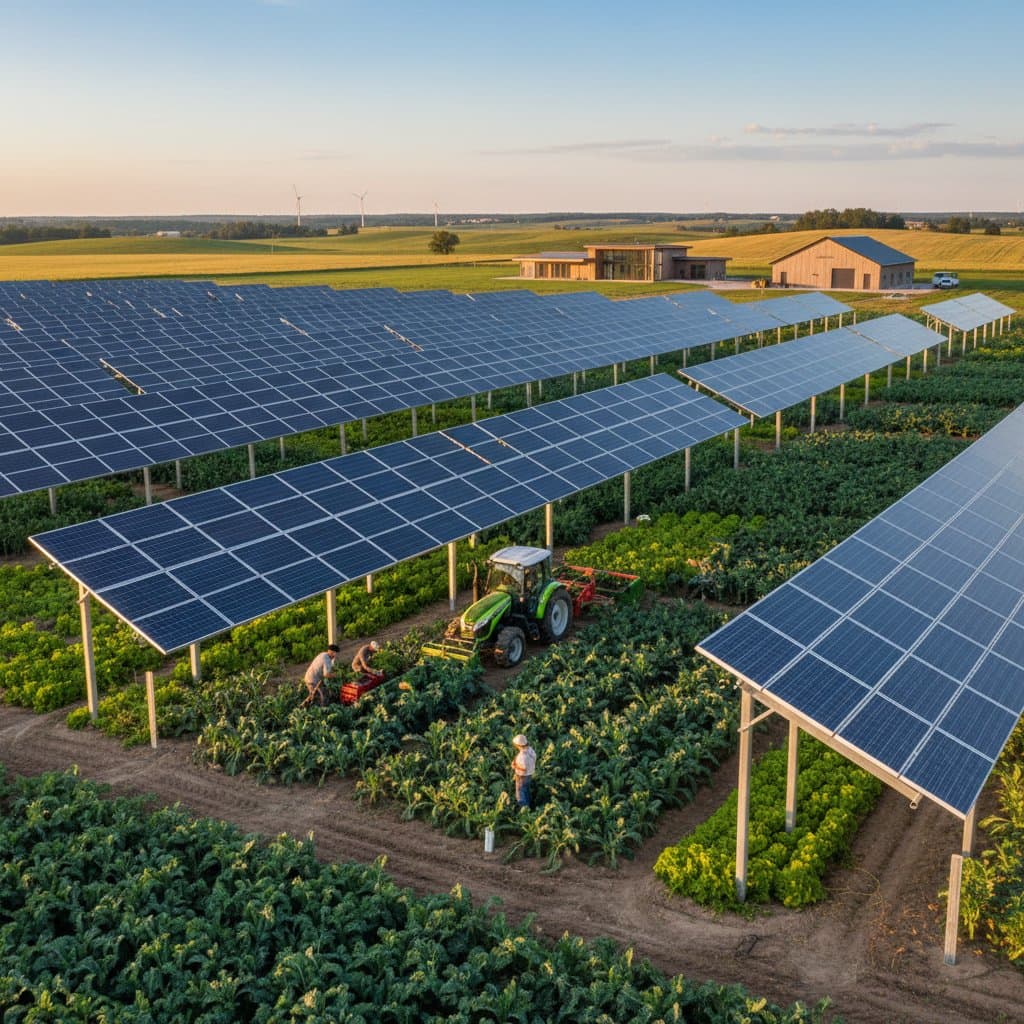
2026 Solar Boom: Farms Doubling Income with Crops
Farmers across the United States reevaluate land productivity amid escalating energy costs, erratic weather patterns, and narrowing profit margins. Solar energy emerges as a viable solution. Fields traditionally dedicated to crops now generate clean electricity alongside agricultural output. This practice, termed agrivoltaics, integrates solar power production with ongoing farming activities. Farms achieve doubled revenue streams without expanding acreage.
Agrivoltaics employs solar panels that coexist with crops or livestock. Panels convert sunlight into electricity, while vegetation flourishes in the diffused light below. Revenue derives from dual sources: soil-based yields and solar-generated power.
How Agrivoltaics Functions
Agrivoltaic installations feature raised solar panels arranged to permit sunlight penetration, rainfall distribution, and equipment maneuverability. Panel elevation and orientation adapt to specific crop requirements. Shade-tolerant varieties, such as leafy greens, root crops, and forage grasses, perform well under partial coverage. Panels mitigate thermal stress, retain soil hydration, and shield against hailstorms or intense precipitation.
On-site power generation supports irrigation systems, refrigeration units, or processing machinery. Excess electricity feeds into the utility grid via net metering policies. Battery storage options ensure availability for nighttime operations or emergency backups.
Projects commence with comprehensive site evaluations. Experts assess solar irradiance, potential obstructions, soil integrity, and drainage patterns. Subsequent phases encompass customized system engineering, regulatory permitting, grid interconnection approvals, and professional deployment. Post-installation, operators track performance through intelligent inverters and digital monitoring platforms.
Costs and Return on Investment
Ground-mounted agrivoltaic arrays incur installation expenses of 1.10 to 1.50 dollars per watt, influenced by scale and regional labor rates. A 500-kilowatt installation ranges from 550,000 to 750,000 dollars prior to rebates.
Government incentives, including federal tax credits and state grants, reduce upfront costs by 30 to 50 percent. Additional support comes in the form of subsidized loans or performance-based reimbursements. Factoring in these benefits, systems typically recoup investments within 6 to 10 years, contingent on local energy tariffs and agricultural earnings.
Solar modules include 25-year efficiency guarantees, while inverters endure 10 to 15 years with periodic upgrades. Routine upkeep extends operational lifespan across decades, sustaining both energy output and crop productivity.
Tailoring Solar Systems to Farm Practices
Optimal agrivoltaic configurations align with individual farm characteristics, including machinery dimensions, crop selections, and operational routines.
- For row crops, elevated frameworks and generous intervals accommodate tractor passage.
- For pasture-based livestock, mid-level panels offer shelter and facilitate routine grazing maintenance.
- For high-value produce, configurable arrays enable precise light modulation during critical growth phases.
- For fruit orchards, boundary or peripheral setups deliver electricity without impeding canopy development.
Advanced inverters route power toward on-farm priorities before exporting surpluses. Integrated mobile applications and analytics interfaces oversee energy yields and crop metrics, enabling adjustments to panel positioning or watering regimens.
Maintenance and Sustained Operations
Agrivoltaic upkeep integrates seamlessly with standard farm protocols. Annual or biannual panel washing eliminates accumulations of dust, pollen, or debris. Weed control merges with existing tasks, often leveraging grazing animals in lieu of mechanical cutting.
Electrical components warrant annual inspections for exposure to elements or pest interference. Inverters and cabling receive scrutiny for degradation. Diagnostic software notifies users of efficiency declines, averting income disruptions.
Upon decommissioning, solar modules enter certified recycling channels. Component materials, including aluminum racking and glass surfaces, support straightforward repurposing, bolstered by growing specialized recovery infrastructure.
Case Study: A Vegetable Farm's Success
A 20-acre diversified vegetable operation deployed a 250-kilowatt agrivoltaic array. The setup yields approximately 325,000 kilowatt-hours annually. Valued at 13 cents per kilowatt-hour, this generation displaces 42,000 dollars in yearly power expenses and generates supplementary sales revenue. Cool-weather greens thrive beneath the panels, complemented by rotational sheep grazing. Shade alleviates midsummer heat, while consistent soil moisture persists through arid periods.
Projections indicate cumulative crop and solar earnings surpassing 800,000 dollars over a decade, net of costs—effectively doubling prior land performance.
Steps to Launch an Agrivoltaic Project
Prospective adopters compile essential baseline information to inform decisions.
- Compile 12 months of utility statements to map consumption trends and peak demands.
- Commission a shading analysis to determine ideal array alignment and coverage ratios.
- Solicit bids from vetted providers, standardizing parameters for capacity and configuration.
- Verify access to rebates, grants, and loans through regional energy authorities.
- Examine grid tie-in protocols to streamline approval processes.
Initial trials with compact systems energizing pumps or coolers validate feasibility. Scaled expansions proceed upon confirmation of agronomic harmony and energy reliability.
Enhancing Farm Efficiency Beyond Panels
Agrivoltaics complements a holistic strategy for rural resilience. Operators optimize daily routines to amplify savings and minimize environmental impact.
- Align watering and climate control with peak solar generation windows.
- Upgrade to variable-frequency drive pumps for reduced energy draw.
- Install high-efficiency LED fixtures in outbuildings and seal storage areas for thermal retention.
- Adopt regenerative soil techniques to enhance durability and sequester carbon.
Community engagement amplifies these efforts. Educational tours for schools and peers demonstrate harmonious integration of renewables and agriculture, fostering advocacy for sustainable practices while honoring farming traditions.
Future Prospects for Agrivoltaics
This innovation addresses intertwined challenges: income stability, energy autonomy, and supply chain robustness. Technological refinements and cost reductions accelerate adoption. Shared experiences among pioneers reassure financial institutions and risk assessors.
Dual-purpose land use exemplifies balanced advancement. Food and energy production converge without compromise, advancing fiscal viability and ecological stewardship.
Consult experienced agricultural solar specialists to initiate planning. Observe operational sites to gauge adaptations for illumination, access, and utility interfaces. Thoughtful implementation transforms solar resources into enduring dual harvests, securing prosperity for future stewards.
Frequently Asked Questions
What defines agrivoltaics?
Agrivoltaics merges photovoltaic installations with productive agriculture on shared terrain. Electricity production occurs above or adjacent to ongoing crop cultivation or animal husbandry.
Does shading from panels diminish crop productivity?
Results vary by species. Shade-tolerant plants gain from moderated temperatures and conserved moisture. Thoughtful layouts preserve adequate illumination for photosynthesis.
Is retrofitting possible for established farms?
Affirmative. Ground arrays or overlaid canopies adapt to existing layouts, provided designs accommodate machinery and pathways.
What output can farm-scale systems achieve?
Capacity hinges on array dimensions and insolation levels. A single kilowatt typically delivers 1,300 kilowatt-hours per year; scale accordingly for totals.