
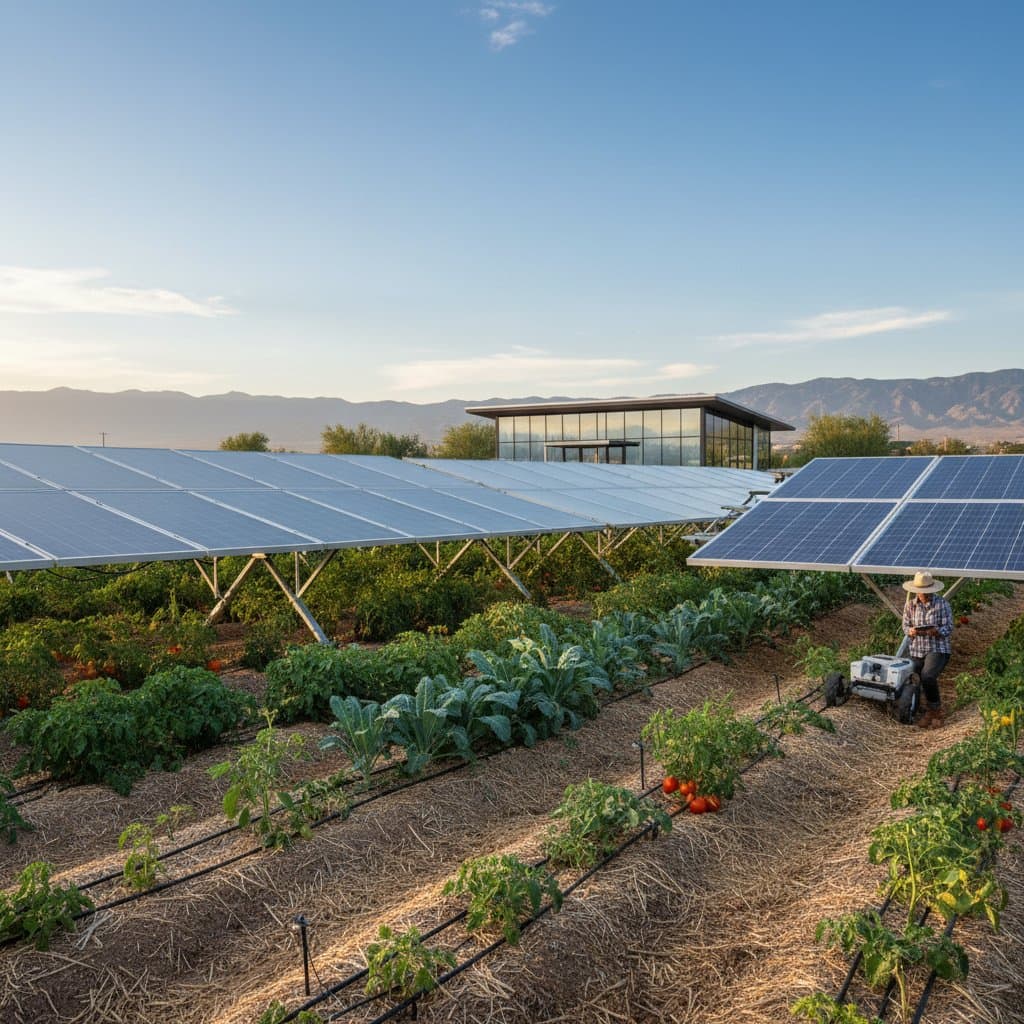
Agrivoltaics in 2025: Advancing Dual-Use Solar Farming
Solar energy innovations often focus on rooftops or vast deserts, yet a practical solution emerges for farmland: agrivoltaics. This method combines photovoltaic systems with crop cultivation or grazing, allowing the same acreage to yield electricity and food. Communities benefit from preserved landscapes, reliable power, and sustained agricultural output.
Agrivoltaics addresses land scarcity by fostering synergy between energy and farming. Elevated or spaced solar panels permit light and water to reach plants below, while generating renewable electricity above. In sun-rich areas with constrained arable space, this integration proves particularly valuable.
Principles of Dual-Use Solar Systems
Photovoltaic panels capture sunlight to produce electricity via semiconductor materials that convert photons into electron flow. In agrivoltaic setups, these panels mount at heights of seven to ten feet and with wider row spacing than traditional arrays. Such configurations ensure machinery access and sufficient illumination for understory vegetation.
Excessive solar exposure can elevate plant temperatures and accelerate evaporation. The partial shade from panels moderates these conditions, promoting healthier growth for shade-adapted species. Conversely, transpiration from crops cools the panels, sustaining their output efficiency. This mutual support elevates overall system performance.
Quantifying Performance and Returns
Consider a one-megawatt agrivoltaic installation spanning five acres. With an annual yield of approximately 1,300 kilowatt-hours per kilowatt, the array produces 1.3 million kilowatt-hours yearly. Valued at 15 cents per kilowatt-hour, this translates to 195,000 dollars in electricity revenue.
Agricultural productivity persists beneath the panels. Shade-tolerant crops like kale or carrots may retain 70 to 90 percent of baseline yields, while grazing supports natural vegetation control. If prior crop revenue averaged 3,000 dollars per acre, adjusted output contributes 10,500 dollars annually. Lease agreements from solar operators add 2,500 to 7,500 dollars per acre, amplifying total earnings.
Economic Advantages and Risk Mitigation
Farmers gain income diversification through fixed solar leases, typically 500 to 1,500 dollars per acre based on regional factors like sunlight and infrastructure. This buffer protects against crop price volatility or drought. Combined revenues from energy sales and farming often exceed traditional single-use outcomes by 20 to 50 percent.
Environmentally, agrivoltaics conserves habitats by avoiding full land conversion to solar farms. Panels shelter soil from erosion and retain moisture, cutting irrigation needs by up to 30 percent in arid zones. Pollinator-friendly underplantings and sheep grazing enhance biodiversity without chemical interventions.
Site Selection and System Design Essentials
Optimal sites feature consistent solar irradiance above 4.5 kilowatt-hours per square meter daily and even topography for installation. Select crops including spinach, tomatoes, or forage grasses that tolerate 20 to 40 percent shade coverage. Proximity to transmission lines facilitates energy export.
Design elements include panel elevation for clearance, row orientations aligned with prevailing winds, and adjustable tilts to optimize dual yields. Integrate drip irrigation to supplement any reduced rainfall penetration. Soil tests prior to setup identify nutrient needs influenced by altered light patterns.
Investment Analysis and Financial Incentives
Installation costs for agrivoltaic systems range from 1.2 to 1.5 million dollars per megawatt, reflecting elevated mounting structures. Federal investment tax credits reduce effective costs by 30 percent or more, with additional rebates from state agricultural programs. For a 1.3 million dollar project, net outlay drops to 910,000 dollars after incentives.
Annual returns of 195,000 dollars from power plus 10,000 dollars from agriculture yield a four-year payback. Post-recovery, profits accrue steadily, supported by long-term power purchase agreements. Sensitivity analyses account for variables like energy rates or crop adaptations to ensure viability.
Sustaining Operations Over Time
Maintenance involves quarterly panel washes to remove debris and biannual structural checks. Monitor crop health through yield logs and adjust shading via panel angles if needed. In grazing systems, fence divisions enable controlled rotation to prevent overgrazing.
Warranties cover panel efficiency at 80 percent after 25 years, with inverters replaced every 10 to 15 years at 10 percent of initial cost. Total annual upkeep remains under 5 percent of revenue, emphasizing the model's low operational demands.
Implementing Agrivoltaics in Your Region
Near Philadelphia, agrivoltaics aligns with urban-rural interfaces, bolstering local energy resilience and farm viability. Partner with certified installers to assess parcels and simulate outputs using site-specific data. Begin with one-acre demonstrations to evaluate crop responses and refine designs.
Track metrics like energy generation and harvest volumes to inform expansions. Engage cooperatives for shared financing and knowledge exchange. This strategic adoption secures dual benefits, advancing sustainable practices for future generations.
FAQ
What defines agrivoltaics?
Agrivoltaics combines solar photovoltaic installations with ongoing agricultural activities, enabling simultaneous production of electricity and food or fiber on shared land.
How do crops perform beneath solar panels?
Shade-tolerant varieties flourish in the moderated environment, often requiring less irrigation and exhibiting reduced heat stress for yields comparable to open fields.