
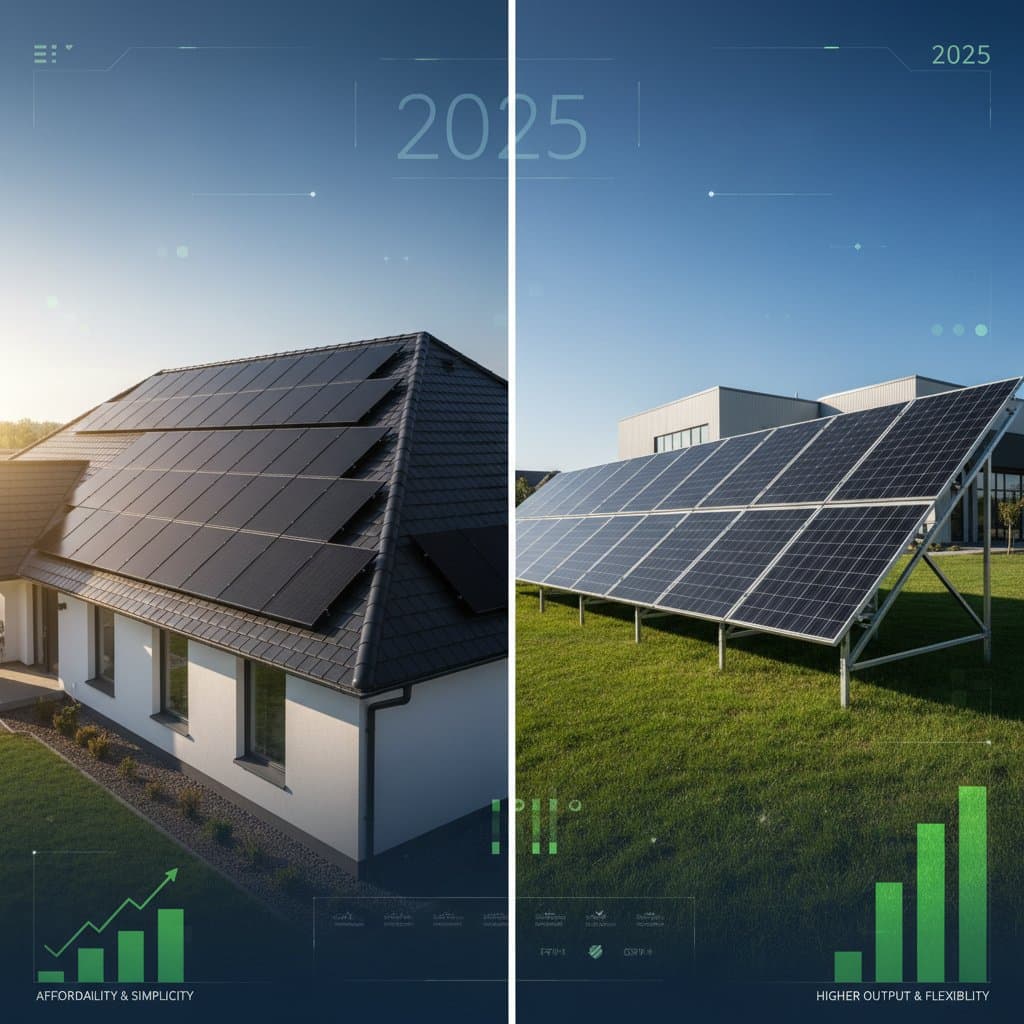
Ground vs Rooftop Solar: Which Costs Less in 2025?
Rooftop solar panels offer a straightforward path to clean energy for many homeowners. Ground-mounted systems provide an alternative that suits specific properties. In 2025, understanding the cost differences between these options helps individuals make informed decisions about renewable energy investments.
This comparison examines installation expenses, efficiency factors, and long-term benefits. Factors such as location, roof condition, and land availability influence the choice. By evaluating these elements, readers gain clarity on selecting the most cost-effective solution.
Cost Breakdown for Installation
Installation costs represent the primary expense for solar systems. Rooftop installations typically range from $2.50 to $3.50 per watt in 2025, depending on regional labor rates and equipment quality. For a standard 5-kilowatt system, this translates to $12,500 to $17,500 before incentives.
Ground-mounted systems cost more due to additional materials like mounting racks and trenching for wiring. Expect prices between $3.00 and $4.50 per watt, leading to $15,000 to $22,500 for the same system size. These figures account for the structural reinforcements required for stability against wind and weather.
Permitting and inspection fees add $500 to $2,000 for both types, though ground systems may incur higher costs in areas with strict zoning laws. Federal tax credits reduce the net expense by 30 percent, making rooftop options appear more affordable upfront.
Efficiency and Energy Output Considerations
Rooftop panels benefit from proximity to the home's electrical system, minimizing energy loss during transmission. They achieve efficiencies of 15 to 22 percent with modern monocrystalline cells. Optimal roof orientation toward the south enhances output by up to 20 percent compared to suboptimal angles.
Ground-mounted arrays allow for precise tilting and orientation, often boosting efficiency by 10 to 25 percent over fixed rooftop setups. Adjustable mounts enable seasonal adjustments to capture maximum sunlight. In shaded areas, ground systems avoid roof obstructions like chimneys or trees, potentially increasing annual production by 15 percent.
However, ground installations face risks from ground-level shading or animal interference. Both systems use similar panel technologies, but ground setups support larger arrays, ideal for high-energy households. Overall, ground systems deliver higher output per panel, offsetting higher initial costs through greater energy generation.
Space and Site Requirements
Rooftop solar requires sufficient unshaded roof space, typically 300 to 500 square feet for a 5-kilowatt system. South-facing slopes between 15 and 40 degrees provide ideal conditions. Homeowners must assess roof age and material; older roofs may need replacement, adding $5,000 to $10,000 to the project.
Ground-mounted systems demand open land, often 400 to 600 square feet, away from buildings to prevent shading. This option suits properties with ample yard space but limited roof suitability. Installation involves soil testing to ensure stable foundations, which can extend timelines by two to four weeks.
Urban dwellers favor rooftops for space efficiency, while rural properties leverage ground mounts for scalability. Both require setbacks from property lines, but ground systems offer easier access for maintenance and cleaning.
Pros and Cons of Each System
Rooftop installations excel in simplicity and lower material needs. They integrate seamlessly with existing home structures and qualify for streamlined permitting in many regions. Drawbacks include potential roof damage during installation and challenges in accessing panels for repairs.
- Pros of Rooftop Solar:
- Lower upfront costs.
- No land use impact.
- Aesthetic integration with home design.
- Cons of Rooftop Solar:
- Limited scalability.
- Dependency on roof condition.
- Higher replacement costs if roof needs work.
Ground-mounted systems provide flexibility in placement and easier expansion. They avoid roof penetrations, preserving warranties, and allow for battery storage integration below ground level. Challenges include higher vulnerability to theft or vandalism and increased visual impact on landscapes.
- Pros of Ground-Mounted Solar:
- Superior efficiency through adjustability.
- Easier maintenance and monitoring.
- Scalable for future energy needs.
- Cons of Ground-Mounted Solar:
- Higher installation expenses.
- Requires dedicated land space.
- Potential permitting hurdles in regulated areas.
Long-Term Savings and Return on Investment
Solar systems pay for themselves through electricity bill reductions and incentives. Rooftop setups achieve payback periods of 6 to 8 years, assuming average U.S. electricity rates of $0.16 per kilowatt-hour. Over 25 years, savings can exceed $30,000, factoring in net metering credits.
Ground-mounted systems extend payback to 8 to 10 years due to elevated costs, yet their higher output accelerates savings in sunny climates. Enhanced durability against roof-related issues reduces long-term maintenance expenses. Both options increase property values by 4 to 6 percent, according to industry assessments.
Energy independence remains a key benefit, shielding users from rising utility rates projected at 3 percent annually through 2030. Insurance premiums may decrease slightly for solar-equipped homes, adding to financial advantages.
Steps to Choose the Right System
Assess your property first by evaluating roof space, orientation, and condition through a professional site survey. Calculate energy needs using past utility bills to determine system size. Compare quotes from at least three certified installers, focusing on warranties and performance guarantees.
- Conduct a shading analysis to identify potential output losses.
- Review local incentives and rebates specific to installation type.
- Model financial projections with tools like solar calculators for personalized ROI estimates.
Consult with experts to weigh aesthetic and practical preferences. This process ensures alignment with budget and sustainability goals.
Maximizing Solar Value for Your Home
Selecting between rooftop and ground-mounted solar hinges on balancing costs with performance. Rooftop systems suit compact urban properties seeking quick affordability. Ground arrays empower larger-scale energy production on spacious lots.
Both pathways lead to substantial savings and environmental impact. By prioritizing site-specific factors, homeowners secure reliable clean energy for decades. Invest in solar today to harness 2025's advancing technologies for a brighter, more efficient future.