
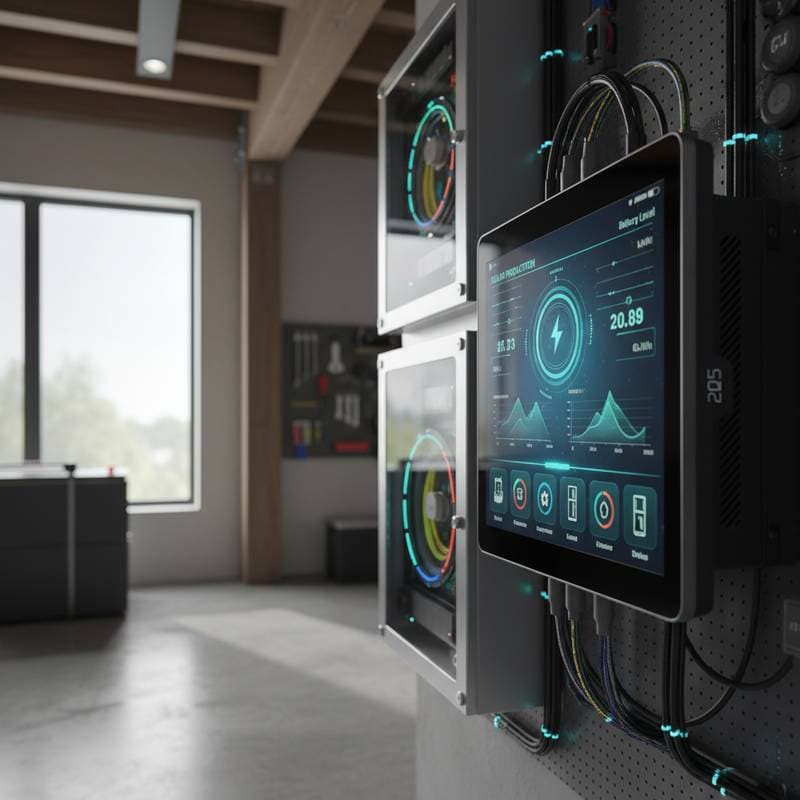
Leading Smart Solar Home Monitors for 2025 Efficiency
Homeowners often question the optimal performance of their solar installations. Even pristine panels can harbor subtle inefficiencies that erode potential savings. Smart solar home monitors eliminate uncertainty by providing real-time data on electricity generation, household consumption, and battery operations. This visibility enables informed decisions that maximize energy value.
Contemporary monitoring solutions surpass basic inverter displays. They integrate sensors, advanced software, and cloud-based analytics to uncover usage patterns influencing comfort and expenses. With comprehensive setups, users gain visibility into appliance interactions with solar output, pinpoint wasteful practices, and refine behaviors to further reduce costs.
The Value of Solar Monitoring
Solar efficiency hinges on informed daily choices. In the Philadelphia region, a standard 7 kW system generates approximately 9,100 kWh annually under ideal conditions, including full sunlight, a 30-degree roof angle, and limited shading. At a utility rate of 24 cents per kWh, this output translates to about $2,180 in avoided costs. However, factors such as panel soiling, inverter misalignment, or standby device power can diminish savings by 5 to 15 percent.
Effective monitoring converts raw data into practical strategies. By aligning consumption with generation peaks, users shift high-energy tasks to solar-abundant daylight hours. For instance, operating a dishwasher midday rather than evening preserves several hundred kWh yearly, equating to roughly $70 in savings and avoidance of 400 pounds of carbon emissions.
Mechanics of Smart Solar Monitors
These devices gather information from primary sources. Sensors capture direct current output from panels prior to inverter conversion. Smart meters log alternating current at the service panel to measure overall household demand. Integrated software merges these inputs to differentiate solar-supplied power from grid reliance.
Advanced units also oversee battery systems, detailing charge levels, flow rates, and efficiency metrics. Optimized batteries achieve up to 90 percent round-trip efficiency. Suboptimal configurations may fall to 80 percent, resulting in hundreds of lost kWh annually.
Certain monitors extend to circuit-specific tracking, quantifying energy draw by individual appliances. This granularity highlights culprits like inefficient space heaters or aging refrigerators that inflate bills by hundreds of dollars each year.
Recommended Smart Solar Monitors
1. Sense Solar Energy Monitor
Sense employs machine learning to discern electricity usage signatures. Installed at the main panel, it identifies appliances through pattern recognition. A solar-specific add-on module monitors production independently. The companion app illustrates solar coverage of loads and grid dependencies, making it suitable for users desiring integrated solar and appliance analytics.
2. Emporia Vue 2
Equipped with sensors for each breaker, the Vue 2 provides complete circuit oversight. It accommodates battery integration and time-of-use optimization. Custom alerts notify users of usage surges. Favored for user-friendly setup, it pairs with smart plugs to enable remote outlet management.
3. SolarEdge Energy Hub with Monitoring Portal
SolarEdge inverters feature native per-panel monitoring. The Energy Hub enhances this with battery insights and compatibility for smart devices. It interfaces with EV chargers and automation platforms, appealing to those preferring a unified system over disparate components.
4. Enphase Enlighten
Paired with Enphase microinverters, Enlighten tracks individual module output. It visualizes timelines affected by shading or temperature. Early alerts for performance decline support consistent system yields.
Investment and Return Analysis
Prices for smart monitors span $150 to $600, varying by capabilities. Installation by professionals adds $200 to $500. Returns stem from efficiency gains and rapid issue resolution. Recovering just 5 percent of output on a 9,100 kWh system yields $110 in annual savings, achieving payback in three to five years with ongoing benefits.
Additional advantages include preserved time and extended equipment life. Prompt fault detection averts prolonged outages. Load shifting reduces demand charges under time-based tariffs.
Available Incentives and System Fit
When bundled with solar installations, monitors often qualify for energy-related tax credits due to their role in supporting generation. Consult installers or tax advisors for eligibility confirmation.
Integration varies by inverter model, connectivity, and network availability. Wi-Fi-enabled options with cloud interfaces dominate modern systems. For data privacy, select on-premises solutions that retain information locally.
Ensuring Ongoing Performance and Precision
Post-installation, monitors demand little maintenance. Update firmware regularly and examine data monthly. Cross-reference with utility statements; discrepancies under 3 percent are typical. Wider variances suggest calibration needs.
Environmental factors like debris, foliage shadows, or accumulation can distort readings. Conduct periodic inspections. App notifications for abrupt generation dips often indicate obstructions or breaker issues.
Embedding Monitoring into Daily Routines
Beyond hardware, monitoring fosters behavioral shifts. Visualizing evening consumption peaks prompts rescheduling of laundry, meal preparation, or device charging to solar hours. Many users report 5 to 10 percent overall reductions from heightened awareness alone.
Combine with intelligent thermostats and networked appliances for automation. Excess solar detection can trigger water heaters or battery top-offs seamlessly.
Practical Steps for Implementation
Review a year's utility bills to establish consumption baselines. Solicit installer quotes specifying uniform system parameters and monitoring inclusions. Inquire about data control and compatibility with batteries or EVs. After activation, analyze weekly reports and adapt habits accordingly.
These measures convert data into tangible gains in efficiency and sustainability, making homes more self-reliant.
Frequently Asked Questions
Do inverter displays suffice without a dedicated monitor?
Inverters report generation alone. Full monitors assess both production and usage, clarifying self-consumption rates and grid interactions.
Will a monitor directly cut my energy bills?
It provides insights for informed choices that drive reductions, rather than automating savings.