
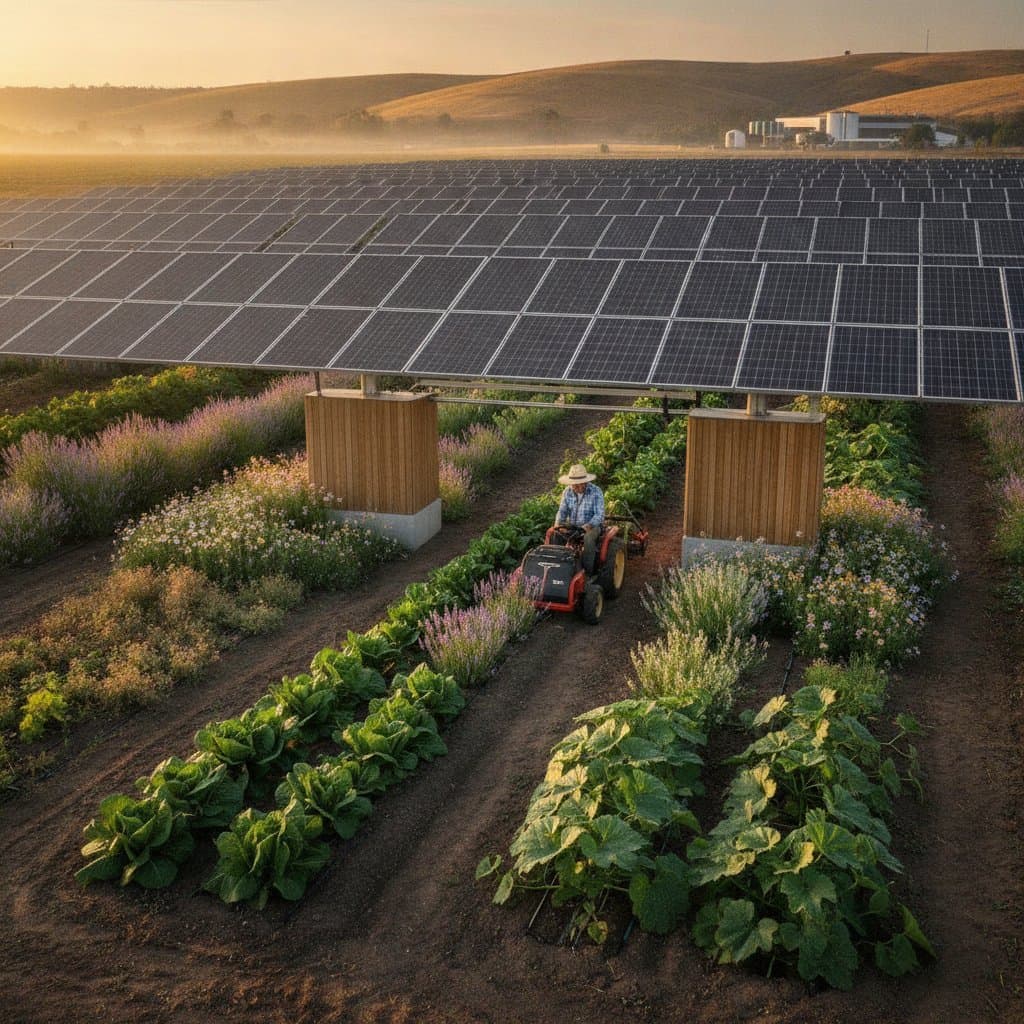
Agrivoltaic Farms Produce Both Power and Crops
Solar research can feel overwhelming at first. Many people assume solar panels and farmland compete for space. Agrivoltaics challenges that assumption by combining agriculture and solar energy on the same land.
This dual-use model produces both food and clean power. It gains attention among farmers, renewable energy developers, and communities that want resilient local food systems.
Agrivoltaic farms modify traditional agriculture rather than replace it. Farmers raise solar panels high enough for crops and livestock to thrive underneath. The same photons that feed a cornfield or strawberry patch also generate electricity for homes, barns, and the grid.
Economics of Dual Land Use
Consider a 25-acre farm with solar modules covering about one-third of the area. The system might total 2 megawatts of capacity and produce roughly 2,600 kilowatt-hours per kilowatt each year. That equals about 5.2 million kilowatt-hours annually.
At a local blended utility rate of 15 cents per kilowatt-hour, the electricity value reaches about 780,000 dollars per year. After maintenance, land lease payments, and taxes, net returns can exceed 500,000 dollars annually.
The same land produces crops on the remaining two-thirds of the acreage. At 2,000 dollars per acre from vegetables or forage, that adds another 33,000 dollars. Combined, the farm earns a stronger and more stable income stream.
Over a 20-year window, such a system could offset millions in energy costs and generate predictable lease income. Payback periods often fall between 7 and 12 years depending on incentives, financing terms, and crop value.
Design and Siting Considerations
Designing an agrivoltaic farm requires balancing crop biology, solar technology, and farm operations. Key variables include sunlight hours and intensity, panel height and spacing, soil type and drainage, access roads and fencing, and grid interconnection.
Crops with moderate light needs such as leafy greens, berries, and herbs adapt well to partial shade. Taller racks allow equipment passage. Wider spacing improves air circulation and reduces shading overlap. Farmers often partner with solar developers who handle permitting, financing, and interconnection while the farmer manages crops or grazing.
Incentives and Cost Recovery
Incentives make agrivoltaics more accessible. The federal investment tax credit can cover a portion of installation costs. Many states and utilities offer rebates or production-based payments. Some agricultural grants also fund research plots or pilot projects.
A 2 megawatt system that costs 2.8 million dollars to install qualifies for a 30 percent credit that reduces the upfront cost by 840,000 dollars. Net capital becomes about 1.96 million dollars. With annual net revenue of 500,000 dollars, payback arrives in under four years.
Maintenance usually involves cleaning panels twice per year, inspecting wiring, and trimming vegetation. When livestock graze the site, mowing needs drop and soil compaction remains low.
Monitoring and Long-Term Performance
Digital monitoring systems now track both energy generation and field conditions. Sensors measure panel output, soil moisture, and temperature variations. Data helps optimize irrigation and identify shading issues.
Solar panels lose efficiency gradually, about 0.5 percent per year. After two decades, most systems still operate above 85 percent of their original output. Warranties often cover 25 years or more.
At end of life, panels can be recycled or repurposed. Glass and aluminum frames are easily recovered. New recycling facilities are expanding to handle photovoltaic materials safely.
Steps for Interested Farmers
- Assess land potential by measuring available sunlight, soil type, and local grid access.
- Review federal and state programs for renewable energy and agriculture incentives.
- Consult engineers and agronomists to design layouts that protect crops and maximize energy yield.
- Model both crop revenue and electricity sales to find total return.
- Create a schedule for cleaning panels, monitoring soil, and maintaining fences or irrigation.
Farmers who start small with a pilot acre can expand once they confirm crop performance.
Building Resilient Systems
Agrivoltaic farming offers a path toward resilient food and energy systems. With careful planning and transparent economics, it helps land work smarter while sustaining both crops and clean power for generations.