
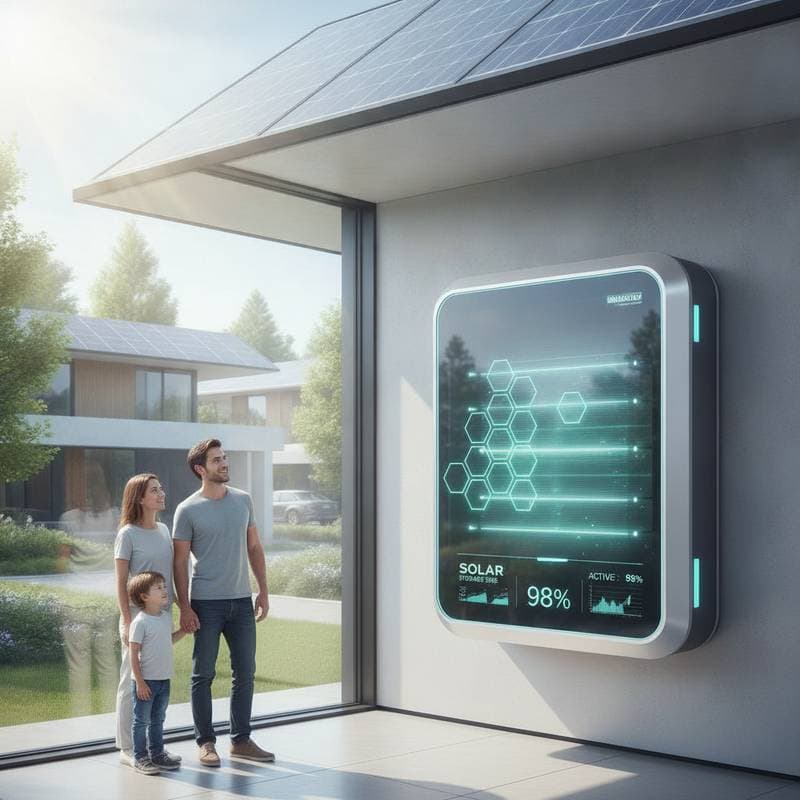
Solid-State Batteries Set to Revolutionize Solar by 2026
Solar research can feel overwhelming at first. Panels, inverters, meters, and now a new type of battery with a name that sounds more like a physics experiment than a home upgrade. Yet solid-state batteries are not science fiction. They represent the next evolution of energy storage and promise higher efficiency, longer life, and greater safety than the lithium-ion cells most homeowners know today.
For anyone considering solar plus storage, this shift is significant. The technology could reshape how households use and store solar power. Energy independence becomes more practical and reliable than ever before.
How the Technology Works
Inside each cell, lithium ions move through a solid layer instead of a liquid. When the battery charges, ions flow from the positive electrode to the negative one and store energy. When the battery discharges, the movement reverses and releases that stored energy as electrical current.
Because the solid material is stable, it prevents the growth of dendrites. These tiny needle-like structures can short-circuit conventional batteries. This stability allows for denser packing of cells, higher operating voltage, and a lower risk of fire or overheating.
In a solar application, this means fewer safety concerns, reduced maintenance, and longer usable life for the battery bank.
Safety and Reliability
Safety has always been a point of concern for homeowners exploring storage. Liquid electrolytes are flammable, and thermal runaway can occur if a cell is punctured or overheated. Solid-state batteries remove that hazard by using materials that do not ignite.
This change makes installation easier, insurance requirements simpler, and long-term peace of mind stronger. For urban homeowners in places like Philadelphia, where solar storage systems often sit in basements or utility closets, that reliability matters.
Realistic Performance Example
Imagine a home with a 7 kW solar system that generates about 1,300 kWh per kW each year. That equals roughly 9,100 kWh of annual production. If the home uses 800 kWh per month, or 9,600 kWh per year, solar production covers most of the load.
A 13 kWh battery allows storage of surplus energy during the day for use at night. With a lithium-ion system operating at 90 percent efficiency, the homeowner would retrieve about 11.7 kWh of usable energy each cycle. A solid-state version at 97 percent efficiency would yield 12.6 kWh. Over a year of daily cycling, that difference totals about 328 kWh of extra usable energy.
At 18 cents per kWh, that is nearly 60 dollars in annual savings, plus the long-term benefit of slower degradation and fewer replacements.
Environmental and Recycling Benefits
Lithium-ion manufacturing requires cobalt and other metals that raise supply and ethical sourcing challenges. Solid-state batteries can use alternatives like nickel or manganese and reduce dependence on scarce materials. Because they last longer, fewer replacements are needed and lifecycle waste decreases.
When eventual recycling occurs, the solid electrolyte is easier to separate from electrodes than liquid-based systems. That simplifies material recovery and reduces chemical waste. For homeowners focused on sustainability, this next-generation storage technology supports a cleaner supply chain from start to finish.
Preparing for the Transition
Homeowners planning solar installations today can take simple steps to stay ready.
- Choose a hybrid inverter that supports both current lithium-ion and future solid-state batteries.
- Install flexible conduit and space for expansion to allow easy retrofit when new models become available.
- Monitor incentive programs because state energy offices and utilities often update rebate lists when new storage technologies qualify.
- Ask about warranty transferability since some manufacturers will apply partial credit if you upgrade to a new battery type from the same brand.
- Stay in touch with your installer because many local solar companies receive early information about upcoming product releases.
By planning now, homeowners can take advantage of today solar incentives while remaining positioned for next-generation storage.
Considering Your Solar Storage Options
If you are considering solar plus storage, start by evaluating your energy goals. Do you want backup power, lower utility bills, or both? A qualified installer can size a system that meets those goals today while leaving room for solid-state upgrades tomorrow.
Ask for quotes that include both current and next-generation options. Compare lifetime costs, not just upfront prices. Factor in warranty length, cycle life, and efficiency. When solid-state batteries reach full availability, early preparation will make the upgrade smooth and cost-effective.
FAQ
1. What is the main advantage of solid-state batteries for solar storage?
They offer higher energy density, longer life, and improved safety compared to traditional lithium-ion batteries.
2. Are solid-state batteries safer?
Yes. They use a nonflammable solid electrolyte that removes the risk of leakage or fire associated with liquid electrolytes.
3. How long do they last?
Typical designs are expected to last more than twice as long as lithium-ion systems, often exceeding 10,000 charge cycles.
4. Can I upgrade my existing solar system later?
In many cases, yes. If your inverter and wiring are compatible, a future retrofit with a solid-state battery may be possible.
5. Will they reduce maintenance?
Yes. There are no liquid components to monitor, and solid-state designs are more stable over time.
6. How efficient are they compared to current batteries?
Most projections show round-trip efficiencies between 95 and 98 percent, compared to about 90 percent for lithium-ion.
7. What will they cost?
Prices will start higher but are expected to fall near or below current lithium-ion costs as production scales.
8. Are there environmental benefits?
Yes. They can use less cobalt and other scarce metals, last longer, and simplify recycling processes.