
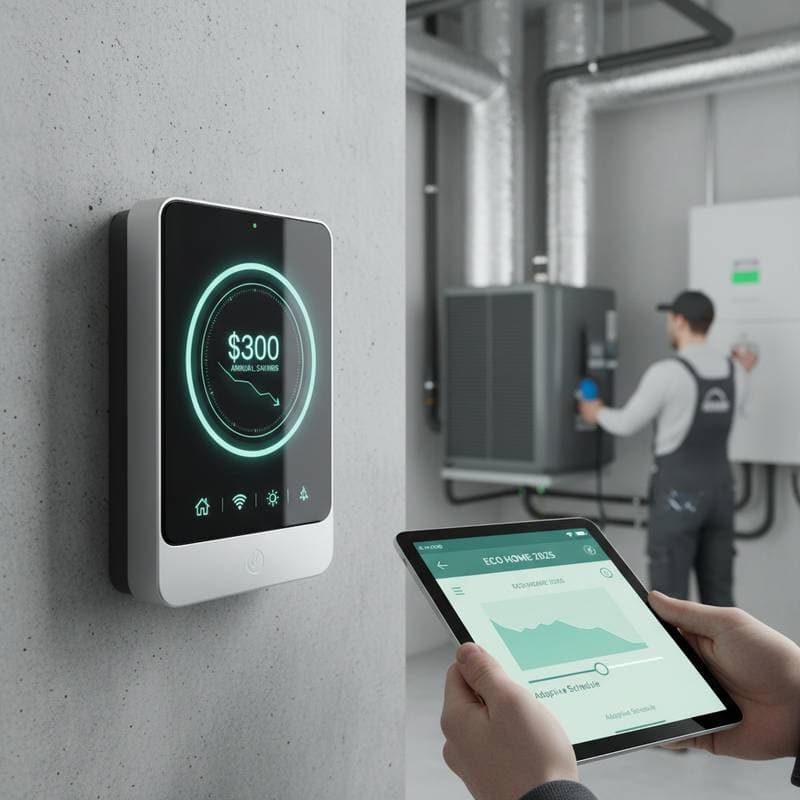
Unlock Up to $300 in Yearly Savings with Leading 2025 Smart Thermostats
Smart thermostats combine comfort, convenience, and substantial energy savings, yet many homeowners question the reality of those benefits. The prospect of lowering heating and cooling expenses while maintaining an ideal indoor environment may seem idealistic. However, with proper installation and configuration, these devices can decrease annual utility bills by as much as $300. Understanding their mechanisms, energy-saving strategies, and optimal models ensures homeowners select options that deliver genuine value.
Mechanisms of Smart Thermostats
A smart thermostat employs sensors, Wi-Fi connectivity, and advanced algorithms to manage heating and cooling with greater precision. It monitors indoor temperature trends, resident occupancy, and external weather conditions to fine-tune operations. For instance, the device reduces heating or cooling intensity when the home stands empty, preventing energy expenditure on unoccupied spaces. Upon detecting resident return, it swiftly restores comfortable conditions.
Core components include a precise indoor temperature sensor that relays data directly to the HVAC system. Additional features such as motion sensors or geofencing utilize smartphone GPS to track arrivals and departures. As usage patterns emerge, the thermostat refines preferred settings and routines, minimizing the need for manual interventions. This approach yields efficient climate management that surpasses the limitations of conventional thermostats, which depend on static schedules or frequent adjustments leading to excess energy consumption.
Calculating Realistic Energy Savings
Examine a standard Philadelphia residence equipped with a gas furnace and central air conditioning, where yearly heating and cooling expenses total approximately $1,500. A smart thermostat capable of reducing energy consumption by 20 percent generates savings of $300 annually. The calculation proceeds as follows:
- Baseline annual HVAC expenditure: $1,500
- Projected efficiency gain: 20 percent
- Resulting savings: $1,500 multiplied by 0.20 equals $300
These savings recur annually, and with device prices ranging from $150 to $250, return on investment occurs within one year. Beyond initial recovery, the thermostat continues to generate passive financial benefits through automated optimizations.
Essential Features for Maximum Efficiency
Smart thermostats achieve their savings potential via targeted functionalities. Each feature addresses specific inefficiencies in traditional systems.
-
Adaptive Scheduling
The device analyzes daily routines to align temperature adjustments with actual occupancy, eliminating energy loss from conditioning vacant areas. -
Remote Access Capabilities
Mobile applications enable settings modifications from any location, allowing preemptive changes to avert wasteful operation during commutes or travel. -
Detailed Energy Analytics
Integrated reports display consumption histories alongside personalized recommendations, empowering users to eliminate patterns like extended runtime in temperate conditions. -
Seamless Smart Home Integration
Compatibility with voice-activated assistants, automated lighting, and additional sensors creates a cohesive ecosystem that amplifies overall energy management. -
Proactive Weather Monitoring
Access to current forecasts enables anticipatory adjustments, such as pre-heating during incoming cold fronts to maintain efficiency.
Selecting an Appropriate Model
Optimal thermostat selection hinges on existing HVAC configuration, household dimensions, and prioritized functionalities. Distinctions among tiers primarily involve algorithmic sophistication, user interface design, and ecosystem compatibility.
- Basic Options provide essential app-based controls, programmable schedules, and fundamental usage monitoring.
- Intermediate Models incorporate machine learning for pattern recognition and broader support for systems like heat pumps or zoned heating.
- Advanced Units include multi-sensor arrays, built-in voice interfaces, and compatibility with accessories such as smart vents or indoor air quality trackers.
Prior to purchase, verify alignment with your system's wiring and protocol requirements. Legacy setups occasionally necessitate a C-wire adapter. Professional assessment or reference to the manufacturer's compatibility tool resolves uncertainties effectively.
Step-by-Step Installation Process
DIY installation typically requires less than one hour and basic tools like a screwdriver and voltage tester. Proceed methodically to ensure safety and functionality.
- Disconnect power to the HVAC unit at the breaker panel.
- Detach the existing thermostat, photographing wire connections for reference and labeling each accordingly.
- Attach labeled wires to the corresponding terminals on the new thermostat's baseplate.
- Secure the baseplate to the wall and snap the display unit into place.
- Re-energize the system and complete initial configuration via the device's interface.
Post-installation, establish Wi-Fi linkage and register through the dedicated application. Input geographic details, desired temperature thresholds, and routine information. The system initiates learning within days, progressively enhancing performance based on observed behaviors.
Long-Term Financial Analysis
Over a 10-year span, cumulative savings from a smart thermostat may surpass $2,500, predicated on consistent $300 annual reductions and negligible upkeep expenses. Regular firmware updates prolong device longevity and sustain interoperability with emerging technologies. Utility incentives, often ranging from $50 to $100, further accelerate cost recovery by offsetting upfront expenditures.
Factors Influencing Performance
Actual savings fluctuate according to regional climate, building envelope quality, and occupant habits. Residences plagued by drafts or antiquated equipment realize modest gains, whereas well-insulated structures with modern HVAC derive amplified benefits. Local utility pricing amplifies value, as elevated rates magnify the impact of conserved energy. Engaging features like economy modes or vacancy detection consistently maximizes outcomes.
Ongoing Maintenance Practices
These devices demand little intervention beyond routine software refreshes to access enhancements and security patches. Periodically wipe sensors free of accumulated dust to preserve accuracy. Confirm robust Wi-Fi signal strength, essential for remote functionalities and data synchronization. Monthly review of analytics reports, coupled with periodic preference tweaks, sustains optimal efficiency.
Homeowners poised for implementation should first investigate rebate qualifications through local providers. Evaluate models suited to your infrastructure, prioritizing comprehensive manuals, responsive support channels, and warranties extending at least three years. Following deployment, track utility statements over three to six months to quantify realized efficiencies and refine settings accordingly.
Frequently Asked Questions
How do smart thermostats achieve energy savings?
They modulate heating and cooling operations according to real-time occupancy, programmed schedules, and meteorological inputs, thereby curtailing idle system activity.
Is self-installation feasible?
Yes, provided wiring compatibility exists; comprehensive instructions and application-guided assistance accompany most units.
Do they integrate with every HVAC configuration?
Compatibility covers the majority of conventional setups, although vintage systems might require adapters or expert intervention.
What annual savings should one anticipate?
Expectations range from $200 to $300, modulated by environmental factors, tariff structures, and operational consistency.