
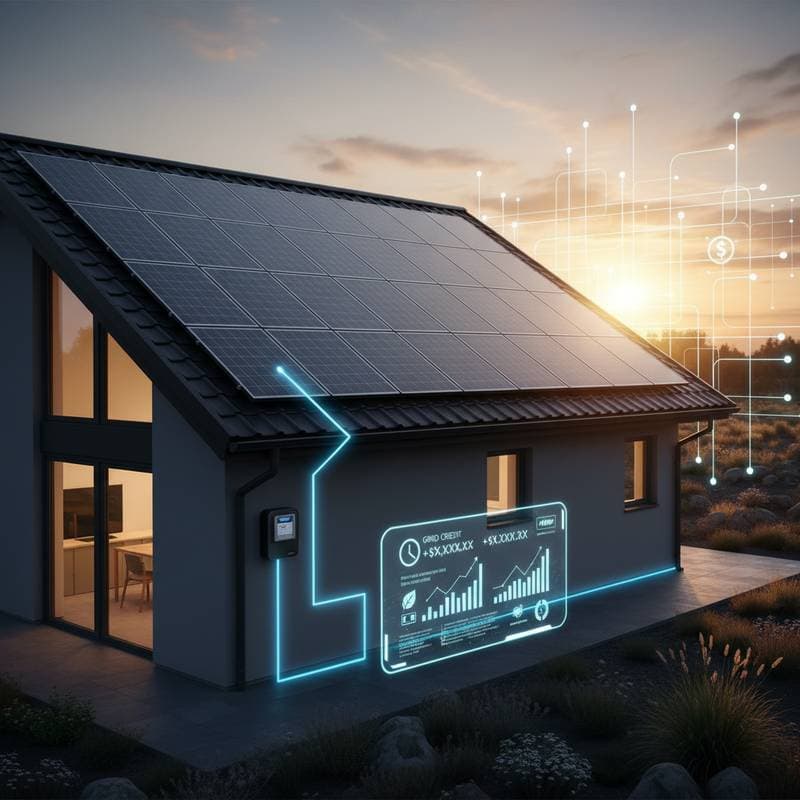
Utilities Compensate for Solar: The Grid Stability Incentive
Researching solar options often presents a maze of information for homeowners. Many discover that utilities offer payments for generating clean energy, though the specifics remain obscured by technical jargon. The prospect of a power company compensating for rooftop panels may appear implausible, yet the logic proves straightforward and grounded in practical needs.
Utilities do not compensate for sunlight. They reward contributions to system stability, added capacity, and lowered demand on strained grids. As more residences produce their own electricity, peak loads decrease, infrastructure faces less pressure, and costly expansions become avoidable. These incentives, credits, and payments stem directly from such efficiencies.
This guide details the operational mechanics of these compensations, factors influencing earnings, and methods to estimate returns on a standard residential solar setup in Philadelphia and nearby regions.
The Mechanics of Solar Energy Production and Credit Generation
Photons from sunlight interact with silicon cells in solar panels, dislodging electrons to form an electric current. This direct current passes through an inverter, which transforms it into alternating current suitable for household use. Excess electricity beyond immediate needs travels back through the meter to the utility grid.
The meter tracks both imported energy for consumption and exported energy from production. Excess exports during a billing period generate credits. If imports exceed exports, credits offset the balance, or the difference incurs a charge.
In Pennsylvania utility service areas, one exported kilowatt-hour typically offsets one imported kilowatt-hour at full retail value or a modest discount. This discount accounts for grid upkeep and operational expenses. The arrangement incentivizes clean energy production, particularly during periods of elevated grid demand.
Exploring Capacity Payments for Grid Support
A lesser-discussed benefit involves capacity payments for distributed energy resources that alleviate peak loads. Certain utilities and regional operators provide remuneration to resources enhancing grid reliability.
In response to severe weather or high usage, utilities traditionally compensate industrial facilities for load reduction. Increasingly, they extend similar payments to solar owners equipped with smart inverters or batteries capable of exporting power or curtailing consumption during critical intervals.
Consider these as availability fees. Homeowners provide not only electricity but also operational flexibility. Such contributions prove more economical for the grid than constructing additional substations or generation facilities.
Program details differ by provider, yet a solar system integrated with storage often qualifies for modest monthly credits, ranging from five to twenty dollars, for readiness during peak events. Accumulated over time, these enhance the overall financial return and accelerate investment recovery.
Analyzing Costs, Payback Periods, and Investment Returns
A reliable 7-kilowatt solar system in the Philadelphia area installs at 2.60 to 3.10 dollars per watt prior to incentives, yielding a total cost of 18,000 to 22,000 dollars.
The federal investment tax credit reduces the net expense to approximately 13,000 to 15,000 dollars. Additional local rebates and initial Solar Renewable Energy Credit (SREC) proceeds, totaling 1,000 to 2,000 dollars, further lower the upfront investment to 12,000 to 14,000 dollars.
Annual bill reductions and credits average 1,800 dollars, resulting in a payback period of six to eight years. Panels come with 25-year warranties guaranteeing at least 80 percent output capacity at the end. Across 20 years, cumulative savings surpass 35,000 dollars, assuming stable electricity rates.
These figures highlight why utilities favor compensating distributed solar over traditional infrastructure growth. Rewarding homeowner generation offers a cost-effective alternative to centralized expansions.
Grid Benefits from Residential Solar Adoption
Each rooftop installation enhances overall system resilience. Localized generation minimizes transmission inefficiencies, stabilizes voltage levels, and diminishes reliance on fossil fuel-based peaking units.
When numerous homes generate power simultaneously, grid operations improve markedly. This collective stability reduces utility expenses over time and fosters a more sustainable, adaptable energy framework.
Homeowners achieve bill savings while contributing to blackout prevention and demand-driven price volatility. The compensations received directly acknowledge this dual value.
Practical Steps for System Optimization and Upkeep
After activation, maintain peak performance through routine practices.
- Conduct visual inspections of panels twice annually to identify debris, bird droppings, or encroaching shade from vegetation.
- Clean panels with a gentle water rinse if dust or pollen accumulates; refrain from abrasive methods.
- Track output via inverter displays or monitoring applications; investigate abrupt declines for issues like circuit interruptions or shading.
- Review SREC and utility statements quarterly to verify accurate credit application.
- Schedule efficiency audits with installers every few years to confirm optimal operation.
Solar panels require little maintenance due to their static design, yet vigilant oversight maximizes entitled production and earnings.
Frequently Asked Questions
Do all utilities compensate homeowners for solar-generated power?
Most regulated utilities implement net billing or credit systems. Rural cooperatives or municipal providers may employ alternative frameworks, but compensation for exported energy remains standard across nearly all.
What occurs at night when panels produce no energy?
Grid power supplies nighttime needs, offset by accumulated daytime credits. Battery storage, if installed, supplies reserved energy to cover portions of evening consumption.
How do Solar Renewable Energy Credits function?
For every megawatt-hour produced, a system generates one SREC. Owners sell these through state-regulated markets to utilities fulfilling renewable portfolio requirements.
Is monthly cash payment available?
Certain initiatives deliver bill credits rather than cash. SREC transactions, however, often result in direct deposits or checks based on enrollment.
How does roof orientation or shading impact viability?
East- or west-facing roofs or partial shading reduce output, but larger arrays or advanced panels mitigate effects. Installers provide production simulations prior to setup.