
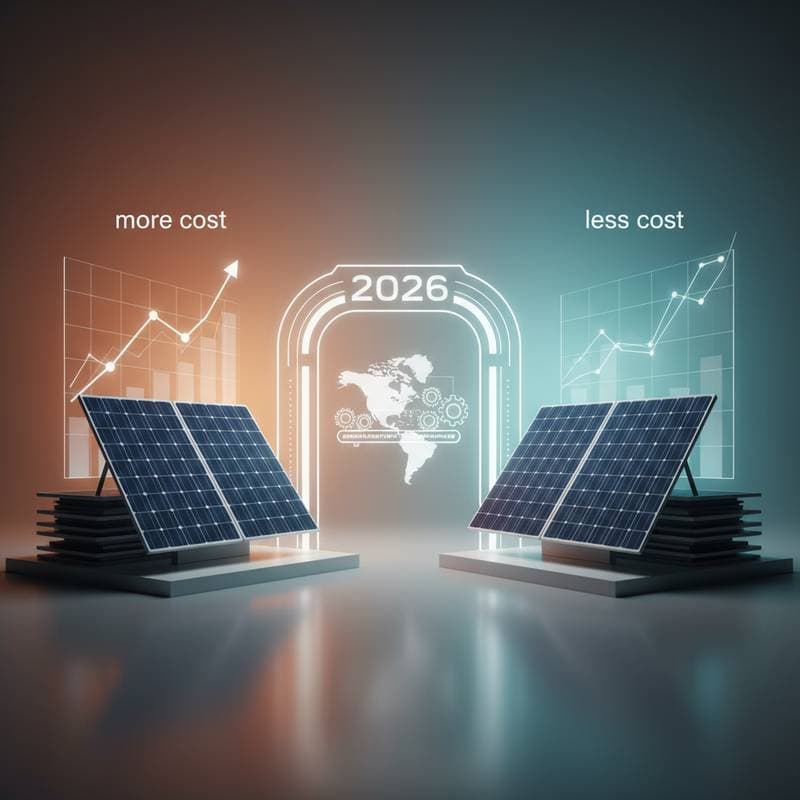
2026 Tariffs: Will Solar Panel Prices Rise or Fall?
Solar research often presents challenges for homeowners. Policy changes, global supply dynamics, and manufacturing goals create uncertainty about future costs. Many individuals ask whether upcoming tariffs will increase or decrease the price of solar panels. The outcome hinges on trade regulations, production capabilities, and the pace of domestic manufacturing expansion.
This article examines the effects of tariffs on solar panel pricing, potential developments under new policies, and preparation strategies for homeowners. It also explores interactions between cost trends, installation schedules, incentives, and system return on investment.
Understanding Tariffs in the Solar Industry
Tariffs function as taxes on imported products. Governments impose them on solar panels and components to bolster local production and employment. However, elevated tariffs can elevate equipment expenses, potentially hindering adoption among residential and commercial users.
These duties typically target photovoltaic modules, cells, wafers, and glass. Panels from regions with large-scale manufacturing offer the lowest production costs, which maintain affordable retail prices. Tariffs increase these costs, forcing installers to choose between absorbing the difference or transferring it to clients.
The impact varies with domestic production growth. Sufficient local output can limit price hikes. Insufficient supply may drive costs higher until equilibrium restores.
Tariffs and the Solar Supply Chain
The solar supply chain spans raw materials such as polysilicon, wafers, cells, and assembled modules. Components frequently traverse international borders before installation. A tariff at any stage elevates expenses for subsequent processes.
Consider a module produced abroad at 25 cents per watt. A 15 percent tariff raises this to approximately 29 cents per watt. Including shipping, distribution, and margins, retail prices may increase by 10 to 15 cents per watt.
For a standard 7-kilowatt residential system, this adjustment adds 700 to 1,000 dollars to equipment expenses. Labor and permitting costs remain unchanged, yet the overall project price rises by several percentage points.
When tariffs lapse or decrease, importers reduce wholesale rates, and installers typically relay savings to customers. Such fluctuations can alter payback timelines by one year or longer.
Factors Influencing the 2026 Tariff Landscape
Forecasting tariff effects requires consideration of multiple elements. Trade policies, manufacturing subsidies, and international supply trends converge to shape outcomes.
Rapid domestic production growth could satisfy residential needs, steadying prices. Numerous states witness new factories for modules and cells. These sites target panel quality comparable to imports, alongside reduced shipping expenses and faster delivery.
Continued progress might minimize tariff influence upon implementation. Prices could hold steady or decline modestly amid heightened competition.
Slower domestic expansion would sustain import reliance. Tariffs then amplify costs pending additional local capacity.
Exchange rate variations, shipping constraints, and material costs further affect results.
Calculating Tariff Impacts on Homeowner Costs
Homeowners benefit from basic calculations to gauge tariff effects on solar investments.
A 7-kilowatt system generates about 9,100 kilowatt-hours yearly at 1,300 kilowatt-hours per kilowatt. With electricity at 18 cents per kilowatt-hour, savings total 1,640 dollars annually.
An 8 percent tariff-induced price rise on a base of 2.60 dollars per watt shifts the system cost from 18,200 dollars to 19,700 dollars.
Applying the 30 percent federal tax credit yields a net expense of 13,790 dollars under tariffs, versus 12,740 dollars otherwise. This 1,000-dollar difference prolongs payback by 7 to 8 months at consistent rates.
Price reductions from lower tariffs or domestic efficiencies shorten payback similarly. A 5 percent drop accelerates return by roughly six months.
U.S. Manufacturing and Supply Chain Stability
Policymakers view tariffs as tools to foster robust domestic production. Expanded factories lessen foreign dependency and generate employment. In solar, this enhances quality oversight, warranty support, and distribution efficiency.
A 2-gigawatt annual capacity plant equips approximately 285,000 typical residential systems. Increasing facilities spur U.S. producer rivalry, potentially lowering prices despite ongoing tariffs.
Domestic sourcing accelerates delivery. Installers obtain materials in weeks rather than months, maintaining project timelines.
Scaling challenges include higher equipment, labor, and energy costs compared to international operations. Manufacturer tax credits mitigate these disparities.
Timing Installations Amid Tariff Shifts
Solar purchasers confront critical timing choices. Installation before tariff adjustments or afterward depends on market adaptation.
Anticipated tariffs prompt demand surges. Installers stockpile imports to preempt hikes, occasionally straining supply and elevating short-term prices.
Post-adjustment, prices often normalize as production aligns. Transition phases prove erratic, favoring early contract commitments for imminent projects.
Fixed-price quotes safeguard against volatility if scheduled promptly. Many installers uphold terms for projects within months, irrespective of later policy alterations.
Interplay Between Tariffs and Incentives
Tariffs modify equipment costs, while incentives determine net outlays. Total expenses reflect tax credits, rebates, and utility programs.
The federal 30 percent credit applies to full installation costs. Tariff-driven increases proportionally boost credit value, cushioning some effects.
State and utility incentives, often fixed per watt or performance-based, cover less of elevated totals. Net cost comparisons post-incentives remain essential.
Solar retains compelling economics despite tariffs, as utility rates rise while generation persists reliably.
Evolving Solar Price Dynamics
Solar module prices have fallen sharply over the last decade through efficiency advances and scaled production. Tariffs may pause this trajectory temporarily, yet technological progress sustains downward pressure.
Current panels surpass 21 percent efficiency, up from 15 percent previously. Greater output per area trims ancillary expenses.
Tariffs adding cents per watt to modules affect only 30 to 40 percent of system costs. Inverter, mounting, and labor enhancements offset impacts.
Overall, tariffs alter one element, not the comprehensive cost structure.
Strategies to Navigate Tariff Uncertainty
Homeowners employ targeted actions to anticipate market changes.
- Obtain quotes from at least three installers to evaluate tariff cost management.
- Inquire about domestic panel sourcing to bypass import duties.
- Verify contract clauses on price locks versus adjustments.
- Schedule installations pre-surge if roofs prepare adequately.
- Monitor incentive availability, as funds deplete over time.
These measures minimize risks and enable confident decisions.
Sustaining Solar System Performance
Post-installation, tariffs cease direct relevance. Systems produce power for decades amid evolving markets. Routine upkeep preserves output and longevity.
-
Clean panels annually or biannually to remove debris reducing efficiency.
-
Monitor inverter data monthly for output anomalies indicating issues.
-
Utilize system apps for real-time and trend analysis.
-
Examine warranties, typically 25 years with minimal degradation.
-
Consider recycling options for end-of-life panels.
Maintained systems counter escalating utility expenses effectively over time.