
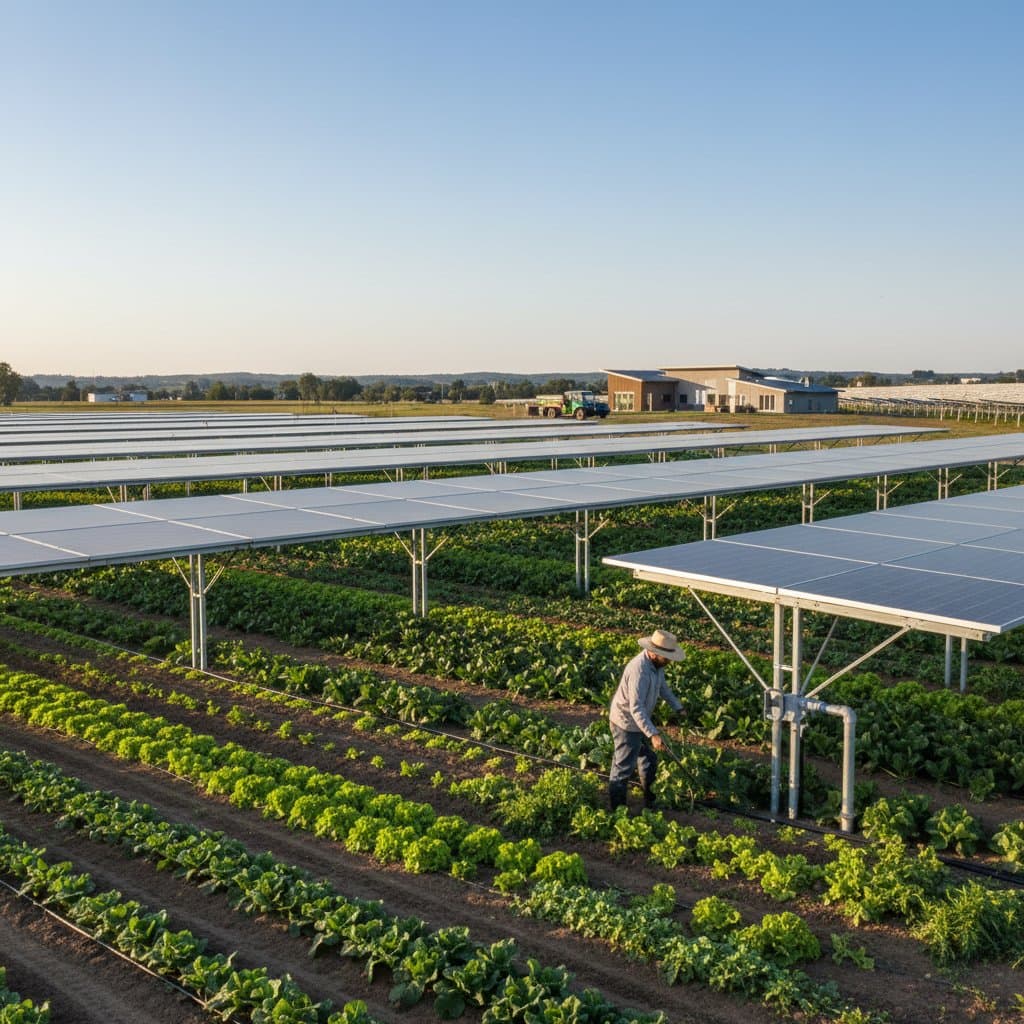
The 2026 Agrivoltaics Expansion: Dual Use of Farmland for Crops and Solar Power
Agrivoltaics combines crop production and solar electricity generation on the same land. Panels sit elevated above fields so that plants receive filtered sunlight while the arrays produce power for farm operations or sale to the grid. This arrangement reduces water demand, stabilizes yields in hot climates, and creates an additional revenue source without removing acreage from agriculture.
System Layout and Daily Operation
Panels mount on frames 8 to 12 feet high with spacing that permits 60 to 80 percent of normal light to reach the ground. Shade tolerant crops such as lettuce, spinach, potatoes, and berries grow beneath the arrays. Sheep can graze the understory to control vegetation.
Sunlight striking the silicon cells generates direct current. Inverters convert the current to alternating current for immediate use or export. Net billing programs credit any surplus, turning the farm into both a food producer and an on site power supplier.
Advantages for Landowners and Operators
Single purpose solar arrays compete with food production for fertile ground. Agrivoltaic designs eliminate that choice. One acre now supplies both harvest income and electricity sales or lease payments. In regions where land prices reflect high soil value, this dual output protects agricultural returns while adding cash flow.
Partial shade lowers soil temperature and cuts evaporation. Field trials record 10 to 20 percent reductions in irrigation needs. The moderated microclimate also lengthens the growing window for cool season vegetables and protects fruit during heat waves.
Economic Example for a Mid Size Installation
A 20 acre site hosts a 1 megawatt array. Annual output reaches approximately 1.3 million kilowatt hours at typical insolation levels. At a blended utility rate of 14 cents per kilowatt hour, the energy value equals 182000 dollars each year.
Elevated racking costs 1.40 to 1.90 dollars per watt installed, placing the project near 1.6 million dollars before incentives. A 30 percent federal tax credit lowers the net investment to roughly 1.1 million dollars. Simple payback occurs in about six years, after which the system supplies low cost power for the remaining 20 plus years of its service life.
Design Choices That Influence Crop and Energy Results
Panel tilt, row spacing, and height must match crop light requirements. Leafy greens tolerate 40 percent shade. Fruiting crops such as tomatoes perform best with 20 to 25 percent shade. Seasonal adjustment of tilt through tracking hardware can raise energy yield by 15 to 20 percent, though fixed tilt structures remain less expensive to install.
Soil moisture sensors and drip lines maintain consistent root zone conditions. Data logs that combine energy output with shade duration help operators refine crop selection and irrigation schedules after the first season.
Upkeep Requirements and Enduring Returns
Routine tasks include panel cleaning, inverter inspection, and vegetation management. Existing farm equipment or rotational grazing handles weed control without extra passes. Warranties cover 25 years of output with annual degradation below 0.5 percent.
Beyond direct energy savings, the installation can improve eligibility for conservation financing and attract buyers who value documented sustainability practices. Fixed solar costs also buffer the operation against future utility rate increases.
Steps to Evaluate and Deploy a System
Begin with a site assessment that records solar access, slope, and soil type. Local permits typically follow standard solar procedures plus an agricultural compatibility review. Installers experienced in dual use layouts coordinate panel height and spacing with planned crop rotations from the outset.
After commissioning, monitoring software tracks both kilowatt hour production and light transmission. Adjustments to irrigation timing or panel angle in the second year often improve combined returns.
Questions Frequently Raised by Operators
- Which crops adapt most readily? Leafy greens, root vegetables, and pasture grasses maintain acceptable yields under partial shade.
- Does reduced light cut total harvest? Individual crop output may decline modestly, yet combined crop plus energy revenue exceeds conventional single use results.
- Is livestock compatible? Sheep and other small ruminants fit beneath the arrays and provide natural vegetation control.