
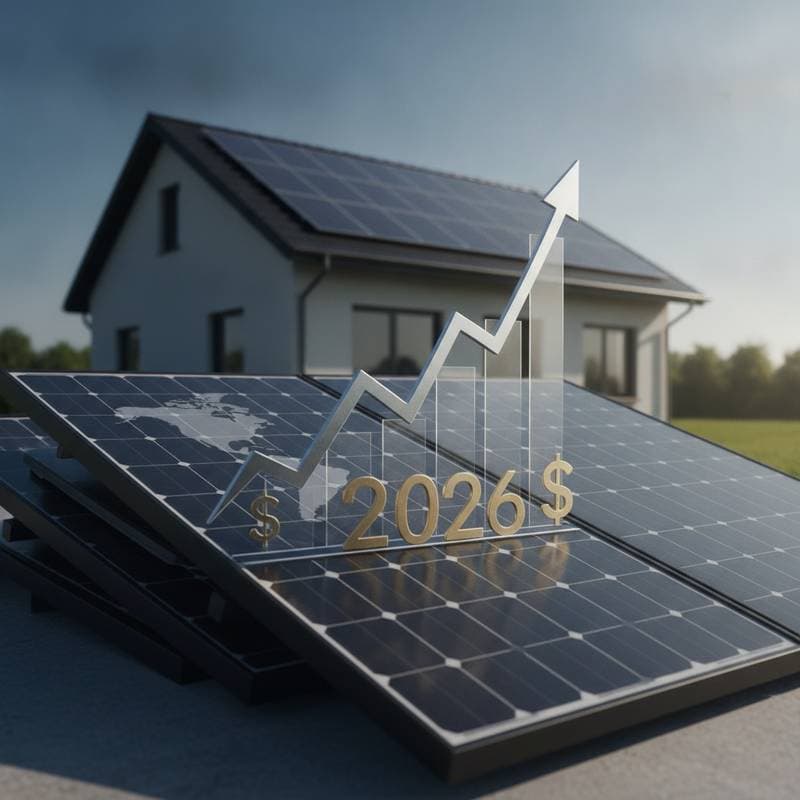
2026 Solar Tariffs Will Raise Panel Costs
Solar research becomes clearer once global trade rules connect directly to local installation prices. Many homeowners now hear about tariff changes that will increase the cost of imported solar panels. The impact remains straightforward. Tariffs raise panel prices and therefore increase upfront system costs.
The upcoming changes will influence nearly every segment of the residential solar market. Policy details center on import duties, yet the effects reach homeowners, installers, and equipment suppliers alike. Solar continues to rank among the most cost effective energy upgrades. Planning a project with clear expectations before prices rise remains the practical step.
How Tariffs Influence Residential System Prices
A solar system total installed cost includes equipment, labor, permitting, and overhead. Panels represent roughly 30 to 35 percent of that total. A 10 percent tariff increase on panels therefore lifts overall system price by about 3 percent. On a 20000 dollar system this change adds 600 dollars. A 20 percent tariff increase raises the same system by 1200 dollars.
These figures vary by region and supplier yet illustrate the arithmetic behind recent headlines. For a typical 7 kilowatt home system the adjustment can extend payback periods by several months. A project that once recovered its cost in nine years may require closer to ten years. That shift affects financing decisions, tax credit timing, and return expectations. Installing before tariffs take effect preserves more favorable long term savings.
Domestic Production and Supply Chain Realities
Some installers expect new domestic panel factories to offset tariff pressure. Several facilities are under construction and assembly lines continue to expand. Many of these plants still depend on imported cells and wafers. Higher input costs therefore continue to appear in final pricing.
The move toward complete domestic production requires time for equipment, workforce training, and steady demand. Until capacity grows, installers stay linked to global supply. Homeowners should anticipate price adjustments that reflect both tariff costs and inflation in aluminum, copper, and glass.
Sample Cost and Savings Calculation
Consider a Philadelphia area home with the following parameters.
- System size: 7 kW
- Annual production: 1300 kWh per kW
- Yearly output: 9100 kWh
- Local electricity rate: 18 cents per kWh
- Annual savings: 9100 kWh times 0.18 dollars equals 1638 dollars
A system priced at 19600 dollars today shows a simple payback of 12 years before incentives. The 30 percent federal tax credit lowers net cost to 13720 dollars and shortens payback to roughly 8 years. An additional 1000 dollar tariff increase extends payback by about six months. Lifetime energy savings stay substantial, yet early installation captures faster returns and avoids later utility rate growth.
Installer Strategies for Tariff Changes
Professional installers monitor tariff updates and maintain relationships with several suppliers. When duties shift they adjust sourcing to limit price swings. Some route imports through countries covered by existing trade agreements. Others secure inventory ahead of rate increases.
Homeowners gain from selecting installers who explain sourcing decisions and warranty terms openly. Direct questions about panel origin, performance data, and tariff handling produce clearer comparisons.
Panel Performance Over Country of Origin
Higher price does not guarantee superior quality. Some high efficiency modules come from manufacturers facing larger tariffs, while certain domestic lines carry different brand names. Focus instead on verified efficiency above 20 percent and annual degradation below 0.5 percent. These specifications protect more than 10 percent of total output across a 25 year warranty.
Market Outlook After Tariff Implementation
Tariffs introduce short term price uncertainty yet often support longer term stability. Expanded domestic factories increase competition and may eventually lower costs. Automation and material recycling investments further reduce production expenses. Previous tariff cycles show the industry adapts while adoption continues to grow.
Homeowners continue to choose solar for energy independence and predictable bills. Temporary installation slowdowns rarely reverse the broader trend. Once prices stabilize, solar retains its position as a reliable home improvement.
Steps Homeowners Can Take Immediately
- Obtain multiple detailed quotes that list panel brands, system designs, and warranty coverage.
- Ask installers about current inventory schedules and the option to reserve panels before tariff adjustments.
- Verify continued eligibility for federal and local incentives that offset equipment cost increases.
- Compare fixed rate financing offers to lock monthly payments ahead of potential price rises.
- Book site assessments promptly because engineering reviews and permits require several weeks.
After installation, clean panels twice each year, track output through the inverter application, and arrange professional service every few years. These actions maintain rated production regardless of market shifts.
Common Questions About the Tariff Changes
Will tariffs raise prices on every component?
Tariffs target imported modules and cells. Inverters, mounting hardware, and wiring experience smaller or no direct changes. Overall system cost impact typically ranges between 3 and 10 percent.
Do American made panels eliminate tariff exposure?
Domestic assembly often uses imported cells that still carry duties. Request models fully assembled in the United States to reduce exposure.
Is it better to wait until tariffs stabilize?
Delay usually increases cost. Demand surges ahead of tariff effective dates push prices higher. Earlier installation secures current pricing and begins savings sooner.
How do tariffs affect battery storage?
Most tariff rules focus on panels. Battery pricing depends primarily on lithium and electronics markets rather than solar trade policy.
Will tax credits or rebates change?
Incentives operate under separate legislation and remain unaffected by tariff adjustments.