
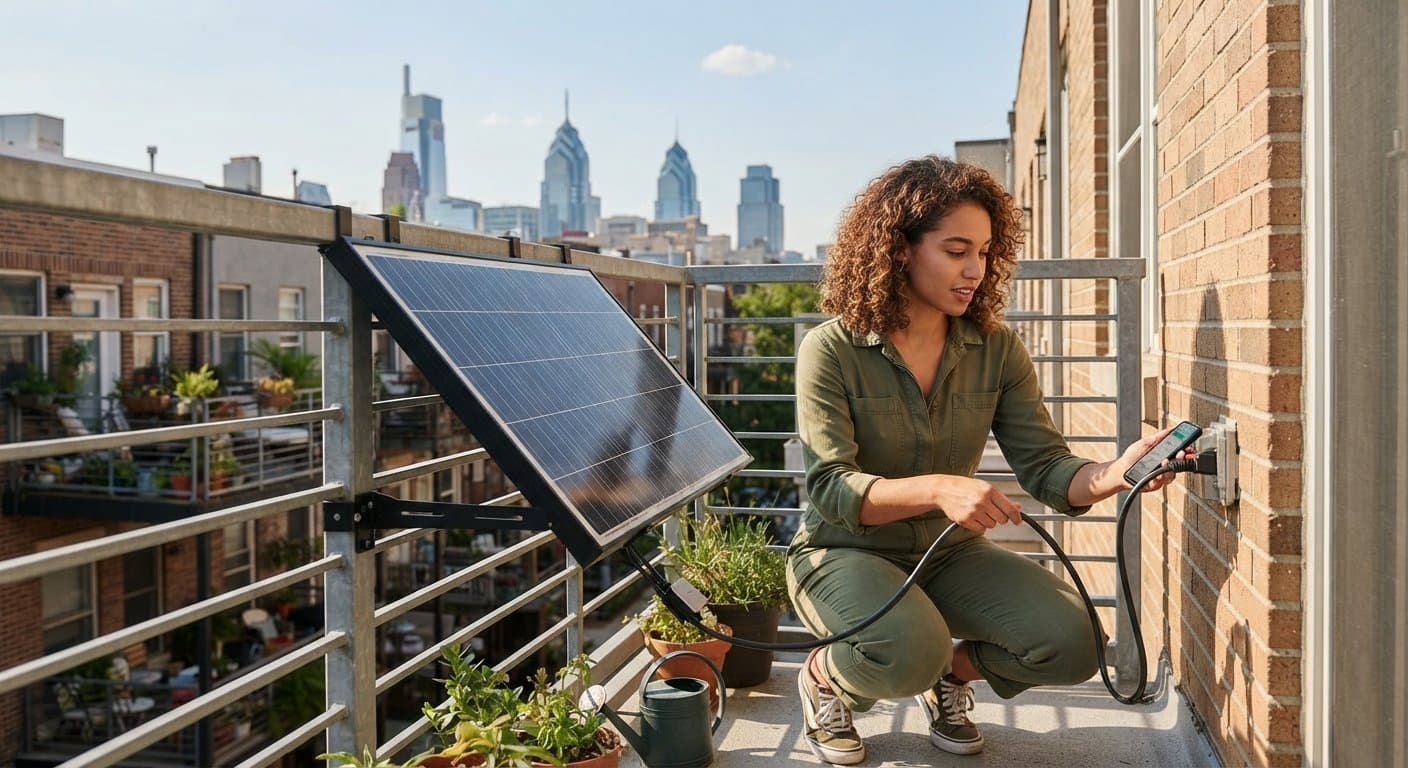
Renters Finally Access Plug-In Balcony Solar Power
Solar can seem out of reach when you rent. Roof panels usually require an owner's approval, and moving can leave you worried about abandoning an investment. Plug-in balcony solar offers a smaller, potentially portable option, but it is not automatically legal, compatible with every outlet, or guaranteed to lower a bill. Philadelphia renters should check building rules, electrical safety, and utility requirements before buying a kit.
What Plug-In Balcony Solar Does
A typical balcony solar kit includes one or more photovoltaic panels, a microinverter, mounting hardware, and a cable that connects to a household outlet. Sunlight moves electrons inside the panels, creating direct current. The microinverter changes that into alternating current, the type used by home appliances.
The electricity flows into the home's electrical circuit and can serve devices that are running, such as a refrigerator, router, or lights. If the panels produce less power than the home needs, the utility supplies the difference. If production exceeds use, extra electricity may flow toward the meter. Whether that earns a credit depends on the utility's rules and the system's approval.
A plug-in kit does not usually power a home during an outage. Standard grid-connected inverters shut off when the grid goes down, protecting utility workers. Backup power requires equipment designed for islanding, often paired with a battery and a permitted transfer system.
What Renters Need to Check in Philadelphia
A balcony panel still counts as an electrical generator. Before installation, ask the property owner or manager for written permission. Review the lease and building rules for restrictions on exterior equipment, railings, wiring, and changes to shared spaces. A panel must not obstruct an exit, create a falling-object hazard, or block required access.
Philadelphia renters should also contact PECO, or the electric utility named on the bill, to ask about interconnection, inspection, metering, and compensation for exported electricity. Requirements depend on equipment and system design. Confirm whether the specific plug-in kit can connect legally before purchasing it. City permitting or electrical requirements may also apply. A licensed electrician can assess the outlet and circuit.
Never assume that any ordinary outlet is safe for continuous solar backfeed. Use equipment listed by a recognized testing laboratory, follow the manufacturer's installation instructions, and do not use extension cords or improvised adapters. Secure panels against wind, and avoid drilling into a facade or railing without approval. Balcony railings vary in strength, and a panel can catch wind like a sail.
Estimate Production and Bill Savings
A small kit may have a rated capacity around 800 watts, or 0.8 kilowatts. Actual production depends on panel orientation, shade, tilt, weather, and local rules for permitted output. For a simple estimate, assume 1,100 kilowatt-hours per kilowatt each year. This is an illustrative assumption, not a Philadelphia production guarantee.
- System capacity: 0.8 kilowatts
- Estimated annual production: 0.8 x 1,100 = 880 kilowatt-hours
- Assumed electricity value: 20 cents per kilowatt-hour
- Maximum annual value if every unit offsets purchases: 880 x $0.20 = $176
That $176 is an upper estimate before fixed utility charges, equipment losses, and exported power that may receive a lower credit or no credit. If the household uses 70 percent of the solar electricity as it is produced, direct bill savings would be about $123 per year, or roughly $10 per month. The remaining power only has value if the utility compensates for it.
A kit costing $900 would take about seven years to recover its price at $123 in annual savings, before repairs or replacement. If permission, utility approval, or a favorable export rate is unavailable, payback could take longer. A renter who moves may be able to take the kit along, but installation labor and new building approvals can add costs.
Choose a Kit for Safety and Portability
Compare complete systems, not panel wattage alone. A practical kit should have a certified inverter, clear electrical specifications, mounting hardware suited to the balcony, and a documented shutdown process. Ask how the system detects grid loss and limits output. Look for a written warranty for the panels and inverter, and check whether the warranty remains valid after relocation.
Portability depends on weight, panel size, mounting design, and cable arrangement. Measure the balcony and check the building's wind and safety rules. A smaller, securely mounted system can be a better fit than a larger panel that blocks a walkway or faces heavy shade.
From Purchase to Routine Monitoring
A careful process reduces surprises:
- Review the lease and obtain written owner approval.
- Ask PECO or the relevant utility about connection and export rules.
- Have an electrician inspect the intended outlet and circuit.
- Compare panel output, inverter certification, warranties, and mounting limits.
- Follow applicable permit and inspection requirements before connecting.
- Monitor production and household use through the inverter app or display.
Clean panels gently when dust or pollen builds up, following the manufacturer's guidance. Check mounts and cables for wear after severe weather, but do not climb or lean over a railing to inspect them. Report loose hardware or damaged wiring to the owner or a qualified professional. At end of life, ask the manufacturer or a local electronics recycler about panel and inverter recycling.
FAQ
Can I plug a balcony solar panel into any outlet?
No. The outlet, circuit, inverter, and connection method must meet applicable electrical and utility rules. Have a qualified electrician check the circuit, and follow the kit instructions.
Will the panels work on a shaded balcony?
They can produce some electricity, but shade can sharply reduce output. Track shadows across the balcony and request a production estimate based on the actual orientation and obstructions.
Can balcony solar eliminate my electric bill?
Usually not. A small kit offsets part of daytime use. Fixed charges remain, and evening electricity generally comes from the grid unless a battery is installed.
Do I need my landlord's permission?
In most rental situations, get written approval before attaching equipment or running cables. Lease terms and building safety rules may restrict balcony installations.
Can I take the kit when I move?
Many kits are designed to be removable, but the new property must allow installation and meet electrical requirements. Carefully label and pack components, and have the connection checked again.
Making the Decision
Plug-in balcony solar can give renters a modest source of daytime electricity when the building, utility, and electrical setup allow it. Start with written permission and a utility check, then compare realistic production and payback estimates before spending money.