
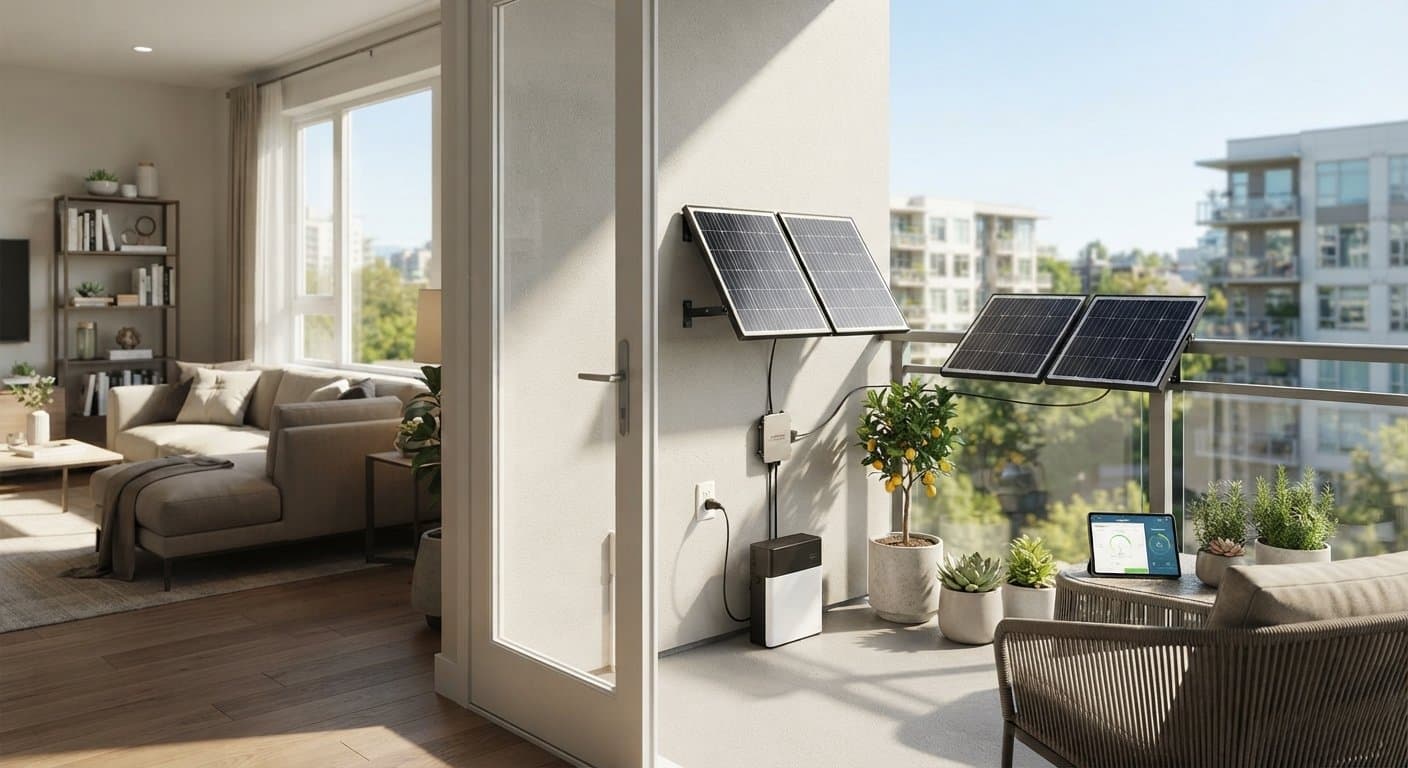
Balcony Solar Kits Are Coming to US Homes
Balcony solar can sound simple: hang a panel, plug it in, and lower your electric bill. The idea appeals to renters and apartment owners who cannot install rooftop solar. Yet a kit's availability does not automatically make it legal or suitable for every home. Equipment standards, building rules, utility requirements, and local electrical codes still matter.
For Philadelphia-area residents, the practical question is not only whether plug-in solar panels are becoming available in the United States. It is whether a specific balcony, electrical circuit, and utility can safely support one. Understanding the basics can help households separate useful savings from unrealistic promises.
What a Balcony Solar Kit Does
A typical kit has one or more solar panels, a mounting system, a microinverter, and cables. Sunlight reaches the panel's silicon cells and frees electrons, producing direct current. The microinverter changes that electricity into alternating current, the type used by household appliances.
The system connects to a dedicated outlet or another approved connection. Solar electricity then serves some of the home's active demand. If a refrigerator, router, or other appliance is using power, the panel can reduce how much electricity the home draws from the grid.
A balcony kit usually does not power an entire apartment on its own. It also does not necessarily store electricity. Without a battery, production falls after sunset, and the home relies on utility power when the panels are not generating enough.
Why US Availability Needs Careful Checking
Balcony solar has gained attention as states and utilities consider ways to accommodate small, customer-owned systems. Utah has passed a law concerning plug-in solar devices, a sign of growing interest in this category. A state law does not create one national rule, though, and it does not replace local building codes, electrical standards, or utility procedures.
In Pennsylvania, customers should check with their electric utility and local code office before connecting a kit. Requirements can differ by utility territory and equipment type. A system may need listed components, an approved connection method, a visible disconnect, or an electrical inspection. Renters should also get written permission from their landlord or building manager.
These checks matter for safety and for utility billing. A standard outlet may share a circuit with other equipment. An improperly installed system can create electrical or fire risks, while unapproved equipment may violate a lease, building policy, or utility rule. Never assume that a product advertised online is approved for use in a particular apartment.
Estimate the Potential Savings
A small system can reduce grid use, but production depends on panel size, sun exposure, orientation, shade, and local weather. Here is a simple example:
- System size: 800 watts, or 0.8 kilowatts.
- Assumed annual production: 1,000 kilowatt-hours per kilowatt.
- Estimated annual output: 0.8 times 1,000 equals 800 kilowatt-hours.
- Assumed electricity price: 20 cents per kilowatt-hour.
- Potential bill value: 800 times $0.20 equals $160 per year.
This estimate assumes the home uses the solar electricity as it is produced. It excludes fixed utility charges and any compensation for electricity sent to the grid. If the apartment is empty during sunny hours, some power may go unused unless the utility allows exports and credits them.
At $800 for equipment and mounting, the simple payback would be five years, calculated as $800 divided by $160 in annual bill value. If the installed cost is $1,200, the same estimate becomes seven and a half years. Actual results can be lower if shade limits output or the household cannot use all the power.
Fit, Mounting, and Building Rules
Balcony conditions shape performance. A south-facing, unshaded location often produces more energy than a shaded balcony facing north, though a good east or west exposure can still help. Nearby buildings, trees, railings, and overhangs can cast shadows. Even partial shade can reduce output, depending on panel and inverter design.
Mounting deserves equal attention. Panels must resist wind and stay secured without damaging railings or exterior walls. Building managers may restrict visible equipment, penetrations, or objects attached to balconies. A fire escape, walkway, or neighboring unit must never be obstructed.
Before shopping, measure the usable space and ask the building manager about written installation rules. Then confirm the local electrical requirements and utility policy. Use the utility's published tariff to check whether exported energy receives credit, and consult public incentive databases for any current state or local programs. Do not include a tax benefit in the budget unless the equipment and installation meet the relevant eligibility rules.
Buying and Managing a Kit
Compare complete systems, not panel wattage alone. Look for recognized electrical safety certification, a clearly identified microinverter, secure mounting hardware, and instructions that match local code. Ask the seller who handles permits or inspections, what the warranty covers, and whether replacement parts will remain available.
Useful homeowner differentiators include a straightforward monitoring app, a warranty that clearly covers the inverter and panels, and mounting hardware designed for the specific balcony surface. Monitoring can show daily production and alert you to a drop that may signal shading, a loose connection, or equipment trouble.
A small system may cost less than rooftop solar because it avoids a large roof installation, but it also produces less electricity. It will not usually eliminate a household bill, which includes fixed charges even when grid use falls. Treat savings as a reduction in energy purchases, not a guaranteed bill amount.
Installation, Monitoring, and Maintenance
Follow the manufacturer's approved installation process and use a qualified electrician when local rules require one. Do not modify a plug, extension cord, or inverter connection to make a kit fit. Keep cables protected from water, foot traffic, and sharp edges.
Once operating, compare monthly production with the system's expected output for similar weather and sunlight. Clean panels only when dirt or pollen visibly blocks light, following the manufacturer's instructions. Check mounts and cables periodically for movement, wear, or damage. Solar panels commonly lose a small amount of output each year, so warranty terms and performance guarantees help set expectations.
At the end of the system's useful life, ask the manufacturer or a qualified recycler about handling panels, inverters, and batteries. Do not place electrical equipment in ordinary household waste if a recycling program is available.
Frequently Asked Questions
Can renters use balcony solar?
Possibly. Renters need landlord or building approval, plus compliance with local electrical and utility rules. A portable design does not override a lease or safety code.
Will a kit power my whole apartment?
No. A typical balcony system produces a few hundred to a few thousand kilowatt-hours per year. Most apartments use far more than that, especially when heating, cooling, and hot water are included.
Does balcony solar work on a shaded balcony?
It can, but output drops. Partial shade from trees, railings, or neighboring buildings reduces production. Some inverters handle shade better than others, yet no system performs as well in shade as it does in full sun.
Can I plug panels into any outlet?
No. The outlet must be on a circuit that can handle the added load, and the connection method must meet local electrical code. Many standard outlets share circuits with other appliances, which creates safety and code concerns.
What should Philadelphia-area households do first?
Start with three steps. Contact your electric utility to learn the rules for customer-owned generation. Ask your landlord or building manager for written installation guidelines. Measure your balcony space and note sun exposure throughout the day.
Next Steps for Philadelphia Residents
Philadelphia households interested in balcony solar should begin with local verification rather than equipment selection. Utility policies, building codes, and lease terms vary widely across neighborhoods and property types. A system that works in one building may face restrictions in another.
Start by requesting your utility's interconnection requirements and any published guidance on plug-in solar devices. Schedule a conversation with your building management to understand approval processes and insurance considerations. Document sun exposure with photos taken at different times of day to assess realistic production potential.
Once these preliminary checks are complete, compare systems based on certifications, warranty coverage, and mounting compatibility with your specific balcony structure. Consider working with local electrical contractors familiar with Philadelphia permitting requirements. This approach helps ensure that any installation meets safety standards while delivering measurable electricity cost reductions.