
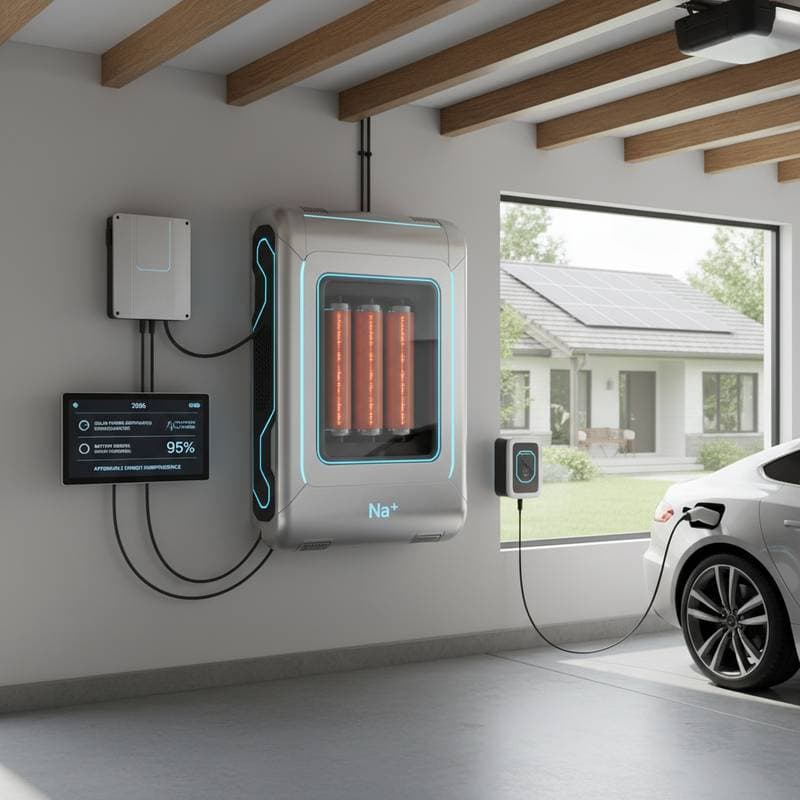
Sodium-Ion Batteries Promise Affordable Storage by 2026
Homeowners exploring solar energy often find that storage cost limits full independence from the grid. Lithium-ion batteries dominate the market. Supply chain limits and mineral costs keep prices high. Sodium-ion batteries are emerging as a safer, less expensive alternative that could make solar storage accessible for more households.
Why Sodium Matters
Sodium is abundant, non-toxic, and widely distributed. Unlike lithium, it does not depend on rare mineral mining or complex refining. This makes production cheaper and less vulnerable to market volatility. Sodium-ion chemistry also avoids cobalt and nickel. The approach lowers environmental impact and supports more stable supply conditions.
From a homeowner perspective, future solar batteries could use materials sourced locally. Fewer geopolitical risks arise. Lower material cost often translates to lower final system cost. This holds true especially when manufacturers scale production under consistent quality standards.
How Sodium-Ion Batteries Work
A sodium-ion battery moves sodium ions between two electrodes during charge and discharge. The principle matches that of lithium-ion systems. The ion size and chemistry differ. Sodium atoms are larger. This slightly reduces energy density. Research teams continue to improve electrode materials to close that gap.
Key components include the following:
- Cathode. Often made from layered oxide or Prussian blue analogs.
- Anode. Usually hard carbon. This material handles larger sodium ions well.
- Electrolyte. A sodium salt solution that allows ion movement between electrodes.
These batteries can deliver stable power output across a wide temperature range. They also tolerate full discharge cycles better than many lithium-ion designs. The result extends usable lifespan when managed correctly.
Safety and Performance
Thermal stability is one of the strongest points for sodium-ion systems. They are less likely to experience runaway reactions that cause fires or explosions. For households, this means a reduced need for complex cooling systems or specialized containment enclosures.
Proper installation remains essential. Always use listed battery management systems. Follow the manufacturer specifications for ventilation and clearance. A licensed electrician should verify that wiring, overcurrent protection, and disconnect switches meet the local electrical code and the authority having jurisdiction. Never open or service a sealed battery pack without professional training.
Cost and Market Outlook
Early prototypes have achieved energy densities close to entry-level lithium-ion units. They do so at significantly lower cost per kilowatt-hour. Large-scale manufacturing could bring retail prices down as production ramps up. For homeowners planning solar projects, this shift could make battery storage affordable enough to support full-day energy use without high upfront investment.
Industry analysts expect sodium-ion systems to first appear in stationary storage. Examples include home or community-scale solar banks. Once reliability and efficiency data confirm long-term performance, manufacturers may expand into electric mobility and grid applications.
What Homeowners Can Do Now
If you are installing or upgrading solar panels, consider designing your system with future storage expansion in mind. Use an inverter that supports multiple battery chemistries and communication standards. This will allow easier integration of sodium-ion units once they reach commercial availability.
Before making any electrical modifications, complete these steps:
- Confirm that your main service panel can handle additional storage equipment.
- Obtain permits through your local building department.
- Hire a licensed electrician familiar with energy storage system installation.
- Schedule inspection after installation to verify compliance.
Planning for Installation and Upkeep
Keep track of product announcements from certified manufacturers and utilities testing sodium-ion storage. Review warranty terms and safety certifications such as UL 9540 or IEC standards before purchase. Once installed, maintain clear airflow. Check connection torque annually. Monitor performance through the battery management interface.
Sodium-ion technology promises a future where solar power is not only renewable but also reliably stored at an affordable cost. Careful planning today prepares your home to benefit from that next generation of clean energy storage.